i hate those posts that are like “hes tall, handsome, funny… i didnt say a name but he popped into your head didnt he ? :)” like no? he didnt. who the fuck is he
a company where a slytherin in payroll is making the decision to pay disabled workers subminimum wage and squib workers minimum wage, while Real Witches and Wizards who work there get a living wage, because it’s cost effective and business is business. and a ravenclaw in HR who makes the decision to segregate them For Their Own Good. and the gryffindor spokesperson is like ISN’T THIS A WONDERFUL THING WE ARE DOING, GIVING THEM WORK. and the hufflepuff lawmaker who says yes, the Value is in the Work, this is an equitable thing.
and how it’s a cognitively disabled hufflepuff worker who says no fucking way this isn’t fair. and a gryffindor who says lets fucking do something about it. and a ravenclaw who says ok cool, but we need a strategy. and a slytherin who says well, this is what they value, this is their weakness.
how it’s a hufflepuff squib who sits through the meetings and says, this is wrong, over and over, patient and polite and unmoving. how it’s a gryffindor labelled with an intellectual disability, who’s slytherin I/DD friends got them out, who grits their teeth and tells their story over and over and over again. how it’s a physically disabled ravenclaw lawyer who sits in the courtroom and argues the legal minutia while their slytherin co-counsel hits all the emotionally salient points with devastating precision. how it’s a gryffindor leading the protest and a hufflepuff doing the logistics. how it’s a ravenclaw writing to the prophet making the arguments for inclusion being good economic practice.
and how there are people from every house on every side with every d&d alignment doing every kind of work
what if medusa was a real woman. i mean: what if the woman with snakes in her hair was once a tiny girl with beautiful braids in her black hair.
what if the stories came from her smooth hands. when she was six she could make pottery that looked like flowers blooming in your palms. could carefully create replicas of any plant she saw.
and medusa was smart. ran from home, tucked up her hair so it looked short, made herself into a little boy. besides, they liked pretty boys. medusa at school with top grades, sending her unknowable stares at the other men. because the whole time she’s learning the planes of their faces, the way they look while they’re thinking, the slight twist of their hand that meant they were lying.
medusa going home to sketch every little figure. comes to school in the morning with her hands caked in pottery clay. medusa learns. scrubs dirt on her face to mimic their planes. tilts her head the right way when she’s thinking. doesn’t twist her hand when she’s lying.
in her back yard, a little garden grows. statues of ceramic boys only three feet tall. at first, she can’t quite get the faces right. men are not the same as plants. there is something weird about the proportions she uses. medusa frowns.
she starts making animals instead for a bit, annoyed and disheartened. she’d always just been naturally good at it, and the fact she couldn’t just make something felt as if she’d lost her gift.
she makes cats and dogs and her neighbor’s birds and keeps going.
the snake wasn’t her favorite. he just wouldn’t leave her alone, so she gave up and let him sleep on her in the cold nights. besides, he was a small garden snake, couldn’t even bite her hard, just wanted a place of warmth. she let him rest on the angles of her shoulders, right near her neck, even if he sometimes forgot and held her too hard. that was okay. when she was little, she forgot too, sometimes, and shattered the slim walls of her pottery. the snake had a lot of growing up to do.
she loved no one. not because she was cold-hearted. just because it wasn’t something she wanted. she was busy with her artwork.
she chose an apprenticeship under a master craftsman. his sculptures made her breath stop. she was careful in the workshop, kept her things simple, kept her mouth shut. he called her stupid often. she would duck her head. sometimes she would make mistakes on purpose. all the while he only made sculptures of men. said there was no beauty in women. often made savage remarks about those they saw in the market.
and all the while, she watched him. she watched him and she went home and sketched. this is how his hands were when he made a vine. this is how they were when shaping a nose.
and her back yard garden would grow. little boys became her master, over and over and over, until she could get his jaw right. ceramic became sculpture.
he was who took her to athena’s temple. who shouted at her about how beautiful the statues were against her own. every week he’d come back and shame her. asked how the women there were smarter than the man she was supposed to be. medusa ducked her head and grit her teeth.
in her back yard, she made them. she made every god and goddess she’d seen in the city. her favorite was athena. she ached over her features. had spent so long in the world of men, was blinded by the beauty of women.
it was a black night. and medusa thought her master had left the temple before her. she loosened all the bindings that kept her from breathing. took her hair out. worshiped in peace. placed on athena’s alter a small and beautiful thing. the goddess, head tilted, thinking.
when he found medusa, what made him angry was not her small frame. it was the statute. a delicate thing. much better than the ones he had ever made.
he took it and snapped it in half. threw it deep in the temple’s well to rot. pulled her by her hair. demanded to know where it had come from.
medusa, angry, tired of hiding, tired of late nights and being a boy and pretending: medusa, athena-mad, spat on him. “I did it,” her voice is strong and full of hatred, “A woman made something better than a man could.”
He meant to kill her. To bash her head into the temple steps, claim it was an accident – or better yet, the spite of a god made flesh.
when he grabs her hair, the goddess bites back. athena, patron of creators, patron of the arts, patron of girls and those who are smart – she turns medusa’s hair into snakes.
it is a quick little thing, darts out and draws blood, almost falls from her hair as a result. she catches the creature and runs, runs until she feels numb.
and what if – while her master is explaining her back yard full of frozen men as being evidence of her evilness – what if medusa finds friends in blind women. and they teach her how to feel what she is seeing. how to use her hands with her eyes closed to make maps of whatever she holds. she starts with plants again. her snake is big now, and has babies. she moves on to their little wiggling forms, amused when they make tiny rings around her fingers. she does not live in a cave. she dresses as a man again, goes to market, sells her roses and vines and beautiful (simple) things. buys herself and the women a nice house out beyond all the noise of it. fills their garden with frozen men.
when the men come to kill her – because now her name is known, it is whispered, sticks in the throat – they don’t find her. they find a tall man who tells them: look in the mountains. when they don’t come back, it’s no fault of medusa’s. frankly, she thinks they should have brought more supplies than their swords into the deep woods. she’s not cruel. when they leave, she makes a statue of them, as her version of a memorial.
but one man is not like the others. he finds her with her hair down, humming, dancing around a marble stone. her snakes are warming in the sun.
medusa? he asks her. it’s a name she hasn’t heard in a long while.
she is tired of being hunted. she just wants to make art. she waits for the sword point. but he hesitates. looks at her full in her face.
strikes a bargain. if she makes him a head for his shield, he will tell the others that she is good and dead. and he will sell her art to better patrons when he could – although he suggests at least hiding the signature she has with maybe a little less snake-like scrawl – he would make her name known.
but medusa knows men. knows they will chomp down on a horror story faster than that of the artist. she is already permanent. she says: no, here’s what happens.
after many months, he has his shield. she wouldn’t let him leave with the first nine hundred versions, always found something wrong with them. he grows fond of her in this time, agrees to her terms. even he can’t really look at the shield head-on. she has captured a scream, a rage, too much. it is so utterly human and at once not that it makes his skin crawl.
where medusa’s blood drops, serpents sprawl. or at least, that’s the code she uses. when he finds little girls who can make art, he sends them to her.
medusa does not expect to be known for the school that she starts. she is a women artist in a time of men, and her name is already dead to them. but i know medusa. i know her. she is known for her work.
after all, who can speak about medusa without mentioning how she froze the world?
“Let’s face it – English is a crazy language. There is no egg in eggplant nor ham in hamburger; neither apple nor pine in pineapple. English muffins weren’t invented in England or French fries in France. Sweetmeats are candies while sweetbreads, which aren’t sweet, are meat. We take English for granted. But if we explore its paradoxes, we find that quicksand can work slowly, boxing rings are square and a guinea pig is neither from Guinea nor is it a pig. And why is it that writers write but fingers don’t fing, grocers don’t groce and hammers don’t ham? If the plural of tooth is teeth, why isn’t the plural of booth beeth? One goose, 2 geese. So one moose, 2 meese? One index, 2 indices? Doesn’t it seem crazy that you can make amends but not one amend? If you have a bunch of odds and ends and get rid of all but one of them, what do you call it? If teachers taught, why didn’t preachers praught? If a vegetarian eats vegetables, what does a humanitarian eat? In what language do people recite at a play and play at a recital? Ship by truck and send cargo by ship? Have noses that run and feet that smell? How can a slim chance and a fat chance be the same, while a wise man and a wise guy are opposites? You have to marvel at the unique lunacy of a language in which your house can burn up as it burns down, in which you fill in a form by filling it out and in which an alarm goes off by going on. English was invented by people, not computers, and it reflects the creativity of the human race (which, of course, isn’t a race at all). That is why, when the stars are out, they are visible, but when the lights are out, they are invisible.”
But, no, because there are reasons for all of those seemingly weird English bits.
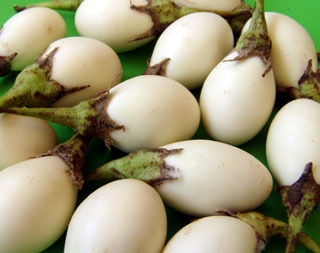
Like “eggplant” is called “eggplant” because the white-skinned variety (to which the name originally applied) looks very egg-like.
The “hamburger” is named after the city of Hamburg.
The name “pineapple” originally (in Middle English) applied to pine cones (ie. the fruit of pines – the word “apple” at the time often being used more generically than it is now), and because the tropical pineapple bears a strong resemblance to pine cones, the name transferred.
The “English” muffin was not invented in England, no, but it was invented by an Englishman, Samuel Bath Thomas, in New York in 1894. The name differentiates the “English-style” savoury muffin from “American” muffins which are commonly sweet.
“French fries” are not named for their country of origin (also the United States), but for their preparation. They are French-cut fried potatoes – ie. French fries.
“Sweetmeats” originally referred to candied fruits or nuts, and given that we still use the term “nutmeat” to describe the edible part of a nut and “flesh” to describe the edible part of a fruit, that makes sense.
“Sweetbread” has nothing whatsoever to do with bread, but comes from the Middle English “brede”, meaning “roasted meat”. “Sweet” refers not to being sugary, but to being rich in flavour.
Similarly, “quicksand” means not “fast sand”, but “living sand” (from the Old English “cwicu” – “alive”).
The term boxing “ring” is a holdover from the time when the “ring” would have been just that – a circle marked on the ground. The first square boxing ring did not appear until 1838. In the rules of the sport itself, there is also a ring – real or imagined – drawn within the now square arena in which the boxers meet at the beginning of each round.
The etymology of “guinea pig” is disputed, but one suggestion has been that the sounds the animals makes are similar to the grunting of a pig. Also, as with the “apple” that caused confusion in “pineapple”, “Guinea” used to be the catch-all name for any unspecified far away place. Another suggestion is that the animal was named after the sailors – the “Guinea-men” – who first brought it to England from its native South America.
As for the discrepancies between verb and noun forms, between plurals, and conjugations, these are always the result of differing word derivation.
Writers write because the meaning of the word “writer” is “one who writes”, but fingers never fing because “finger” is not a noun derived from a verb. Hammers don’t ham because the noun “hammer”, derived from the Old Norse “hamarr”, meaning “stone” and/or “tool with a stone head”, is how we derive the verb “to hammer” – ie. to use such a tool. But grocers, in a certain sense, DO “groce”, given that the word “grocer” means “one who buys and sells in gross” (from the Latin “grossarius”, meaning “wholesaler”).
“Tooth” and “teeth” is the legacy of the Old English “toð” and “teð”, whereas “booth” comes from the Old Danish “boþ”. “Goose” and “geese”, from the Old English “gōs” and “gēs”, follow the same pattern, but “moose” is an Algonquian word (Abenaki: “moz”, Ojibwe: “mooz”, Delaware: “mo:s”). “Index” is a Latin loanword, and forms its plural quite predictably by the Latin model (ex: matrix -> matrices, vertex -> vertices, helix -> helices).
One can “make amends” – which is to say, to amend what needs amending – and, case by case, can “amend” or “make an amendment”. No conflict there.
“Odds and ends” is not word, but a phrase. It is, necessarily, by its very meaning, plural, given that it refers to a collection of miscellany. A single object can’t be described in the same terms as a group.
“Teach” and “taught” go back to Old English “tæcan” and “tæhte”, but “preach” comes from Latin “predician” (“præ” + “dicare” – “to proclaim”).
“Vegetarian” comes of “vegetable” and “agrarian” – put into common use in 1847 by the Vegetarian Society in Britain.
“Humanitarian”, on the other hand, is a portmanteau of “humanity” and “Unitarian”, coined in 1794 to described a Christian philosophical position – “One who affirms the humanity of Christ but denies his pre-existence and divinity”. It didn’t take on its current meaning of “ethical benevolence” until 1838. The meaning of “philanthropist” or “one who advocates or practices human action to solve social problems” didn’t come into use until 1842.
We recite a play because the word comes from the Latin “recitare” – “to read aloud, to repeat from memory”. “Recital” is “the act of reciting”. Even this usage makes sense if you consider that the Latin “cite” comes from the Greek “cieo” – “to move, to stir, to rouse , to excite, to call upon, to summon”. Music “rouses” an emotional response. One plays at a recital for an audience one has “called upon” to listen.
The verb “to ship” is obviously a holdover from when the primary means of moving goods was by ship, but “cargo” comes from the Spanish “cargar”, meaning “to load, to burden, to impose taxes”, via the Latin “carricare” – “to load on a cart”.
“Run” (moving fast) and “run” (flowing) are homonyms with different roots in Old English: “ærnan” – “to ride, to reach, to run to, to gain by running”, and “rinnan” – “to flow, to run together”. Noses flow in the second sense, while feet run in the first. Simillarly, “to smell” has both the meaning “to emit” or “to perceive” odor. Feet, naturally, may do the former, but not the latter.
“Fat chance” is an intentionally sarcastic expression of the sentiment “slim chance” in the same way that “Yeah, right” expresses doubt – by saying the opposite.
“Wise guy” vs. “wise man” is a result of two different uses of the word “wise”. Originally, from Old English “wis”, it meant “to know, to see”. It is closely related to Old English “wit” – “knowledge, understanding, intelligence, mind”. From German, we get “Witz”, meaning “joke, witticism”. So, a wise man knows, sees, and understands. A wise guy cracks jokes.
The seemingly contradictory “burn up” and “burn down” aren’t really contradictory at all, but relative. A thing which burns up is consumed by fire. A house burns down because, as it burns, it collapses.
“Fill in” and “fill out” are phrasal verbs with a difference of meaning so slight as to be largely interchangeable, but there is a difference of meaning. To use the example in the post, you fill OUT a form by filling it IN, not the other way around. That is because “fill in” means “to supply what is missing” – in the example, that would be information, but by the same token, one can “fill in” an outline to make a solid shape, and one can “fill in” for a missing person by taking his/her place. “Fill out”, on the other hand, means “to complete by supplying what is missing”, so that form we mentioned will not be filled OUT until we fill IN all the missing information.
An alarm may “go off” and it may be turned on (ie. armed), but it does not “go on”. That is because the verb “to go off” means “to become active suddenly, to trigger” (which is why bombs and guns also go off, but do not go on).
I have never been so turned on in my entire life.
Are you Susie Dent from Dictionary Corner?
Ok, I love the poetry of the first part, and I love the explanations in the second because I learned things.
So with my new “I’m going to art the shit out of my problems” life plan, I’ve got some cool things you might be interested in.
First! I have a series of erotic/romantica short stories available on Amazon – four stories in the series, and the fifth/last one to come shortly. Want to see if they’re your cup of tea? For this week (so May 2 through May 6), the first one is FREE. The rest? Ninety-nine cents, which is less than a candy bar and full of much more nougat.*
(*Nougat content varies.)
Click on the cover below to take you to the first story in the series:
But wait! THAT’S NOT ALL.
I’m starting up (again) my youtube video series “Stories About Stories” – which none of you know about! BUT NOW YOU DO. I take public domain books, short stories, ballads, and plays and tell them in much the same manner as, say, someone who only remembers half of what’s going on at any given moment and also uses accidental puppets. Behold one of my favorite eps, soon to be close captioned because I want to be a good bro:
FINALLY: You may have heard me talk in the past about my concept magic shop. Well, bros, I have made it real. I’ll be creating individual supernatural/paranormal art pieces, one of a kind, and selling them for reasonable prices. What kinds of things? Check it:
As these things are updated/created, I’ll put up new posts so you can follow along.
And if you like anything you see, or if you want to support my dangerous art habits, check out my Patreon (linky here). There are cool goals, and nifty rewards, and generally a good time had by all.
THANK YOU AND GOODNIGHT AND SORRY FOR TOMORROW’S REBLOG.
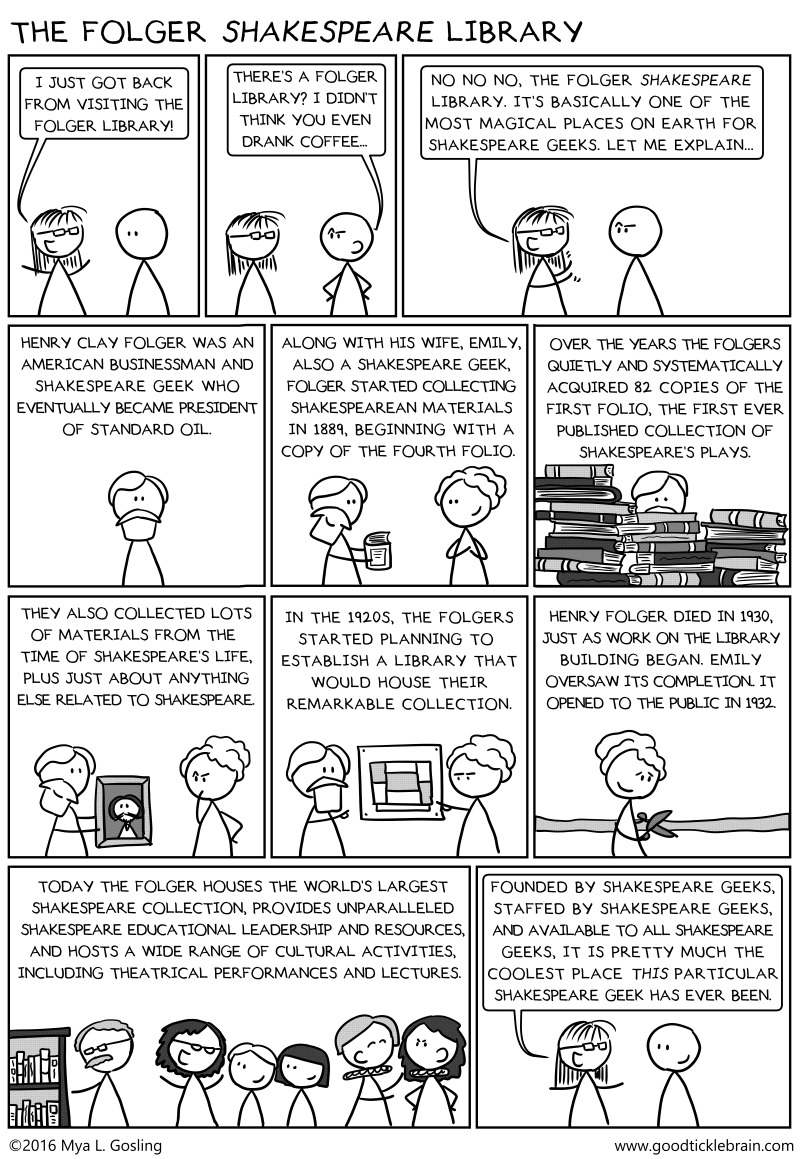
OK, I have SO MUCH material to share with you about my visit to the Folger Shakespeare Library in Washington D.C., but we’ll just start with an overview of WHAT, exactly, the Folger Shakespeare Library is.
Visiting the Folger Shakespeare Library is TOTALLY FREE, as the Folgers gifted it to the public. There is a gift shop, though, stocked with all sorts of awesome Shakespeare stuff, so you’re not liable to escape unscathed. There are different Shakespeare exhibits rotating through the Great Hall, so there’s always something new to see.
There are several books about the Folgers’ collecting adventures, but the only one I’ve read so far is The Millionaire and the Bard, by Andrea Mays. I recommend it.
To see some of the photos I took at the Folger, visit my original blog post.
Tune in again on Thursday for a SUPER SECRET* trip into the famous vaults of the Folger!
Did you happen to use the reading room? I’m looking to apply for a reader’s card with my PhD credentials and I wondered if you might have any pointers on that front. Glad you had a good visit!
I got a tour of the reading room, but didn’t actually use it. I don’t know how picky they are about issuing reader’s cards, but I imagine as long as none of your references say “THIS PERSON REGULARLY DROOLS ON THEIR BOOKS”, you should be OK.
I was just there last week! I loved their 400 Years of Shakespeare exhibit and caught a good eyeful at the First Folio they have on display. Love it!
They have “Shakespeare in America” exhibit on now which is also excellent! And more about Folios in Thursday’s post… 😉
One of the perks of growing up in northern Virginia was getting to participate in the Folger Shakespeare Festival every year during high school. I miss Cam. (“I am the mistress of the revels! …I am the mistress, you are the revels!”)






 Kimchi and Justice