guys whine about being “beta males” like no shit most people would rather wait for the stable release than fight with your unspeakably broken user interface and that weird glitch where you clip through a wall and end up in the friend zone
Guess that would make alpha males where they don’t have the textures finished yet, so it’s all primary colors with no shading or nuance.
I mean
I feel like that’s a pretty good description of a guy in a polo shirt
Hate vocal fry? Bothered by the use of “like” and “just”? Think uptalk makes people sound less confident? If so, you may find yourself growing increasingly unpopular—there’s a newwave of peoplepointingoutthat criticizing young women’s speech is just old-fashioned sexism.
I agree, but I think we can go even further: young women’s speech isn’t just acceptable—it’s revolutionary. And if we value disruptors and innovation, we shouldn’t just be tolerating young women’s speech—we should be celebrating it. To use a modern metaphor, young women are the Uber of language.
What does it mean to disrupt language? Let’s start with the great English disruptor: William Shakespeare.
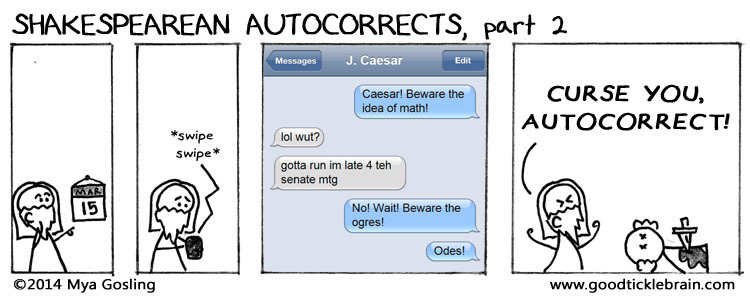
Shakespeare is celebrated to this day not just because he wrote a mean soliloquy but because of what he added to our language—he’s said to have brought in over 1,700 words. But recent scholars have called that number of words into question. As Katherine Martin, head of US Dictionaries at Oxford University Press, has pointed out, if Shakespeare was inventing dozens of new words per play, how would his audience have understood him? Rather, it’s likely that Shakespeare had an excellent grasp of the vernacular and was merely writing down words that his audience was already using.
So if Shakespeare wasn’t disrupting the English language, who was? And how did we get from Shakespearean English to the version we speak now? That’s right: young women.
A pair of linguists, Terttu Nevalainen and Helena Raumolin-Brunberg at the University of Helsinki, conducted a study that combed through 6,000 personal letters written between 1417 and 1681. The pair looked at fourteen language changes that occurred during this period, things like the eradication of ye, the switch from “mine eyes” to “my eyes,” and the change from hath, doth, maketh to has, does, makes.
In 11 out of the 14 changes, they found that female letter-writers were changing the way they wrote faster than male letter-writers. In the three exceptional cases where the men were ahead of the women, those particular changes were linked to men’s greater access to education at the time. In other words, women are reliably ahead of the game when it comes to word-of-mouth linguistic changes.
This trend hasn’t changed much. While young people have long driven innovation, it’s not just an age thing—it’s also a gender thing. During the decades that sociolinguists have been researching the question, they’ve continually found evidence that women lead linguistic change.
Plus, young women are on the bleeding edge of those linguistic changes that periodically sweep through the media’s trend sections, from uptalk to “selfie” to the quotative like to vocal fry.
The role that young women play as language disruptors is so well-established at this point it’s practically boring to sociolinguists. The founder of modern sociolinguistics, William Labov, observed that women lead 90% of linguistic change—in a paper he wrote 25 years ago. Researchers continue to confirm his findings.
It takes about a generation for the language patterns started among young women to jump over to men. Uptalk, for example, which is associated with Valley Girls in the 1970s, is found among young men today. In other words, women learn language from their peers; men learn it from their mothers.
While the pattern is well-established, we still don’t know for sure yet why young women reliably lead linguistic innovation. Maybe it’s nature, maybe it’s nurture; but we do know that young women tend to be more socially aware, more empathetic, and more concerned about how their peers perceive them. This may translate into a greater facility for linguistic disruption. Women also tend to have larger social networks, which means they’re more likely to be exposed to a greater diversity of language innovations.
And of course, women are still likely to spend more time caring for children than men—even if a particular woman works outside the home, daycare workers and elementary school teachers are disproportionately female. This means that even if young men were disrupting language as much as women, they would be hard-pressed to pass it along.
All of this leads us to the biggest question: if women are such natural linguistic innovators, why do they get criticized for the same thing that we praise Shakespeare for? Plain old-fashioned sexism.
Our society takes middle-aged men more seriously than young women for a whole host of reasons, so it’s only logical that we have also been conditioned to automatically respect the tone and cadence of the typical male voice, as well as their word choices.
Sure, let’s encourage young women to speak with confidence, but not by avoiding vocal fry or “like” or whatever the next linguistic disruption is. Let’s tell them to speak with confidence because they’re participating in a millennia-old cycle of linguistic innovation—and one that generations of powerful men still haven’t figured out how to crack.
“The role that young women play as language disruptors is so well-established at this point it’s practically boring to sociolinguists” *weeps with joy*
THIS IS SO FUCKING COOL
also @loveandfolly I feel like this thing with sensitivity to/ disruption of language describes our high school circles
So everyone talks about Steve being able to wield Mjolnir and that’s cool and all, but a lot of people forget that Clint, in the comics, is one of the few people who can properly use Steve’s shield.
So…yes. Steve holds his hand out and accidentally catches Mjolnir and meanwhile Clint’s out of arrows and the shield lands near him so he just kind of says “fuck it” and picks up the shield and starts throwing it. And Thor kind of shrugs and just grabs the nearest thing to use as a weapon. Maybe tosses one of the bad guys at the other bad guys. Maybe tosses Tony at the bad guys. Something.
And later they all agree that was pretty fun.
It’s always fun to use Tony as a blunt instrument.
It really is:
i love that because it implies its a legitimate strategic tactic theyve used before SEVERAL TIMES
Tony: NOT THE OLD FASHINED WAY AGAAAaaaaa-aaaªªªªªªªªªªiiiiinnnnnn-
I really need to somehow include using Tony as a blunt instrument in my fic somewhere.
YES PLEASE THAT WOULD BE SO MUCH FUN TO READ OUT LOUD.
If you’re saying M’lady you should be wearing tights and a neck ruffle. If you’re wearing a fedora you should be saying like… see here and dame. Classy fedora dudes never said M’lady. Wtf.
And why do they always have katanas? There’s like 5 different time periods in this horrible trope.















 Kimchi and Justice