Here I am, providing quality content
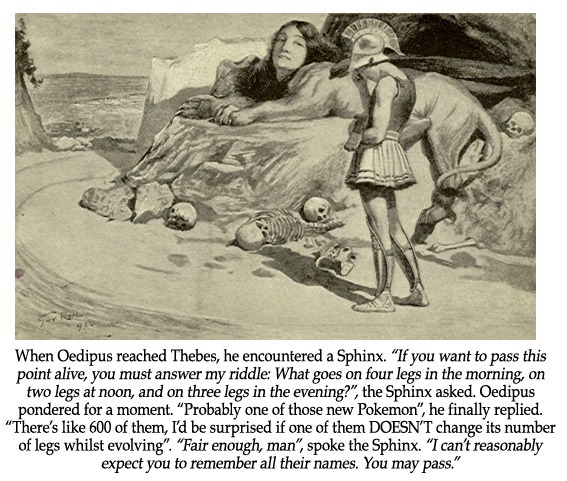
A reading of the Gospel: Letters of Juan 1:31 “And then Jesus turned to the Pharisee and said, ‘Fight me’, and then Jesus threw hands, and the Pharisee caught those hands. And the Lord said, ‘You thought’, and the Pharisee realized he did not know.“
Lord of Hands, pray for us sinners who are thought to be wild pussy, and moreso pray for the people who got us fucked up so that they may cease to be wild. Amen.
@intrinsicallydisordered @blossomingink @and-also-with-yall @papinegro
I’m currently cackling at “And the Lord said, ‘You thought’, and the Pharisee realized he did not know.”
GOODBYE LOL
I cannot. LMFAOOOO
Newly discovered frescoes of ‘fighting Jesus’ challenge Christian traditions

spot the difference
they didn’t even censor her nipples

Chris is reading Men at Arms
Except really, really really not. At all.
In fact, Sam Vimes would loathe Bruce Wayne/Batman. Some wealthy bastard experiences the nasty side of society and decides that means he gets to throw out all rules and accountability, unilaterally running around beating the crap out of people without any oversight? Bugger that. Sam Vimes would make hunting the bastard down and sticking him in jail his life’s work.
In fact, Sam Vimes, and the City Watch of Ankh-Morpork, is an emphatic and direct rejection of the entire set of values of superheroes. It’s outright and explicit: there’s even a discussion about it in The Last Hero between Vetinari and the leader of the Historian’s Guild, about how heroes are in fact the antithesis of everything that society stands for and everything it means – including the rule of law, real law, law that applies to everyone, including the rich, powerful and psychologically wounded.
Bruce Wayne is an incredibly privileged, wealthy, powerful man who, in response to personal tragedy decided that the law didn’t work, that civil society was broken, and the only thing to do about it was lurk around in the shadows assaulting people, breaking and entering, enacting illegal surveillance, etc, etc, etc.
Sam Vimes grew up “too poor to waste dirt” (Feet of Clay), got the shit kicked out of him by life, joined the Watch, got the shit kicked out of him by life again, was forced to watch bad things happen over and over again and be powerless to stop them because the rich and powerful decided that they didn’t have to follow the law (that they could remake it and ignore it as they pleased, order justice “like coal” when they wanted it and send the Watch to the servants’ entrance), to the point where the depression drove him to severe alcoholism and despair.
And then, when it really looked like any semblance of civil order and society was being thrown out, because now the city was under the heel of a dragon and there wasn’t any law, “except ‘you’ll get burned alive if you don’t’” (Guards! Guards!) he snapped. And kept snapping: when Carrot arrested the dragon it wouldn’t’ve meant much except that Vimes backed him up. Vimes took it further and arrested Wonce, trampling over the Patrician’s attempts to intervene.
And he drilled an idea right into Carrot’s head: nobody gets to act like a quote-unquote-hero. You don’t get to tell everyone what to do just because of who you are. That’s why kings are bad. Because of the idea of “kings” is above the law, the idea that “kings” are somehow a special type of person, not subject to all the same things as all other people. That somehow when a king is a murdering abusive bastard you can’t walk into the palace and arrest him. And he drilled that into Carrot’s head so well that when Carrot realizes he could be that kind of king, he’s distressed, and disturbed, and makes damn sure nobody can ever prove it by burying all the evidence, and refusing the command of the Watch.
Sam Vimes’ moments of victory are all about the validation, the victory of civil and common law. Over privilege, over warfare, over bigotry, over vengeance, even over violence and absolute lawlessness. He is a servant of the City and a servant of the Law, and the Law arises from the City, from the society and civilization that creates it, and it applies to everyone, from Patrician to slum-dweller, human, dwarf, troll, golem, undead and goblin alike. The point of every single Watch book is the increase of the jurisdiction and protection of that law: over the dragon and its master, over the Assassin’s Guild and stupid politics and over Carrot, over the secret backbiting political landscape of power (see: Dragon King at Arms) and over the golems, over kings and leaders of army (one of the greatest triumphs of Sam Vimes’ life being arresting two armies under the charge of “conspiracy to make an affray” – also “loitering with intent” and “loitering within tent”*), to the ruler of the city (for treason), to a crazed werewolf and its related nobility, all the way to the top and all the way to the bottom of Ankh-Morpork, and even over the goblins, after centuries of being considered vermin.
Now note that this is a very high ideal of law, and real life fails it a lot (so much), and so does Discworld, but the entire point of Sam Vimes is that the answer to that is not to pull a Batman and throw out the idea of law and society, because that just makes everything worse, that just guarantees that all you’ve got is a bunch of gangs looking after their own via violent retribution; that what needs to be done is fix the system, fix it so that the law is there, and real, and there’s no private version of it, and it shields and holds accountable everyone.
Now, Vimes does this while being aware of how much people suck, which is a pretty amazing trick, really. What it tells you about him is that he’s actually a deeply, ridiculously loving and devoted human being, because he’s doing it without a single damn illusion. In Feet of Clay he says, “The common people? They’re nothing special. They’re no different from the rich and powerful except they’ve got no money or power. But the law should be there to even things up, so I guess I’ve got to be on their side.” [Emphasis mine.] In Night Watch, which is entirely from top to bottom a meditation on the place of law enforcement in civil society (spoilers: it is NOT on the side of the rich and powerful and NOT shielding cops just because they’re cops), Vimes notes to himself that the problem with revolutionaries like Reg Shoe is that they don’t realize that “the people” are actually petty, small-minded, conservative, untrusting, ungrateful, and not very bright and you have to deal with them from that place, while knowing what your duty is. Which is to be there to even things up.
There’s a reason that Night Watch ends, not with Carcer’s death, but with his arrest. “The machine ain’t broken, Carcer,” is what Vimes says, and he means society, law, civilization: that this isn’t a private grudgematch between him and Carcer, it’s society rejecting Carcer and all of his works, and Vimes is acting as a watchman, as an officer of the law, as part of the machine.
Not from the darkness. Not because he’s decided it’s time to dress up in a bat-mask and beat up criminals. Not because he’s Especially Smart and Righteous and Strong: but because he’s an officer of the law, and that’s his job, right out where people can see him, and answering for all of it.**
When he fights the Summoning Dark, what he fights it with are the rules of being a copper. Arrest, not kill; justice, not vengeance. Actual justice, out in the light, where justice has to be. He’s not a hero, he’s a servant, and that’s the shield he’s kept in front of him all his life.
*look sorry that’s just one of my favourite puns.
**for those who may be looking at Snuff and going “err, he kind of does a lot of law argy-bargy in this one … ”: so Snuff is actually a lengthy philosophical argument about natural versus positive law, and if those terms don’t ring a bell, I’ll let you hit’em up on wiki and learn exciting new things. Vimes is emphatically for natural law: murder is a crime, and the unjust killing of a person is murder and the story is over. Vetinari, having to run civilization, has to deal more carefully with issues of positive law, where the problem becomes “well yes but we didn’t legally DEFINE them as people at the time.” Vimes gives no fucks: they were people, it was murder, he acted on the law. That’s why Vetinari sent him. Vetinari is a sneaky fucker like that.
dw:
when did we replace the word “said” with “was like”
When it occured to us that “said” implies a direct quote, while “was like” clarifies that you mean to communicate the person’s tone and general point without quoting them word for word.
THANK YOU
because I’m both a smart alec and a linguistics nerd, I’m going to add that the answer is sometime before 1982, which is the OED’s earliest citation for the phrase. Given how long it takes for slang to make it to formally attested sources – or perhaps I should say how long it did take before the internet was widespread, given how much that’s changed how we can access new usages as they’re developing – I’m gonna say at least the 1970s. It was apparently, at the time, stereotypically associated with valley girls, because the first attestation is in a song called “Valley Girl”.
By the way, the idea of having a word that implies a direct quote and one that implies an indirect quotation isn’t new – the older usage is “goes”. Like, “I told him I was angry, and he went [making exaggerated facial expression] ‘whaaat? why?’” This usage, apparently, can be traced back to Dickens.
So, really, we’re replacing ‘went’ with ‘was like’, not ‘said’.
for those of you who want more information about this, there’s an Actual Published Linguistics Paper here (you can read it there or download the pdf) about vernacular like. it turns out there are at least four uses of vernacular like, and only the quotative like can plausibly be traced back to valley girls in the 1980s; the other three uses (approximation, discourse marker, and particle) are at least a century older than that
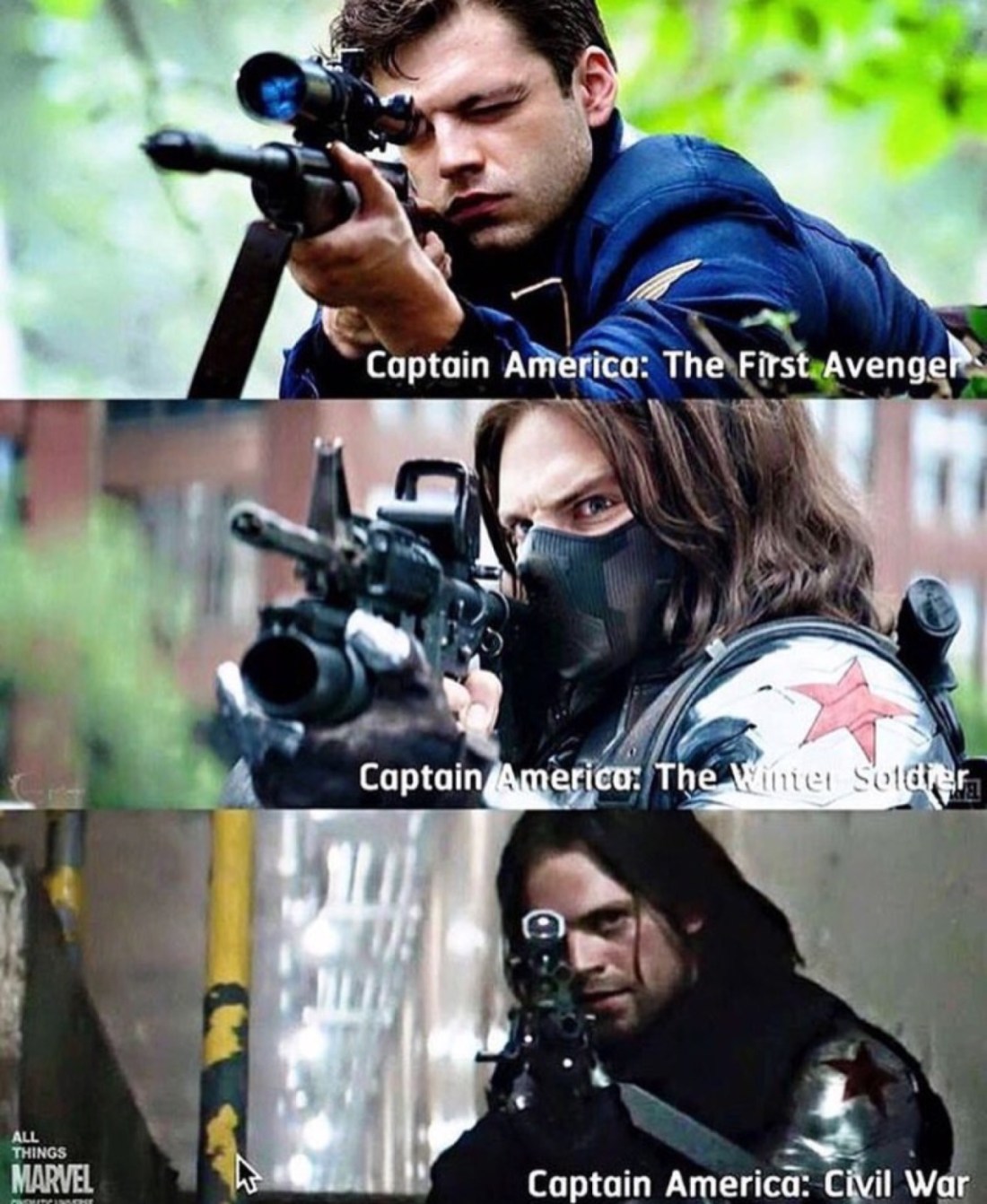
Which do you like best?
Jesus, take a moment to appreciate the similarities and differences in the acting, please
While you’re at it, take a moment to appreciate the fact Seb holds the props like they’re real weapons and not props.
I read in some othetr post he’s the only one who does that.
Those posts were probably mine, lol. I love Cevans from the top of his dark brown roots to his unusually good looking feet, but I’ve criticized him several times for the way he handles prop guns like they’re, well, props. He flags others with his muzzle, doesn’t sight, chicken wings, ect. Seb never does that. He maintains control of a prop weapon as if it might actually be deadly (which is smart bc these days, a lot of prop weapons are actually real ones that fire blanks, which can still injure people even with a blank firing adaptor at the front, and I think other cast members have mentioned before that they’re using real weapons with blanks to capture realist recoil and set the mood for the actors on set.)
I’ve decided to myself that if I ever meet Chris, the first thing I’ll do after climbing off him, disposing of the condom and throwing him a damp wash cloth is take him to a gun range to put a few thousand rounds down range. (As opposed to the first thing I’ll do if I meet Seb, which is feed him authentic TexMex breakfast tacos.)
Bucky’s a sniper. And Sebastian plays the part perfectly. Snipers have fucking RESPECT for their guns and know how to handle them intimately. Seb does a FANTASTIC job handling a gun. There’s a lot of confidence there.
I haven’t really studied how Cevans has used guns in past performances (although there’s a lot of videos of him doing training for Street Kings with guns, so if he’s shit, I guess we can blame them?), but the way he uses a gun in the MCU is perfectly 100% Steve. Watching Steve with a gun is WEIRD, and I feel like Steve handling a gun is WEIRD, and it plays like that on film. We’ve seen Steve with guns before, but usually small hand guns. And it’s clear that he neither likes nor prefers to use them (mostly you see him use them out of desperation or for dramatic shots like the howling commandos busting into that building etc). He handles them like an amateur, which, frankly, he is.
But take a look at how Cevans handles that fucking shield. Fuck, half the time he’s MIMING using it, and even that is fucking UNREAL. I have to sit and remind myself that he’s busy grabbing air. But when he isn’t, the amount of control he has over what is really unwieldy object? DAMN. That shield is Steve’s weapon. That’s what he has respect for, which is why when he drops it on the helicarrier in TWS, it’s powerful.
So yeah, he may not be great at guns, but watch Sebastian or Tom Hiddleston try to wield Steve’s shield. Like a window shutter in a hurricane. Cevans just has his own prop forte.



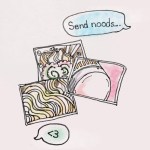
Ramentic Valentines, a collaboration that broth us all together.
1 and 2 by ponderosa121; 3, 4, and 5 by @juckinator; 6 by @kirimoth ❤
Prepare to be bowled over by our ramentic notions.
We shio make a great kombu-nation! It makes miso happy.
Shoutout to the people who:
-have symptoms that aren’t visible to others
-are able to function even while in extreme pain
-hide their illness well
-who don’t “seem sick”
-who have flareups at night or other times when no one else sees
-fight a daily battle that others can’t see
-feel like they’re making too big of a deal out of their illness because “it could be worse!”
I see you out there, I feel you, you’re awesome.
 Kimchi and Justice