Remember Atlah Worldwide Church in Harlem? The church that wrote “Jesus Would Stone Homos” and other anti-LGBT messages on its marquee?
They racked up over a million dollars in unpaid bills, and now the building is up for public auction. The Ali Forney Center, which houses about 107 homeless LGBT youth in New York City, is ready and willing to make an offer, buy the space and convert it into an LGBT homeless youth shelter – if we can help them come up with the money.
Since 2014, local Harlem residents have opposed Rev. Manning’s messages of hatred and violence by organizing a series of events to raise funds for the Ali Forney Center, as well as to increase awareness of the needs of homeless LGBT youths. Also they have organized a series of protests outside of Atlah Church. These efforts, under the name of Love Not Hate, have been coordinated by Stacy Parker Le Melle.
“I am ecstatic to imagine a future where our Harlem corner will be a home of compassion, not hatred. We have a homeless problem in New York City. The de Blasio administration is working hard to remedy this, but LGBT young people are especially vulnerable with the shelter system. They need protection. The Ali Forney Center is a beacon, but they need more space for transitional housing and job training. I can’t imagine a better use for that property. Who needs more luxury condos? We need to care for the most vulnerable in our midst.”
Le Melle continued “When the ATLAH story broke on Thursday, immediately I heard from neighbors: wouldn’t it be amazing if an LGBT group could acquire the property? What if it were the Ali Forney Center? We all knew that this would be poetic justice. We need to care for those kicked out of homes, often on religious-based grounds. We need to care for those most vulnerable to ATLAH’s hate speech.”
Ali Forney needs at least $200k to begin to make this happen.If you can, donate. If you can’t, spread the word. There’s a whole lot of need in Harlem, and how amazing would it be to take a place that was a site of such hurt and vitriol and turn it into something truly life-saving?
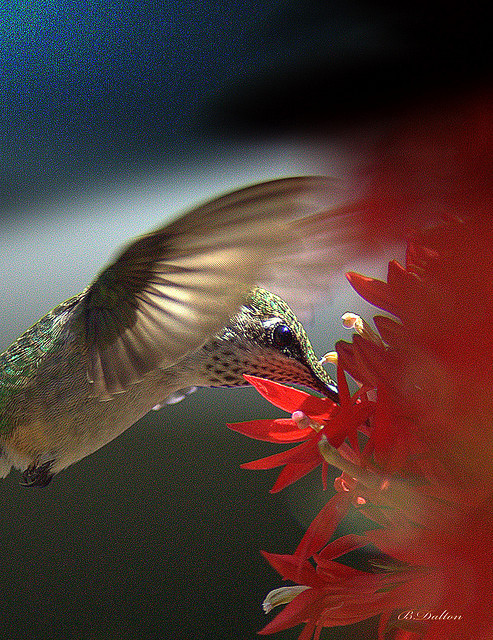
Legends say that hummingbirds float free of time, carrying our hopes
for love, joy and celebration. Like a hummingbird, we aspire to hover
and savor each moment as it passes; embrace all that life has to offer
and to celebrate the joy of every day. The hummingbird’s delicate
grace reminds us that life is rich, beauty is everywhere, every
personal connection has meaning and that laughter is life’s sweetest
creation. –Papyrus
I…Ah…hmm.
Look, it’s a great photo. The photographer kicked butt. They should be very proud of this photo.
But hummingbirds are not carrying your hopes for joy around. I am sorry. Have you met hummingbirds? Hummingbirds believe strongly that they should be eighteen feet tall and have flamethrowers. They are a half ton of pugnacious wrapped up in a half ounce of feathers. Given the choice, hummingbirds would fly around with “Ride of the Valkyries” blasting out of tiny speakers on their wings, putting the eyes out of their enemies.
They do not fear humans, but if they learn that humans will provide feeders, they will become very demanding. They are fiercely territorial. They are…kind of jerks, actually.
Also, there are papers indicating that female hummingbirds engage in what can only be termed “nectar-based prostitution” where they trade sexual favors to males in return for access to particularly rich nectar sources.
If your hopes for love involve nectar and your hopes for joy involve crushing your foes, seeing them driven before you, hearing the lamentations of their nestlings, etc, then possibly the hummingbird may carry them around, otherwise…uh…have you considered vultures? Vultures are very pleasant, affectionate, and social birds. You should probably give them your hopes and dreams. They would be better at it.
Did I mention it’s a great photo?
VULTURES, NOW.
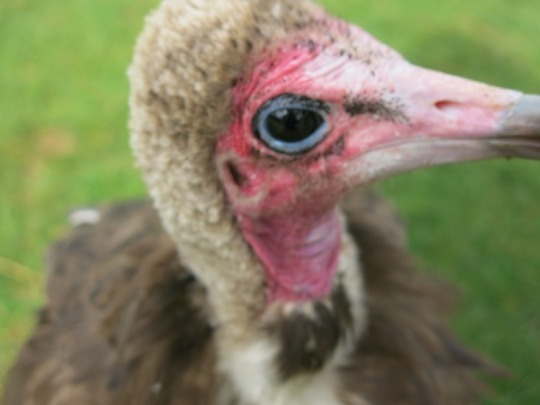
this is Jack.
Jack (full name: Jack Sparrow) lives at the Hawk Conservancy. (He’s missing some toes because he was rescued from Vulture Smugglers.)
When you interact with Jack, you can tell he’s at about the level of … something between a ferret and a dog. Funny short little attention span, and a weird face to look at, but a human reads him as curious, friendly and interested in people.
When you meet a working vulture, you realize that they are definitely a wild predatory animal and very instinctive, but with a
consciousness that extends to interest in their surroundings; like, he’s
very much focused on THE SNACK, but before and after the SNACKTIME he
also wants to have a chat about your day and look at your face and peer into your camera and ask to look at the pictures you took and then say “hey now take one where I’m doing duckface” and you’re like “ok Jack go ahead”
Contrast with owls, which are typically pretty, but which are basically as interactive as a pop-up ad. They exist to land on things and eat them. They are not complicated. Vultures are hey-whatcha-doin. They’re yeah I’m a psychopomp but my real hobby is DJ-ing. They’d like to couchsurf next time they’re in town. You’d let them.
I would give Jack my dreams to carry. He would hold them well, in his big black lovely inky eyes, in his broken gentle feet.
If anyone ever complains about celebrity culture today, or despairs at how we’re all obsessed with actors, just hit them with some facts about acting in Imperial Rome:
Romans were obsessed with actors called pantomimes, masked, silent dancers who told stories through movement, not unlike our modern ballet dancers. You might not think that sounds exciting, but people went apeshit over them.
Seriously. People formed fan clubs for their favourite pantomimes. There is an inscription on a wall in Pompeii that gives endorsement to a political candidate from the Paridiani – the fan club of the pantomime Paris. The Paridiani were like the ancient equivalent of our Hiddlestoners and Cumberbitches.
These fan clubs could get really, really violent. They formed factions that would sit together at the theatre, and brawls often broke out as they fought over their favourites. (For some reason, riots hardly ever occurred at the amphitheatre, where people were getting murdered and torn apart by beasts, but at the theatre, where they were watching ballet dancers of all things, riots broke out all the time. Unbelievable.)
In 14 CE the populace rioted when one of the pantomime actors hired
for the Augustalia refused to perform unless his pay was
increased; the tribunes had to request an emergency meeting of the
Senate so they could beg for more money before the people tore them apart. (Dio
56.47.2).
I cannot overstate how serious some of these theatre riots were. In Tiberius’ reign, it is believed that the rivalry between the pantomime fan clubs was the biggest threat to law and order in the city of Rome. They were so bad they required Senate intervention. Actors
were targeted and punished for inflammatory behaviour, expenditure on
entertainment was slashed, and the crowd was brought to heel by threats of exile for
disorderly conduct. They were threatened with exile to stop the fighting. Suddenly the Cumberbitches don’t seem so bad.
Sometimes the rioting and the licentious behaviour of the actors meant that emperors would banish entire theatre troupes from the city of Rome, or from Italy itself, to keep order.
The rivalry between the actors themselves was no less intense. At one
performance, the pantomime Pylades heckled his rival (and former pupil)
Hylas, who was playing Blinded Oedipus, by calling out “You’re seeing!”
In another story, Pylades was playing Insane Hercules when
the spectators heckled him for using inappropriate gestures. Pylades
ripped off his mask and yelled, “Fools! I am playing a madman!” and tried to fight the audience. (Macrob
Sat. 2.7.15-17.)
This same Pylades (he got around a lot) also shot
actual poisoned arrows into the audience when he was playing Hercules.
Similarly, the tragic actor Aesopus (not a pantomime) is said to have gotten so into his role as the villain Atreus that he actually killed one of the servants crossing the stage.
Emperor Caligula was so passionate about acting that when a clap of thunder interrupted the performance of his
favourite pantomimes, he tried to fight the sky. Seneca says: “Emperor
Caligula was angry with heaven because it kept drowning out
his pantomime actors… and when his revelry was terrified by lightning
bolts (which must have fallen short of their mark!) he called on Jupiter
for a fight to the death, exclaiming the Homeric verse: “Either lift me
up, or I will lift you!” (De Ira, 1.20.8).
Many emperors and aristocrats had pantomimes as boyfriends (Maecenas, Caligula, Nero, etc.) Those chosen as imperial consorts were the best of the best; it would be like monarchs or presidents today taking Oscar winners as their lovers. Tom Hanks and Vladimir Putin, anyone?
Certain emperors became so caught up in the celebrity and entertainment-fuelled culture of Imperial Rome that they started acting themselves (something that was hugely degrading for any freeborn person, but especially an aristocrat or an emperor to do). Caligula was assassinated when he was on his way to the theatre, to prevent him from making his public debut as an actor. The famous Nero often performed and acted in tragedies, weirdly enough, while wearing masks fashioned after his own face, or (if he were playing a woman’s role) after the face of his dead wife Poppaea, whom he kicked to death. Nero was so into performing that he forced people to stay and watch him, and there are (probably exaggerated) stories of women giving birth and men shamming death so they could escape because no one was allowed to leave. (Could you even imagine Barack Obama starring in Broadway shows? Or Queen Elizabeth spending her nights playing Lady Macbeth at the Globe? Incredible.)
People complain today about girls being obsessed with actors, but it was the same in Rome. Juvenal says: “When nancy-boy Bathyllus is dancing the Leda pantomime, Tuccia wets herself. Apula whimpers, just as if she were in a man’s embrace, drawn-out and with sudden anguish.” (Satires, 6.63-5). I need a cold shower.
Another, humorous description of female infatuation with actors: “Some women burn for sordid folks and cannot rouse desire
unless they see either slaves or servants in short tunics. The arena ignites
some, or a mule-driver flooded with dust, or an actor made low by exhibiting
himself on stage. My mistress is one of these; she jumps all the way from the
orchestra and the first fourteen rows and with the plebs in the upper seats seeks
what she loves. (Petronius, Satyricon, 126).
Empresses were not immune either, and pantomimes were involved in sex scandals at the highest level. The Empress Messalina forcibly seduced Mnester; the Empress Domitia Longina seduced Paris. (Both of the actors were executed.)
And that doesn’t even scratch the surface!
In conclusion, if you think our modern obsession with celebrities or the tendency for teenage girls to obsess over actors is in any way new, think again. This has been happening since the years BC. It happened in Greece, it happened in Rome, it happened in Shakespeare’s time. At every point in history, people have been obsessed with actors and celebrities. Just be grateful we don’t have to watch our world leaders acting anymore.
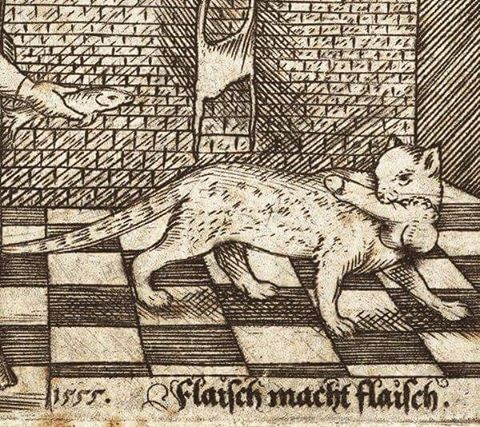
16th century #cat running about with some guy’s penis
And there is a bargain going on
well you know the old saying:
“when a cat steals your penis you’re wise to have a fish at hand”
I have never heard this saying.
The text at the bottom says “Flaisch macht flaisch” I’m going to guess “flaisch” is an old way of saying “fleisch” which is meat (flesh). I have no idea what “flesh macht flesh” is supposed to mean.
afaik it means literally “meat makes meat” but in this context implies a trade of meat for meat. 😉
the person is trying to trade the cat a fish to get the penis back.
RIBALDRY
I am going to ask a silly question. How did he lose his penis to a cat?
**sighhh** it might help ppl to see the full illustration. this is why i hate when art history blogs don’t link back.
She is bribing the cat with a fish to get the penis in exchange. The Rijksmuseum text reads (loosely): “Nun runs with fish in hand chasing a cat, she wants to exchange the fish with a penis that has the cat in its mouth. A jester is watching through a window frame.”
I hope this helps people understand the situation being depicted.
I love my major…
Is this that Neko Atsume game I keep hearing about
where a grad student becomes a supervillain for extra credit since their doctoral committee is lowkey three of the city’s supervillains. and they meet the hero who is cute and charming and idealistic. and damn, extra credit is so not worth this. but damn, grad school is expensive and the job market is competitive
“there’s good in you”
“i really think all that’s in me at this point is ramen, red bull and spite”
oh man why is this happening I actually know where I’d go with this, too
























 Kimchi and Justice