people who call birds boring obviously don’t know much about them because “colourful flying reptile with a respiratory system that extends into its bones” is far from boring. as a matter of fact it is, conceptually, quite horrifying.
“You know how stuff runs in families? Blue eyes, buck teeth, that sort of thing? Well, Death runs in my family. I remember things that haven’t happened yet and I can TALK THAT TALK and stalk that stalk and…if he gets sidetracked, then I’ll have to do it. And he does get sidetracked.”
Two trees in a fancy neighbourhood in Bristol, UK have had strips of
anti-bird spikes nailed to their branches, rendering them “literally
uninhabitable” by local wildlife, according to local Green Party
councillor Paula O’Rourke.
I am still laughing about how a friend’s social media outrage about these two SPECIFIC trees has gone viral and RUN AROUND THE WORLD
The funniest part is that you can’t park in Bristol, because the rich jackoffs who own single-family houses in the higher parts of Clifton (the “fancy neighborhood”) wanted to be able to park their cars on the street in front of their houses. They can park there but now nobody else can park anywhere. There USED to be free on-street parking throughout most of the city. It was first-come first-served, but you could always find somewhere to leave your vehicle. But obviously that was terrible.
When we lived in a rented flat in Clifton, we frequently had to park the car – please restrain your gasps – ON THE NEXT STREET,
Like, I want you to really pause and savor the indignity of this problem, SOMETIMES, we COULD NOT PARK IN FRONT OF OUR OWN FRONT DOOR –
WE HAD TO PARK ALMOST A BLOCK AWAY SOMETIMES, LIKE HEATHENS, AND WALK,
BECAUSE THERE WERE OTHER CARS ON THE STREET,
like, that was an outrage, obviously, that was shocking. Parking at the other end of a street! Or sometimes even a block away! In a city! For free! Have you ever HEARD of such hideous living circumstances? Leaving your car, for free, somewhere convenient in a city, and having to walk A CERTAIN LENGTH to your final destination.
(And if you were disabled and planned to live somewhere for a while then the council would come and paint you a Specific Parking Spot in front of the place you lived. but everyone else had to walk sometimes, and didn’t always get the exact parking spot they wanted, which was an outrage, because the DISABLED PEOPLE WERE GETTING THINGS AGAIN.)
And if you want to go shopping in Bristol then sometimes!! it’s!!! easier!! to walk!! than to drive, in this perfectly-sized city, bursting at the seams with everything you could possibly want, with free parking, so that sometimes – SOMETIMES –
YOU! WOULD! LEAVE! YOUR CAR! IN FRONT OF SOMEONE ELSE’S HOUSE! Sometimes in front of a Rich Person’s house.
OR! you might go to work somewhere! And you might park near your work! In a space that was free because NOBODY WAS USING IT AT THE TIME, which is obviously stealing, because a Rich Person might want that space at any moment.
anyway, this state of affairs was CLEARLY impossible for the Rich Folk, who were nearly perishing under the strain of parking only slightly-adjacent to their own homes, in the heart of a desirable city.
“There’s too many cars here!” they wailed, and begged their Mayor, Mayor Red Trousers, to do something. “We can’t park exactly in front of our own houses at any time of day we wish, because sometimes a PLEB is parked there. For free! Paying nothing! They have no right! We ought to own the street in front of our houses!”
So they abolished free on-street parking across the entire goddamn city. Bristol is now Residents-Only. You can ONLY park your car in the neighborhood where you LIVE. You are not supposed to drive to another neighborhood to work and leave your car there. You are not supposed to commute from outside the city by car. Like, at all.
When people said “But Mayor Red Trousers, this city is a place where a lot of our jobs are, and many of us cannot afford to live IN it anymore, so we uhhhh, we drive to work, what are we supposed to do with the car?”
Mayor Red Trousers replied, magnificently, “Take the buses.”
“Have you met the buses in and around Bristol,” the people asked carefully.
“If more normal working people took the buses,” Mayor Red Trousers said with apparent seriousness, “Then the buses would be better.”
“The buses operate on a different time schedule to the rest of civilization, make us improbably late for work, and somehow cost all of our lunch money,” the people said. “We cannot use them.”
“That’s because you don’t use them enough,” said Red Trousers; he literally said this in writing, on the Bristol website. “You see, you must outcompete the poors who usually take them,” he added, but he didn’t write that part down.
“Hey,” the people said, reading the fine print, “This says you can only have, like, two cars for every house? Like, only two cars for every individual address?”
“If you want to buy a third car for your teenager, you can buy another permit, but it’ll cost you money,” Red Trousers said with a generous chuckle.
“Okay but do you realize,” said the people, “You’re picturing that only two adults live in each house. But normal people in Bristol live in houses that are subdivided into a flat for every floor. That means that about five households live in every separate house. Sometimes a flat is shared by multiple roommates, many of whom have their own cars. There is actually an average of, like, ten adults for every address.”
“That sounds like poor people talk?” said Red Trousers, bibbling a finger along his lips. “Two cars per house. I’m sorry, friends, but if you can afford to buy a BMW for your kid, you can afford to pay £1000 a year for another car permit.”
“What we’re trying to tell you is that our houses have about five cars each,” the people yelled, “Because we live in flats WITHIN the houses, and this address has THIRTEEN ADULTS living here, not two. Can you rewrite this to, say, two cars per HOUSEHOLD?”
“You don’t need THIRTEEN BMWs,” Red Trousers chuckled.
Eventually it was worked out that you can park in front of your house, probably, if you’re not poor, as long as you don’t take the car to go somewhere else. And you have to display a special permit that Keeps the Plebs in their Places, and if a car from Bedminster or Montpelier is spotted in Clifton it will be vaporized ON THE SPOT
In a city renowned for social justice and rioting with the least provocation, the people took all of this fairly well, because most of the rioters don’t own cars, and thought this was Great and Green and would make everything Much Less Problematic. “This will improve our Green City,” they told each other, because they’re pig-ignorant fuckos, bless them;
Mayor Red Trousers said “This will be green! eco! Greeny greeeny green green. the greenest” and the social justice scene went “but will it be vegan?” and he was like “it’ll be SO vegan, DOUBLE vegan” and they went “Massive!” and didn’t riot at all.
And now you can only leave your car anywhere in Bristol if you’re rich, or lucky.
So after changing the ENTIRE landscape and economy of a city in order to park in front of their own houses with no competition, the rich people then put pigeon spikes ON TREES to prevent the pigeons from shitting down onto their cars,
those self-same cars; to protect those parking spaces so ferociously fought for and won, in the public street outside their homes, those exact same BMWs and Audis that they casually threw over an entire city’s infrastructure to enshrine in front of their houses,
Jesus FUCKING Christ,
Thus causing Friend Jennifer to go “ARGHLEBLARHGLHE” on social media for a bit, because she likes birds, (like, she REALLY likes birds, she’s an official Friend to Birds, the birds gave her a medal about it)
Causing the ENTIRE WORLD to flip the fuck out,
That is the socioeconomic context with which you should hate these pigeon spikes.
So the essence of grimdark is that everyone’s inherently sort of a bad person and does bad things, and that’s awful and disheartening and cynical. It’s looking at human nature and going, “The glass is half empty.”
Hopepunk says, “No, I don’t accept that. Go fuck yourself: The glass is half-full.” YEAH, we’re all a messy mix of good and bad, flaws and virtues. We’ve all been mean and petty and cruel, but (and here’s the important part) we’ve also been soft and forgiving and KIND. Hopepunk says that kindness and softness doesn’t equal weakness, and that in this world of brutal cynicism and nihilism, being kind is a political act. An act of rebellion.
Hopepunk says that genuinely and sincerely caring about something, anything, requires bravery and strength. Hopepunk isn’t ever about submission or acceptance: It’s about standing up and fighting for what you believe in. It’s about standing up for other people. It’s about DEMANDING a better, kinder world, and truly believing that we can get there if we care about each other as hard as we possibly can, with every drop of power in our little hearts.
Going to political protests is hopepunk. Calling your senators is hopepunk. But crying is also hopepunk, because crying means you still have feelings, and feelings are how you know you’re alive. The 1% doesn’t want you to have feelings, they just want you to feel resigned. Feeling resigned is not hopepunk.
Examples! THE HANDMAID’S TALE is arguably hopepunk. It’s scary and dark, and at first glance it looks like grimdark because it’s a dystopia… but goddammit she keeps fighting. That’s the key, right there. She fights every single day, because she won’t let them take away meaning from her life. She survives stubbornly in the hope that one day she can live again. “Don’t let the bastards grind you down,” is one of the core tenets of hopepunk, along with, “The arc of the moral universe is long, but it bends towards justice.”
Jesus and Gandhi and Martin Luther King and Robin Hood and John Lennon were hopepunk. (Remember: Hopepunk isn’t about moral perfection. It’s not about being as pure and innocent as the new-fallen snow. You get grubby when you fight. You make mistakes. You’re sometimes a little bit of an asshole. Maybe you’re as much as 50% an asshole. But the glass is half full, not half empty. You get up, and you keep fighting, and caring, and trying to make the world a little better for the people around you. You get to make mistakes. It’s a process. You get to ask for and earn forgiveness. And you love, and love, and love.)
And THIS, this is hopepunk:
HOPE AND HONESTY IN A SOCIETY THAT VALUES CYNICISM AND DECEPTION IS SUBVERSIVE AND THEREFOR PUNK
I AM HERE FOR THIS MOVEMENT. HOPE AND HONESTY ARE DEEPLY PUNK ROCK. KINDNESS IS GOTH AS FUCK.
Sometimes people like to write things about florist’s shops. Here are two things you need to know, the most egregiously wrong things.
1. It makes no fucking sense to sketch out a bouquet before you make it. Every individual flower is different in a way that cannot really be adjusted the way other building materials can be adjusted, and each individual bouquet is unique. Just put the fucking flowers together.
2. No one — in months and months of working at the flower shop — has ever cared what the flower/color of the flower means. No one’s ever asked. It’s just not something people tend to care about outside of fiction and it’s certainly not something most florists know. You know what florists know? What looks good and is thematically appropriate.
Here’s an actual list of the symbology of flowers, as professionals use it:
Yellow – for friends, hospitals Pink – girls, girlfriends, babies, bridesmaids Red – love Purple – queens White – marriage and death (DO NOT SEND TO HOSPITALS) Pink and purple – ur mum Red, orange, and yellow – ur mum if she’s stylish Red, yellow, blue – dudes and small children Blue and white – rare, probably a wedding Red and white – love for fancy bitches
Here are what the flowers actually mean to a florist:
The Fill It Out flowers:
Carnations – fuck u these are meaningless filler-flowers, not even your administrative assistant likes them, show some creativity Alstroemeria – by and large very similar to carnations but I like them better Tea roses – cute and lil and come several to a stalk, a classy filler flower Moluccella laevis – filler flower but CHOICE Delphinium – not as interesting as moluccella but purple so okay I guess Blue thistle – FUCK YEAH, some fucking textural variety at last! you’re getting this for a dude, aren’t you? Chrysanthemums – barely better than carnations but better is still better Gladiolus – ooh, risky business, someone understands the use of the Y-axis, very good
Focal points:
Long-stem roses – yeah whatever Lilies – LBD, looks good with everything, get used as often as possible Hydrangeas – thirsty fuckers, divas of the flower world and rightly so, treat them right and they make you look good Gerbera daisies – the rose’s hippie cousin, hotter but no one admits it Peonies – CHA-CHING, everybody’s absolute favorite but you need guap Orchids – if this isn’t for a wedding you’re probably trying too hard but they’re expensive so keep ordering them
You know what matters? THE CUSTOMER’S BUDGET. THAT’S TELLING.
-$20 – if you’re not under 12, fuck off, get your sugar something else $30 – good for bouquets but an arrangement will be lame $40 – getting there, there’s something that can be done with that. you can get some gerbs or roses with that and not have them look stupidly solo. $50 to $70 – tolerable $80 – FINALLY. It sounds elitist but this really is the basic amount of money you should expect to spend on an arrangement that matters. That’s your Mother’s Day arrangement. You’re probably not going to spend $80 on a bouquet. $90 to $130 – THE GOOD SHIT, you’re likely to get some orchids $130+ – Weddings and death. This amount of money gets you a memorial arrangement or a handmade bridal bouquet. Don’t spend this on a Mother’s Day or a Babe I Love You arrangement, buy whosits a massage or something.
Miscellaneous:
Everything needs greening and if you don’t think that you’re an idiot.
As a new employee, when you start making arrangements, you can’t see the mistakes you’re making because you’re brand new and you’re learning an art form from the ground up.
With a few exceptions customers don’t have a clear plan in mind. They want you to develop the bouquet for them. They want something that will delight their little sweetbread but you’re lucky if they know that person’s favorite color, let alone flower.
Flower shops don’t typically have every kind of flower in every kind of color. Customers generally aren’t assed about that. Most people don’t care about the precise shade of the rose or having daffodils in July, because they’re not boning up on flower language before they buy. That would imply that they’ve got a clear bouquet in mind and, again, they don’t.
Being a florist is essentially a lot like what I imagine being a mortician is about. You’re basically keeping dead things looking good for as long as possible. You keep the product in the fridge so it doesn’t rot and look horrible by the time the family gets a whack at it, and in the meanwhile you put it in a nice container.
Anyway that’s flowers.
this is magnificent and I love hearing about ppl job feilds
Medrano noticed that the way each cord was tied onto the khipu seemed to correspond to the social status of the 132 people recorded in the census document. The colors of the strings also appeared to be related to the people’s first names. The correlations seemed too strong to be a coincidence. After spring break, Medrano told his professor about his theories.
“I just remember being pretty excited, that, ‘Wow! I think the guy’s got it,’” Urton says. “There were a couple of things that didn’t add up and I’d point that out and he’d take it back and work on it for a week or two and come back and he would have understood something about it at a deeper level.”
Medrano worked with Urton over the next several months and the two compiled their findings into a paper which will be published in the peer-reviewed journal Ethnohistory in January. Medrano is the first author on the paper, indicating he contributed the bulk of the research, something Urton notes is extremely rare for an undergraduate student.
Sabine Hyland researches Andean anthropology at the University of St. Andrews. She has read Medrano and Urton’s forthcoming paper and describes their discoveries as “thrilling.”
“Manny has proven that the way in which pendant cords are tied to the top cord indicates which social group an individual belonged to. This is the first time anyone has shown that and it’s a big deal,” Hyland says.
Urton is now optimistic that the six khipus examined in the research could serve as a key to decode the hundreds of others he has in his database. The colors of the cords as they relate to first names could hint at the meanings of colors in other khipus, for example.
“There’s a lot we can draw on from this one case,” Urton says.
But what’s most exciting to Urton and Medrano is the potential to better understand Inca history from the indigenous point of view. As Medrano puts it, “history has been written from the perspective of the conquerors and to reverse that hierarchy is what I see this project as doing.”
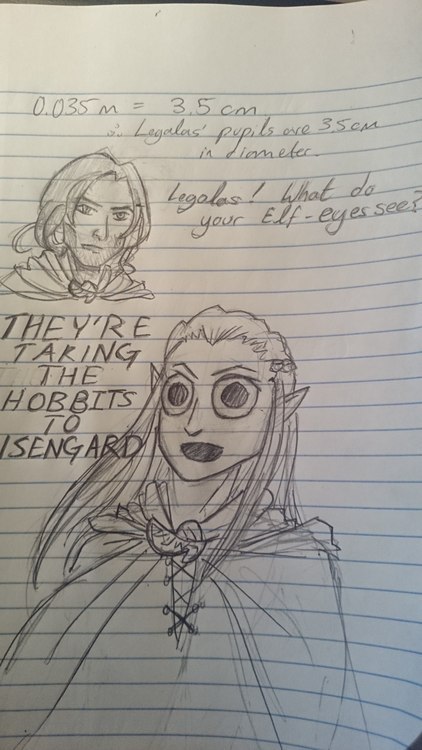
Update: Legolas’ pupils are about 3.5 cm wide each. Now drawing kawaii Legolas on physics assignment.
And they told you science was no fun.
Science!
I’m going to do it. I’m going to hand it in.
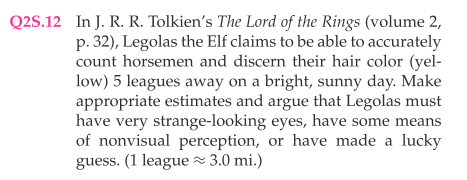
Legolas’s pupil size isn’t the problem here, though. 5 leagues is 17.262 miles. The curvature of the Earth means that for a person of average height, the visual horizon is less than three miles away. Even if your vision is telescopic and the atmosphere is perfectly clear, you can’t see around the planet. If they were standing on a hill, it would have to be at LEAST 198 feet above sea level in order to see the horizon at 17.2 miles away, with nothing tall in between. Which, knowing Rohan, isn’t impossible.
But consider: Elven satellite eyeballs.
you mean like
@sidereanuncia it’s back, the post that I can only imagine haunts your nightmares
I shall never find peace.
Also, for what it’s worth, there’s absolutely no reason to believe that the curvature of Middle Earth is the same as that of Earth.
There’s no evidence that Middle Earth curves.
Yeah there is. The Silmarillion states that the world was curved after the fall of Numenor (I believe), preventing access to Valinor. But Elves (among others) can travel the straight path across it.
So middle earth is round, but not for Elves because magic.
So wait, the reason he can see that far is because Elves just have the ability to ignore the curve of the earth? That’s awesome. It also means that no matter how good your optics got, you would always want elf eyes manning the spyglass because they can see arbitrarily far while everybody else is limited by this ‘horizon’ bullshit.
Oh thank God, my poor elf prince has seen too much in this post
Elves are flat-earthers
This post went from amusing to horrifying, to be brought back down to amusing, sprinkled in with some cannon explanation, and then you leave me here in fucking outrage






 Kimchi and Justice