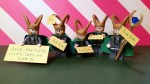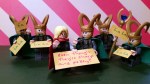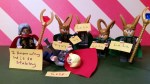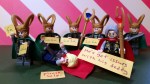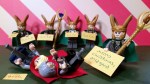
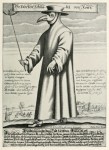
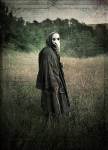
During the Bubonic Plague, doctors wore these bird-like masks to avoid becoming sick. They would fill the beaks with spices and rose petals, so they wouldn’t have to smell the rotting bodies.
A theory during the Bubonic Plague was that the plague was caused by evil spirits. To scare the spirits away, the masks were intentionally designed to be creepy.
Mission fucking accomplished
Okay so I love this but it doesn’t cover the half of why the design is awesome and actually borders on making sense.
It wasn’t just that they didn’t want to smell the infected and dead, they thought it was crucial to protecting themselves. They had no way of knowing about what actually caused the plague, and so one of the other theories was that the smell of the infected all by itself was evil and could transmit the plague. So not only would they fill their masks with aromatic herbs and flowers, they would also burn fires in public areas, so that the smell of the smoke would “clear the air”. This all related to the miasma theory of contagion, which was one of the major theories out there until the 19th century. And it makes sense, in a way. Plague victims smelled awful, and there’s a general correlation between horrible septic smells and getting horribly sick if you’re around what causes them for too long.
You can see now that we’ve got two different theories as to what caused the plague that were worked into the design. That’s because the whole thing was an attempt by the doctors to cover as many bases as they could think of, and we’re still not done.
The glass eyepieces. They were either darkened or red, not something you generally want to have to contend with when examining patients. But the plague might be spread by eye contact via the evil eye, so best to ward that off too.
The illustration shows a doctor holding a stick. This was an examination tool, that helped the doctors keep some distance between themselves and the infected. They already had gloves on, but the extra level of separation was apparently deemed necessary. You could even take a pulse with it. Or keep people the fuck away from you, which was apparently a documented use.
Finally, the robe. It’s not just to look fancy, the cloth was waxed, as were all of the rest of their clothes. What’s one of the properties of wax? Water-based fluids aren’t absorbed by it. This was the closest you could get to a sterile, fully protecting garment back then. Because at least one person along the line was smart enough to think “Gee, I’d really rather not have the stuff coming out of those weeping sores anywhere on my person”.
So between all of these there’s a real sense that a lot of real thought was put into making sure the doctors were protected, even if they couldn’t exactly be sure from what. They worked with what information they had. And frankly, it’s a great design given what was available! You limit exposure to aspirated liquids, limit exposure to contaminated liquids already present, you limit contact with the infected. You also don’t give fleas any really good place to hop onto. That’s actually useful.
Beyond that, there were contracts the doctors would sign before they even got near a patient. They were to be under quarantine themselves, they wouldn’t treat patients without a custodian monitoring them and helping when something had to be physically contacted, and they would not treat non-plague patients for the duration. There was an actual system in place by the time the plague doctors really became a thing to make sure they didn’t infect anyone either.
These guys were the product of the scientific process at work, and the scientific process made a bitchin’ proto-hazmat suit. And containment protocols!
reblogging for the sweet history lesson
Reblogging because of the History lesson and because the masks, the masks are cool
Humans, you all know historical medicine ain’t my Thang™, but if any of you have any interest about plague times or just want to understand these bitchin’ get ups, this post is for you!
tfw you can’t get a concept through to your class and end up drawing “function machines” on the whiteboard
“this is a function machine. you can tell it’s a machine because it has smoke coming out of it, see. you put your t in this box, and it whirs and chugs and then a t and a six come out…”
if it works for three-year-olds, it should work for undergrads, right
it’s this bizarre but charming series of picture books teaching advanced math concepts. yes, picture books; as in intended for early readers, or to be read to children who can’t yet read
(they are, incidentally, charmingly illustrated and a visual delight)
here we see our friends Kris and Kross playing with their function machine! sorry, “magic machine,” the book doesn’t use the word “function,” being intended for small children.
as you can see, this here is the “double a thing” machine. (the book doesn’t name it; the book just shows you the pictures and invites you to name the machine and think about how it behaves.) it even covers inverses, as Kris and Kross try putting things in the other end of the machine (and discover that the “turn all objects into gray blobs” machine won’t let them put things in the other end…)
these are great to read over and over with small children, because they get a bit more of it each time. the first time they just like imagining their own magic machines (“the turn-things-sparkly machine!”); by the last time they can figure out for themselves why the other end of the blobbifying machine is locked. (and then your preschooler understands why only injective functions are invertible!)
don’t forget to also pick up “anno’s hat tricks”…
…for those who want their small child to understand that one puzzle about the island where no one is allowed to know their eyes are blue.
seriously, these things are amazing. cannot recommend highly enough.
It had feathers and looked as if it were part penguin, part duck and part swan. It was between the size of a chicken and a turkey and ate the same sorts of things in the same sorts of places as a heron.
But it was a dinosaur.
“This is kind of a bizarre one,” said University of Alberta paleontologist Philip Currie, who introduced his new feathered friend Wednesday in the journal Nature.
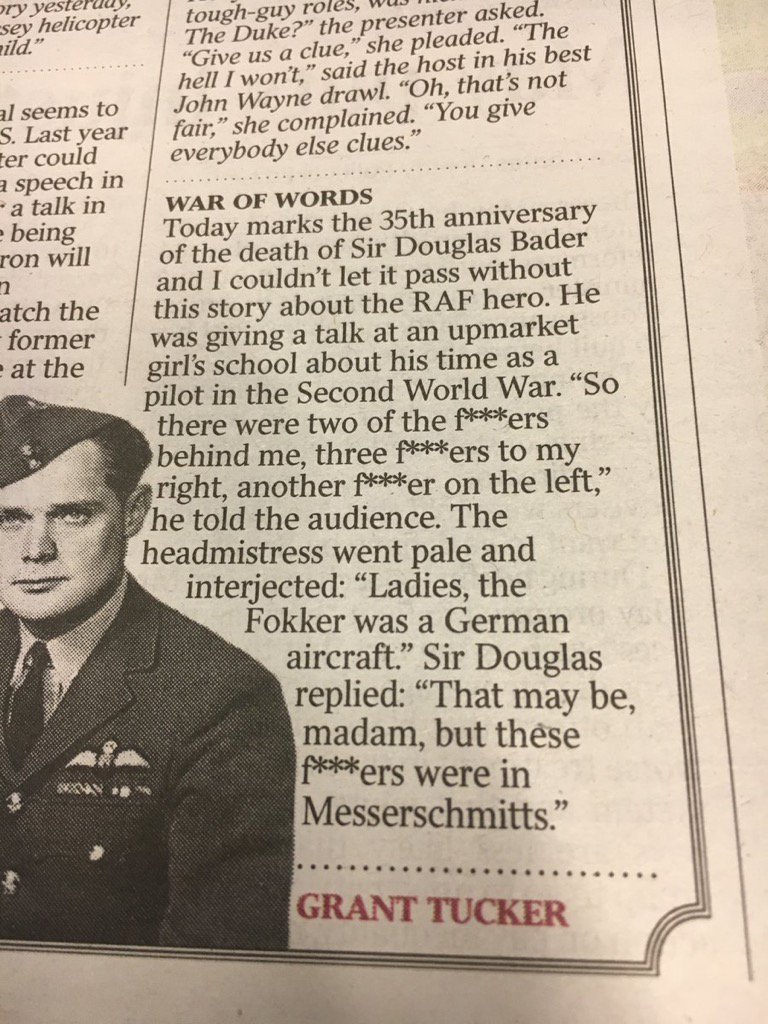
Anyone who tries to tell you that WWII soldiers didn’t use “fuck” as punctuation is lying.
No, guys Douglas Bader is the best!
In 1931,at age 21 (!!) Bader crashed after attempting some aerobatics too low to the ground, and he had to be rushed to hospital, and the plane crash pulverized the bones in his legs.
Bader woke up in the hospital to find that one of his legs had to be amputated. Several days later, his other leg was removed. Now a double amputee, Bader was told he could never do anything he loved again. Rugby, dancing, flying, let alone walking. Yet that didn’t stop him. When his legs healed enough to allow for prosthetics, he told the men building them that he needed to get them done quickly, as he “would need them to take someone out dancing later that week”. They laughed at him, as no one had ever walked without a cane, or even regained full mobility with TWO prosthetic legs.
Bader, basically saying ‘fuck you i can do what i want’, then went on to never EVER use the cane. A few months after the initial fitting, he took his sweetheart, Thelma Edwards, dancing in his own, specially modified car.
Eventually he got a job doing desk work at Shell, as the RAF gave him as Medical Discharge, due to the loss of both legs (one above and one below the knee). He was unhappy with this, as he LOVED flying, and knew he could fly the planes if there were only some minor modifications. But the RAF didn’t want, or need, less than 100% physically fit men in these interwar years. Yet Bader kept petitioning the RAF commanders to let him fly, and they eventually agreed reluctantly, if Bader could only prove to them he was physically fit.
To the RAF’s surprise, he passed the tests with flying colours, and basically demanded a plane. Then WWII started, and the RAF needed experienced, trained, officers.
During the Battle of Britain, he pioneered some innovative new flying tactics (called the Big Wing), and Bader was given command after command. He was eventually given command of a motley unit of Canadians who had lost most of their numbers and supplies in the Battle of France. He pulled them together into an effective fighting force, and was commonly seen wandering around with his distinctive rolling gait, yelling at the supply distributors, and with a massive cigar in his lips.
Though, while on one of his flights over Nazi-occupied France, he got shot down. The way the plane went down however, if he didn’t have detachable legs he would have been unable to bail and would have died.
Then Bader was captured by Germans and sent to a hospital, where he received a new prosthetic leg from a German official (who found him hilarious, a pilot with no legs!)
Bader escaped the hospital but was recaptured due to his distinctive gait and relative slowness of walking pace (just wait this is a pretty common theme from here on out).
He was then transferred to Stalag Luft III (a POW camp lead by the Luftwaffe (German version of RAF)), where he was involved with, and had so many escape attempts the Germans threatened to take his legs away.
After a final, most nearly successful escape, Bader was transferred to the Colditz Castle, six hundred and fifty kilometers from non-Nazi occupied land. With walls two meters thick, and which sat on a cliff seventy-five meters above the River Mulde, this castle was escape-proof.
For officers deemed an escape risk, Like Bader, this castle was the last stop. It held the worst of the escape prone POWs. Several other POWs in the castle had ridiculous plans to escape, ranging from paragliding, to using contortion and gymnastics. Yet Bader, with his instantly recognizable gait and lack of legs, would only be a hindrance at best, and would ensure they would all be recaptured, and killed as spies at worst. So Bader spent the rest of his time in Colditz, from Aug 1942-April 1945, when the castle was liberated by the US Army.
Bader was given many awards and distinctions, yet after the war he left the RAF (for good this time) and went on to work at Shell again, this time flying around the world in his own plane with his wife.
More than that he became an activist and a hero for disabled people.
Before, if someone had lost both of their legs, they would have been told, like Bader, that they would have no options but to walk with a cane, or be wheelchair bound, and live a drastically limited life to what they lived before.
After Bader, when kids asked if they could ever walk again, their nurses and doctors would point at Bader and say “Well, if he can, there is no reason why you cannot”.
He was eventually knighted, not for his leadership in war, or his medals, but due to his massive work in propelling disabled activism and repelling the stigmas around the ‘limitations’ of disabled people.
(There is a great biography of his life by Paul Brickhill, called Reach for the Sky, and he is pretty great. I did a book report on it in grade 11 and it is very, very interesting, if you are interested at all in WWII, or stuff like that!)
TL;DR – Man looses both legs in a plane accident at 21, told he could never walk again. Through sheer stubbornness and ‘Fuck You.’ energy, he becomes a pilot and the squadron leader/group leader of many different units in WWII, before becoming POW in the most inescapable POW camp–due to proclivity to escape–until the end of the War. 1976, was knighted for his work on behalf of disabled people, and being a disabled activist.
And yeah, I think he is pretty great.
My grandfather, one of the politest and most genteel men who ever lived, referred to his war comrades as “those motherfuckers.” He said, “it’s a word i haven’t used since, but it’s the only thing they ever called each other.”
1) Monteflore Formatori Dormatori Mme. Monteflore’s Home for Exceptional Students (who sometimes burst into fire and might be part reptile). A superpowered teen romp using Fate Accelerated Edition (Evil Hat) designed for people who have never played or run a tabletop RPG in their lives. The tone is along the lines of Young X-Men or Runaways.
2) Franklin, Nowhere A supplement for Monsters And Other Childish Things (Arc Dream) based loosely on a mashup between Digimon and Narnia/Magic Knights Rayearth if it occurred in the Canadian wilderness.
3) Dragon Dicks There’s two dragons. Named Richard. Shhhhh… This one is still fairly underdeveloped, but it started with “What would happen if the orcish territories were based on the Iroquois Confederacy that then had its own series of French Revolutions?” and “Wouldn’t Metis selkies portaging it up be amazing?”