You’re an ancient Greek man coming home from 4 months of war to find your wife 3 months pregnant. Now you’ve embarked on a solemn quest: to punch Zeus in the face.
Soon after you begin your quest, you encounter another man in a similar situation. You decide to join forces, as two mortal men stand a better chance at punching Zeus than one.
Two villages over, you encounter a woman who had relations with Zeus and was left with a highly aggressive half-boar half-man offspring. She too feels your anger and offers to join your quest.
By the time you reach Mount Olympus, you’ve amassed a large and formidable army of cuckolded/ravished mortals, demigods with daddy issues, mythical creatures with scores to settle, and a seamstress who you’re pretty sure is Hera in disguise.
person of color: hey wouldn’t it be cool if angels were represented as brown or black more often–
edgy whites who went to a week of bible study 15 yrs ago and regurgitate all their Superior Knowledge from textually inaccurate all-caps tumblr posts written by supernatural fans: um…… ACTUALLY🙂 angels don’t look like HUMANS they look like ELDRITCH NIGHTMARES™ that MELT YOUR BRAIN OUT so stop giving them skin colors 🙂 try a few animal heads instead 🙂 don’t forget the eyeballs 🙂
But it’s true?? That’s why they’re always saying “do not be afraid”. Some of them have three faces on one head?? It’s in both Old Testament and Revelations.
i mean, this is my favorite of all subjects so why not chat about it a little. sorry in advance for the essay you didn’t ask for, but i’m getting a lot of smartasses on this post telling me the Edgy Whites aren’t wrong. so let’s go:
1) even if it was true (which it’s not, i will get to that) this wouldn’t be an adequate reason for criticizing or derailing poc who are trying to subvert the association of divinity/purity & whiteness. you know the idea of the aryan race came from the myth of divine whiteness? you know how all fantasy elves are pale slender & white, thanks to j.r.r. tolkein’s prevailing white/christian influence? so if you see poc trying to reframe this, let them!
2) it isn’t true. don’t get me wrong, you can envision, interpret, and portray angels however you want, that’s part of the fun of art and writing and fantasy. i know that a certain post influenced how a lot of people on tumblr imagine angels (again, because people like subverting popularized imagery) but if we’re talking about biblical accuracy, then let’s be biblically accurate.
more specifically, if someone is going to condescend to poc (or anyone!) about the “factual” appearances of angels in the bible, then they damn better get it right.
to start with– angels as winged messengers were popularized after the roman catholic church began co-opting greco-roman imagery, and modeled much of their depictions of angels after hermes and eros. so yeah, the image of pale white angels is tiresome and not technically accurate to the bible.
that said, the majority of angels in the bible very likely appeared as wingless humans with occasional supernatural attributes.
biblical angels are understood by theologists & angelologists to exist in a celestial hierarchy, de coelesti hierarchia, which accounts for nine distinct types. they’re organized in tiers, so to speak. within the first sphere are seraphim, cherubim, and ophanim. this first choir resides within the inner sanctum of heaven; they are the lovecraftian ones tumblr is so big on.
the seraphim (isaiah 6:1-8 and revelations 4:8, the burning ones, sometimes interpreted as a mass of serpents, multiple eyes, etc.) the cherubim (isaiah 1:5-11 and ezekiel 1:5-13, multiple wings, multiple faces) and ophanim (ezekial 1:15-21′s iconic Wheels™)are all witnessedby prophets. not in visitations, but in visions of heaven. these are THEscary angels, the angels of the guillermo del toro persuasion.
but, they exist outside of sight from humans, which is why it was exclusively prophets who could describe them. they do not come down to earth to chat with random civilians. they’re too busy with the tasks of the omniscient, and their proximity to god is what makes them so powerful and so otherworldly. (and no, you won’t drop dead just looking at them: only god is said to be that powerful.)
the second choir– the dominions, virtues, and powers– are typically interpreted to remain unseen and work on the spiritual plane, tasked with more menial things than the first choir, keeping the nonphysical realm in working order.
the third choir are the ones who move between heaven and earth to serve humans: the principalities, archangels and angels. these are the ones most regularly described in the bible as messengers, guides, and guardians who take on the form of man in order to serve and aide them. almost every mention of angelic messengers or apparitions in the bible is an angel of the third choir.
(side note: the only angels not accounted for in the celestial hierarchy are the nephilim: the fallen ones who had children by humans, referenced in genesis 6:1–4 and often considered to be demons.)
so if the angels appearing to humans aren’t abominations, why do they scare people so badly?
the phrase “do not be afraid/be not afraid” is said in variations over 100 times in the bible, not exclusively by angels. most often it’s spoken as an assurance of god’s love and protection. yes, a handful of times it’s said by angels. (matthew 1:20, matthew 28:5, luke 1:13, luke 1:30, luke 2:10, to name some prominent instances.) almost every single one of these, the angel in question is doing just that– assuring vulnerable or frightened people that god is protecting them.
most notable of these angels is gabriel, the archangel and messenger who appears to mary to tell her she will conceive jesus. let’s look at the context at play: mary was a young unwed woman who would not have been accustomed to spending time alone with young man outside her family. when gabriel appears to her, a strange man in her home, she has every reason to be frightened. gabriel goes on to tell her that she’s going to be the mother of god, and this is when he reassures her not to be afraid, because it will be done through god’s workings. gabriel ≠ an eldritch horroterror.
the second instance is that of the messenger angel who tells the women of jerusalem not to be afraid, but jesus has been raised from the dead. this angel is described as unearthly, and tbqh he’s dope as hell: “his appearance was like lightning, and his clothing white as snow.” (matthew 28:5) there’s reason to believe this angel is of the same countenance as the one described in a vision in the book of daniel: “then i lifted up mine eyes, and looked, and beheld a certain man clothed in linen (…) his body also was like the beryl, and his face as the appearance of lightning, and his eyes as lamps of fire, and his arms and his feet like in colour to polished brass, and the voice of his words like the voice of a multitude.” (daniel 10:5-7) my fave description of an angel in the bible by far, but… still not an eldritch horrorterror.
in a third instance (luke 2:10), the angelic heralds who inform the sleeping shepherds of jesus’ birth do startle the men, and they do tell them not to fear. but it’s said its the glory of god emanating from them that scares the shepherds, not a monstrous appearance.
the cosmic fear attributed to visits from the divine is called numinous dread, the terror that fills us when we’re approached by something we have no capacity to understand. numinous dread is akin to what makes people quiver at the thought of ghosts, or the size of distant planets, or the expanse of the universe– something incalculable and unknowable to the point of being frightening. this to me is by far the coolest aspect of angels. the fact that the very scope of their existence can tug and distort the fabric of our dimension, to the point that humans are bowled over by the merest whiff of their presence? it’s why angels who appear human but still frighten people is such an underrated concept.
you know the phrase “every angel is terrifying”? the author, rainer maria rilke, wrote endlessly on the nature of the human and divine, especially in his work the duino elegies. in the full quote from the first elegy, he mused on the vastness of angels in comparison to mortals:
“For beauty is nothing but the beginning of terror, which we are still just able to endure, and we are so awed because it serenely disdains to annihilate us. Every angel is terrifying.”
this, to me, is the most succinct and lovely illustration of angels, which doesn’t define them either as monsters or humans– he’s fixed on the feeling of awe that’s inherent to the divine, however it manifests.
none of this invalidates creative interpretations of biblical angels! it just means you should not be talking down to anyone about their level of accuracy, especially in regards to race.
in summary: YES, some angels are scary looking in the bible. NO, not every single one looks like edgy white tumblr wants to believe. YES, everybody is allowed to have fun with their interpretations and portrayals, go wild. NO, it’s not even remotely acceptable to condescend to people who want to envision them as people of color because, textually, they manifest as humans in the bible, and everyone in the bible was brown and black.
This is just simply awesome. I really enjoyed this read. Not only is it a wonderful response, but the information in it is so neat. Thank you, Sera!
[[ Source. Original creator: wats6831. Additional information and images linked under each one. ]]
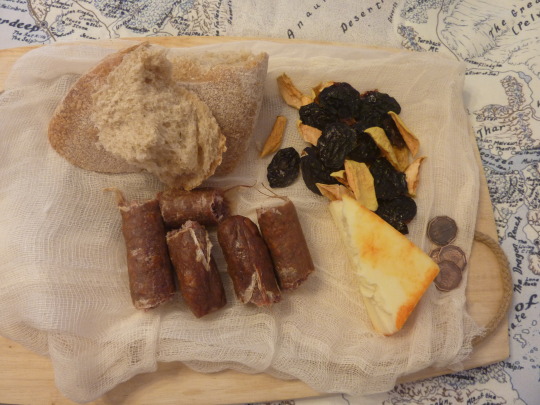
Universal:
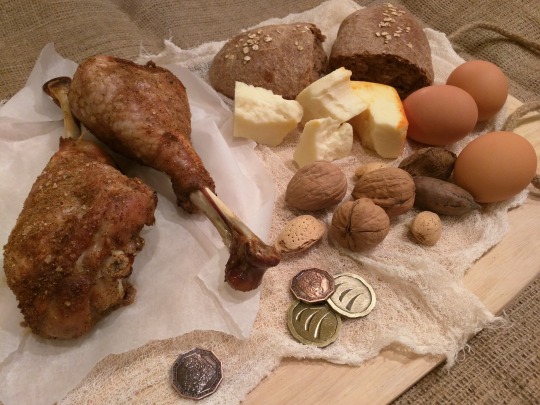
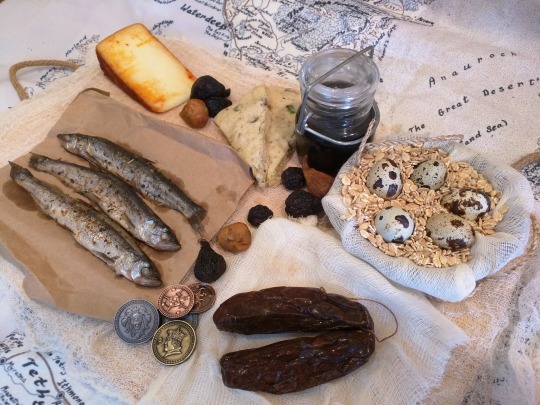
Homemade artisan herb bread, home grown and dried apples and prunes, uncured beef sausage, munster cheese. Made a small bag from cheesecloth and tied it closed.
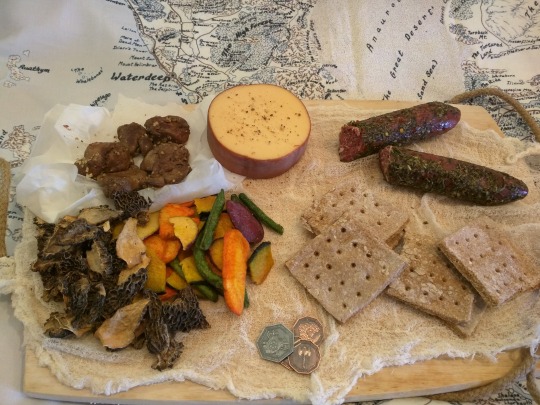
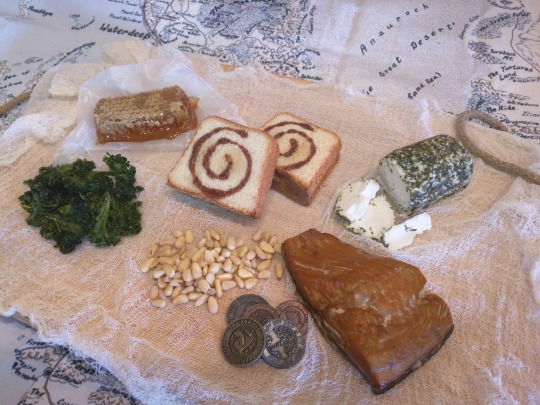
Top left to right: Evereskan Honey Comb, Elven Travel Bread (Amaretto Liquer Cake with custom swirls), Lurien Spring Cheese (goat cheese with garlic, salt, spices and shallots), Delimbyr Vale Smoked Silverfin (Salmon), Honey Spiced Lichen (Kale Chips), and Silverwood Pine Nuts.
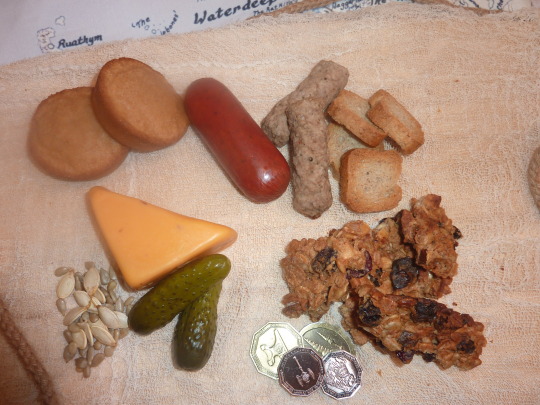
From upper left: “Honeytack” Hard tack honey cakes, beef sausage, pork sausage mini links, mini whole wheat toast, cranberry cheddar cheese mini wedge, mini pickles, pumpkin and sunflower seeds, lower right is my homemade “travel cake” muesli with raisins, golden prunes, honey, eggs and cream.
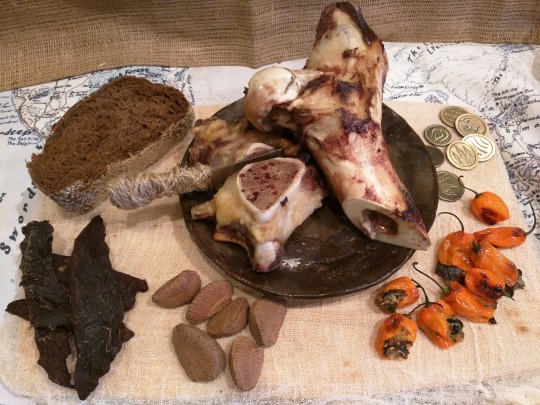
Orcs aren’t known for their great cuisine. Orcs prefer foods that are readily available (whatever can be had by raiding), and portable with little preparation, though they have a few racial delicacies. Toughs strips of lean meat, bones scavenged from recent kills, and dark coarse bread make up the bulk of common orc rations.Fire roasted rothe femur (marrow is a rare treat) [beef femur], Strips of dried meat (of unknown origin) [homemade goose jerky], foraged nuts, only edible by orcs….nut cracker tusks [brazil nuts], coarse black bread, made with whatever grains can be pillaged [black sesame bread], Pungent peppers [Habanero peppers stuffed with smoked fish and olives].
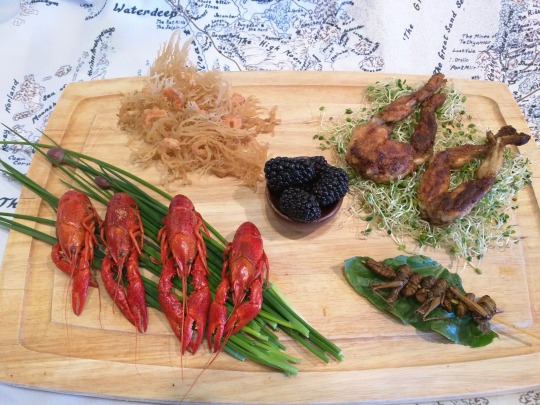
Lizardfolk are known to be omnivores, forage for a surprising variety of foods found within the confines of their marshy environs, in this case the Lizard Marsh near Daggerford. Fresh caught boiled Delimbyr Crayfish on wild chives, coastal carrageen moss entrapping estuary brine shrimp (irish moss, dried brine shrimp), Brackish-Berries (blackberries), Blackened Dart-Frog legs (frog legs) on spring sprouts (clover sprouts), roasted bog bugs on a stick!
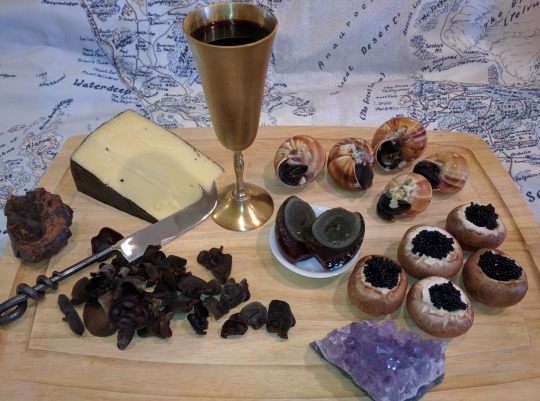
From top left: Menzoberranzan black truffle rothe cheese (Black Knight Tilsit), Donigarten Moss Snails (Escargot in shallot butter sauce), Blind cave fish caviar in mushroom caps (Lumpfish caviar), faerzress infused duck egg imported from the surface Realms (Century egg), Black velvet ear fungus (Auricularia Black Fungus Mushroom).
Will we see the discourse goalposts move to pre-historical accuracy?
Snarkiness aside, I really wish the disciplines would communicate more in matters like these, because I think that the implications for our greater cultural consciousness regarding human mythology and modern sociological structures are kinda cool?
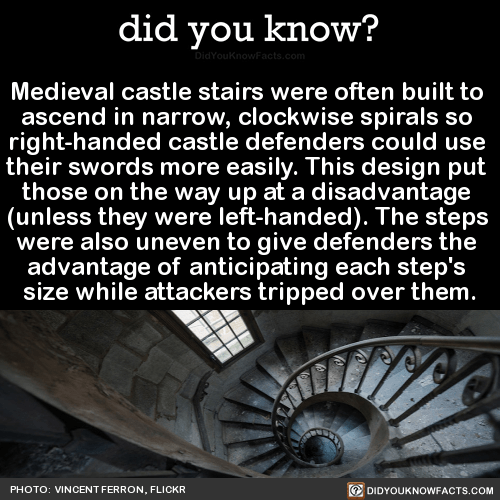
Medieval castle stairs were often built to ascend in narrow, clockwise spirals so right-handed castle defenders could use their swords more easily. This design put those on the way up at a disadvantage (unless they were left-handed). The steps were also uneven to give defenders the advantage of anticipating each step’s size while attackers tripped over them. SourceSource 2Source 3
Not really the best illustration since it totally negates the effect by having a wide open space for those ascending. Castle tower staircases tended to look like this:
Extremely tight quarters, with a central supporting pillar that is very, very thoroughly in the way of your right arm.
Wider, less steep designs tend to come later once castles moved away from being fortresses to simply noble family homes with the advent of gunpowder.
Oh! Pre-gunpowder military tactics are my jam! I don’t know why, but this is one of my favorite little details about defensive fortifications, because the majority handedness of attackers isn’t usually something you think about when studying historical wars. But strategically-placed walls were used basically worldwide as a strategy to secure gates and passages against advancing attackers, because most of the world’s population is right-handed (and has been since the Stone Age).
Pre-Columbian towns near the Mississippi and on the East coast did this too. They usually surrounded their towns with palisades, and they would build the entrance to the palisade wall in a zigzag – always with the wall to the right as you entered, to hinder attackers and give an advantage to the defender. Here’s some gates with some examples of what I’m talking about:
Notice that, with the exception of the last four (which are instead designed to congregate the attackers in a space so they can be picked off by archers, either in bastions or on the walls themselves) and the screened gate (which, in addition to being baffled, also forces the attackers to defend their flank) all of these gates are designed with central architectural idea that it’s really hard to kill someone with a wall in your way.
In every culture in the world, someone thought to themselves, “Hey it’s hard to swing a weapon with a wall on your right-hand side,” and then specifically built fortifications so that the attackers would always have the wall on their right. And I think that’s really neat.
Ooh, ooh, also: Bodiam Castle in Sussex used to have a right-angled bridge so any attacking forces would be exposed to archery fire from the north-west tower on their right side (ie: sword in the right hand, shield on the useless left side):
These tactics worked so well for so long because until quite recently lefties got short shrift and had it trained (if they were lucky) or beaten out of them.
Use of sword and shield is a classic demonstration of how right-handedness predominated. There’s historical mention of left-handed swordsmen (gladiators and Vikings), and what a problem they were for their opponents, but that only applies to single combat.
A left-handed hoplite or housecarl simply couldn’t fight as part of a phalanx or shield wall, since the shields were a mutual defence (the right side of the shield covered its owner’s left side, its left side covered the right side of his neighbour to the left, and so on down the line) and wearing one on the wrong arm threw the whole tactic out of whack.
Jousting, whether with or without an Italian-style tilt barrier, was run shield-side to shield-side with the lance at a slant (except for the Scharfrennen, a highly specialised style that’s AFAIK unique.) Consequently left-handed knights were physically unable to joust.
The construction of plate armour, whether specialised tournament kit or less elaborate battle gear, is noticeably “right-handed“ – so even if a wealthy knight had his built “left-handed” it would be a waste of time and money; he would still be a square peg in a world of round holes and none of the other kids would play with him.
Even after shields and full armour were no longer an essential part of military equipment, right-hand use was still enforced until quite recently, and to important people as well as ordinary ones – it happened to George VI, father of the present Queen of England. Most swords with complex hilts, such as swept-hilt rapiers and some styles of basket-hilt broadsword, are assymetrical and constructed for right handers. Here’s my schiavona…
It can be held left-handed, but using it with the proper thumb-ring grip, and getting maximum protection from the basket, is right-handed only. (More here.) Some historical examples of left-hand hilts do exist, but they’re rare, and fencing masters had the same “learn to use your right hand” bias as tourney organisers, teachers and almost everyone else. Right-handers were dextrous, but left-handers were sinister, etc., etc.
However, several
predominantly left-handed
families did turn their handedness into advantage, among them the Kerrs / Carrs, a notorious Reiver family along the England-Scotland Borders, by building their fortress
staircases with a spiral the other way to the OP image.
This would seem to be a bad idea, since the attackers (coming upstairs) no longer have their right arms cramped against the centre pillar – however it worked in the Kerrs’ favour because they were used to this mirror-image of reality while nobody else was, and the defender retreating up the spiral had that pillar guarding his right side, while the attacker had to reach out around it…
For the most part Reiver swords weren’t elaborate swept-hilt rapiers but workmanlike basket-hilts. Some from Continental Europe have the handedness of my schiavona with thumb-rings and assymmetrical baskets, but the native “British Baskethilt” is a variant of the Highland claymore* and like it seems completely symmetrical, without even a thumb-ring, which gives equal protection to whichever hand is using it.
*I’m aware there are those who insist “claymore” refers only to two-handers, however the Gaelic term claidheamh-mòr
– “big sword” –
just refers to size, not to a specific type of sword in the way “schiavona” or “karabela” or even “katana” does.
While the two-hander was the biggest sword in common use it was the claidheamh-mòr; after it dropped out of fashion and the basket-hilt became the biggest sword in common use, that became the claidheamh-mòr.
When Highlanders in the 1745 Rebellion referred to their basket-hilts as claymores, they obviously gave no thought to the confusion they would create for later compilers of catalogues…
Also, muskets had their whole “Flint and steel and gunpowder” thing on the right side so if you tried firing it lefty you’d get a face full of fire. More recently, rifles eject their spent shell casings to the right, so if you’re a lefty you get some hot metal in your eye.






 Kimchi and Justice