Romeo and Juliet: For never was a story of more woe/ Than this of Juliet and her Romeo.
Julius Caesar: For never was a story of more blood and guts/ Than this of Rome and her Julius.
Othello: For never was a story with more calling an innocent lady a ho/ Than this of Desdemona and her Othello
Macbeth: For never was a story of more death/ Than this of Lord and Lady Macbeth.
Titus Andronicus: For never was a story more ludicrous/ Than this of Titus Andronicus
Richard III: For never was a story of less chill/ Than this of Richard and those he killed
King Lear: For never was a story more weird/ Than this of three girls and their dad, King Lear
Antony and Cleopatra: For never was a story of dying in more agony/ Than this of Cleopatra and her Antony
Coriolanus: For never was a story of more gayness/ Than this of Aufidius and his Coriolanus
Hamlet: For never was a story more overblown/ Than this of Prince Hamlet and the Danish throne.
Tag: always reblog shakespeare

Behold! My office greenery: Rosenplants (Right) and Gildenfern (Left)
how dare you
Heads.
I know it’s fashionable to hate shakespeare for being a white cis male shitlord but calling his work trashy just displays your ignorance. there are reasons he still gets studied in school hundreds of years later. the man basically invented the english language as we speak it today.
I don’t hate Shakespeare.
I love Shakespeare.
In my opinion, the greatest disservice anyone can do to his work is to elevate it to some kind of highbrow high art literary thing. The reason he’s studied today is that his plays endured (plus or minus some changes in fashion over the centuries), and the reason his plays endured is because they were popular, and the reason his plays were popular is because he crammed them full of stuff that people wanted; i.e., lots of jokes focusing on the less refined features of the human anatomy and the things they get up to.
Perhaps you’ve had it explained to you that Hamlet’s talk of “country matters” was an uncouth pun, and his reply in the same conversation of “nothing” was a similar reference. Did you think that was a one-off thing?
If you’re aware that “nothing” was a euphemism for the vulva in Shakespeare’s England, have you ever stopped to marvel at the sheer audacity, the sheer brass somethings that a man would have to have to name a play Much Ado About Nothing?
Translate that into modern-modern English, and you’d get something like Everybody’s Up In Arms About Pussy. Though you’d lose the pun on “nothing/noting” in doing so… yes, that’s how far from highbrow Shakespeare is. He made the title of his play a triple pun.
And yes, Much Ado is not one of the Bard’s more serious works to begin with… but then, what is? We divide Shakespeare’s plays up into tragedies and comedies based on the dramatic convention of which ones have a happy ending versus a sad one, but they are all comedies in the modern sense of “things you go to expecting to laugh”. The country/nothing lines come from Hamlet. Heck, Hamlet is hilarious throughout. Any scene with Polonius in it is guaranteed to be comedy gold.
Of course, the people who want to call Shakespeare highbrow are probably the people who quote him in all blustering sincerity when he says “to thine own self be true”… or funnier still, when they paraphrase him as saying that “brevity is the soul of wit”.
Of course, hands down, my favorite bit in Hamlet is when he’s giving instructions to the players that basically amount to William Shakespeare pre-emptively bringing up every stereotype of Serious Shakespearean Acting we have today and saying, “This. This thing. Do not do this thing.”
Anyway, let’s talk about the idea that he “invented the English language”; e.g., he created so many hundreds of new words. Okay, well, first of all, we don’t know how many he invented. We just know there are words and usages of words for which the texts of his plays are the earliest surviving example. The thing is, all those words evidently made sense to his audience.
There’s a post that goes around Tumblr listing some of the words credited to Shakespeare, and one of them is “elbow”. The commentary attached to this post basically boggles over the idea that nobody in the English world had a name for “the bendy part of an arm” until an actor gets up on stage and says “elbow”, and everybody’s like, “Oh, yeah, that’s what it is.”
Except it didn’t happen like that. The noun elbow isn’t what is attributed to Shakespeare; the verb to elbow (as in “elbowing someone aside”) is. His character took a noun and used it to describe an action. That’s not a highbrow creation of language as some sort of received wisdom handed down from authority. That’s naturalistic language use.
Even if he was the first person to describe the act of “elbowing someone”, it caught on because it worked, because it made sense to vernacular speakers of English.
So many of his words fit this model: they are butchered foreign words, they are slangy applications of English words, they are colorful metaphors or synecdoches. In short, he was writing in what we call “Buffyspeak”. If he had an unusual talent for doing it memorably, it still ultimately worked because it reflected the language of the time.
hamlet au where everything is the same but no one ever puts anything down gently, not even the background characters, if someone is putting something down at all they must throw it to the ground like it did them serious wrong, im talking flat out slam dunking anything in their hands, but otherwise the play doesnt change
Horatio: Goodnight, sweet prince [LIFTS HAMLET ACTOR INTO THE AIR AND SLAMS THEM INTO THE GROUND]
THE PLAY ENDS WITH THE FOUR CAPTAINS DUNKING HAMLET’S CORPSE INTO A COFFIN AT LIKE 90 MILES AN HOUR
SLAMLET.
“Alas, poor Yorick…” (Shatters the skull)
It is way too late at night for me to be awake because i am LOSING MY SHIT over this post

and this is why the Globe twitter team must be stopped
if by “stopped” you mean “encouraged”
I THINK THAT BILLY SHAKES WOULD BE SO PROUD OF THEM FOR THIS ART! THIS IS THE TRUE SPIRIT OF HIS WORK!
Viola
Viola goes up to the counter and orders iced cinnamon dolce latte. The barista, confused, says they just made that order for them ten minutes ago. Viola turns around and recognizes her long-lost twin brother. Antonio pays for both their coffees.
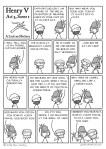
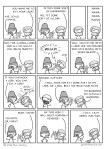
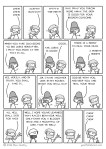
It’s Saint David’s Day! As a proud 1/32nd Welshwoman, I am always delighted to have an excuse to celebrate my fractional Celtic heritage.
Today’s comic is actually my entry to the @graphicshakespeare competition being run in conjunction with this year’s Elsinore Conference. For the competition, artists were asked to adapt and illustrate a scene from Shakespeare, either one of several pre-chosen scenes or one of our own choosing.
Naturally, I opted to adapt the scene that would allow me to draw people getting hit by leeks.
If you want to see some of the other awesome entries to the Graphic Shakespeare Competition, check out these links:
- Andrew Wales (King Lear, 1.4)
- Paul Shinn (Macbeth, 1.1)
- Rachel Ang (Macbeth, 1.1)
- Наталья Глушенкова (The Tempest, 1.1) Part 1, Part 2
- Angelina Popelnykh (The Tempest, prequel)
- Leah Yael Levy (The Merchant of Venice, 5.1)
- Katya Vakulenko (The Tempest, 2.1)
- Alexandra Chubar (The Tempest)
- Lizabeth Zaft (The Tempest, prequel)
- Margreet De Heer (Romeo and Juliet)
- Michi Mathias (A Midsummer Night’s Dream, 3.1)
- Em Evans (Hamlet, 3.1)
- Lena Kozlova (The Tempest)
(There are a lot more than just those entries, but those are the ones I have links for. Will update it as I get more links.)
i just saw a picture saying “dø or die” and it literally translates to die or die
#do u want to die in danish or english
*Hamlet sweats nervously*
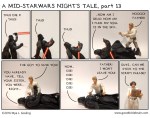
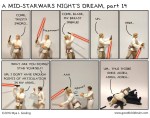
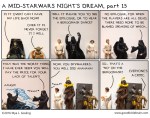
Well, here we are, finally at the end of my decongestant-fueled, action figured-aided jaunt through A Midsummer Night’s Dream. If you’re just joining us, get caught up on Episodes One, Two, Three, Four, Five, and Six of the Rude Galacticals’ misadventures in amateur dramatics.
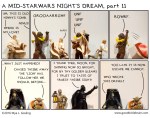
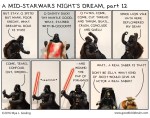
Thanks for putting up with this somewhat meandering tangent. People seemed to really like this series, and I must admit I had quite a bit of fun putting it together, so there might be more action figure comics in the future. After all, now I can’t let my Lord of the Rings action figures feel like they’re being excluded from all the fun….
 Kimchi and Justice