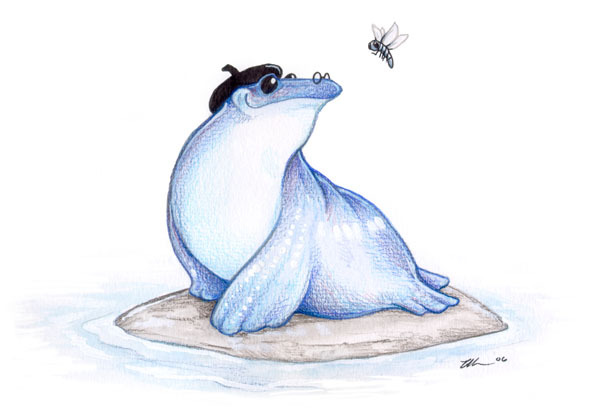
Ambulocetus beatnikii knew he was the heppest of the transitional forms.
——————
A very very quick silliness. Ambulocetus was an ancestral walking whale, and actually probably looked more like some kind of mutant Death Otter, but I was goin’ for cute. (Not that death otters wouldn’t be cute.)
Oh, like YOU never get the urge to draw transitional stages of whale evolution, only pudgy, with a beret… – Ursula Vernon
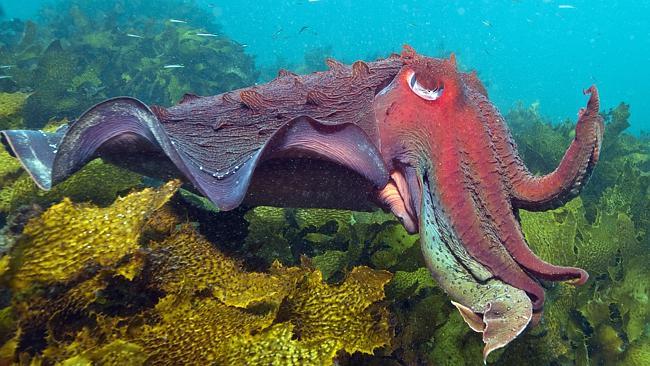
Guys I think it’s time to talk about my favorite cuttlefish, the giant Australian cuttlefish (Sepia apama)
Giant Australian cuttlefish gather in huge numbers in the Australian winter to mate.
There are way more males than females so competition is EXTREMELY intense.
They wrestle
Try to freak each other out with hypnotic color displays. It’s great.
So naturally the smaller males don’t stand a chance in all this ruckus. So what do they do? They cross dress.
So the little males pull some color changing shenanigans and do their best impression of a female. And it works. The males generally have longer arms and have a different color pattern, so the sneaker males pull up their arms and adopt a more female color.
So called “sneaker males” will pull up their arms, put on a “female” color pattern, and meet up with the females. Females often mate with the sneaker males and what’s EVEN CRAZIER is that the sperm from the cross-dressing males is used to fertilize a higher percentage of the eggs than the macho men. Since female cuttlefish mate with many males then choose which male’s sperm to use to fertilize the eggs, they must prefer these small clever males. You go little man!
what is the most terrifying creature on this planet? (if you can’t think of one, may i suggest looking up deep sea creatures?)
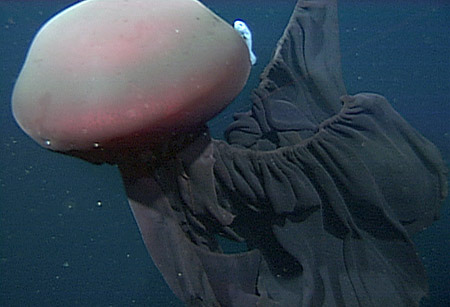
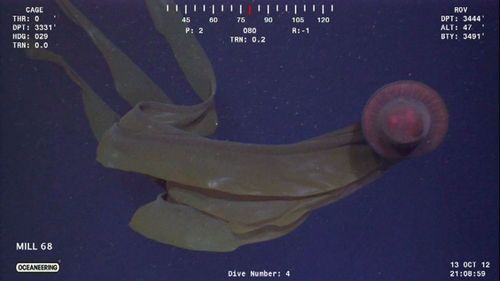
It would be harmless to a human (and the pale, slimy fish we see here, which seems to spend its whole life as its symbiote) but the sheer idea of Stygiomedusa gigantea is so powerfully haunting it gives me chills to think about; especially from the perspective of its prey.
What you see here is at least twenty feet in length, and they’re seen so rarely they could easily get bigger. Their red-black coloration makes them invisible in the abyss, and they don’t have any stinging tentacles – only the vast oral arms, which as in other jellies are an extension of the digestive lining.
Prey are simply folded up and smothered in the sheets of tissue, and already begin to digest without even being drawn into the bell.
They’re out there, right now, thousands of miles away in the freezing abyss, billowing like huge, empty cloaks, blind and thoughtless. They don’t need to chase their prey. Helpless little things just find themselves trapped in a sticky, living shadow, wrapping up tighter in the membranous jelly the more they struggle. They digest so slowly that exhaustion or suffocation probably kills them first.



 Kimchi and Justice