Can we talk about how autism discourse often revolves around throwing people with intellectual disabilities (and other cognitive stuff) under the bus? Like I’m reading something and it involves literally saying “well at least autistic people can actually be really smart and not have cognitive/intellectual disabilities!”
First, autism and intellectual disability are not mutually exclusive.
Second, intellectual disability does not preclude meaningful lives. Intellectual disability does not mean people cannot have input on their own lives and choices.
Stop talking about it like autism is higher up on a hierarchical scale and that’s why autistic people are worth something.
People are worth something because they are people.
Awareness says: Here is your child. Unfortunately this is a defective child.
Maybe, if you work with this kid hard enough, you will be able to have at least a tiny taste of the joys of parenthood. You will need a lot of money. I am sorry for you. Good luck, don’t expect too much.
Acceptance says: Here is your child! Congratulations!
Awareness says: This is the list of all of your child’s deficits. Good luck, I am so sorry.
Acceptance says: Here is a list of things your child might do differently. Since Autistic brains process things differently, the best approach is to listen to, and observe the child, making necessary accommodations for her to achieve full potential.
Awareness says: Your child cannot understand human feelings. Your non-verbal child will never say “I love you”
Acceptance says: Your child processes feelings in a way that might seem odd, but the feelings are real. The love received will come back, sometimes in a non-speaking way.
Awareness says: Correct those behaviors! Fix this mess!
Acceptance says: Behavior is communication. Understand and respect.
Awareness says: Don’t trust the adults who “have autism”. They are too “high-functioning” to understanding the heartbreaking struggles of “real” autism.
Acceptance says: Everyone struggles. Seek your community/your child’s community for input.
Awareness says: Those “low-functioning” people “with autism” cause too much pain. Burdens! Poor parents!
Acceptance says: Everybody has something to offer and do contribute when supported.
Awareness says: Beware of autism! It will cause havoc in our lives! All these people! How tragic!
I thought your post about kids with autism was great… but tbh I feel like a lot of autism resources ignore autistic people who are less self aware? For example, my sister, who has autism and is unaware of it + cannot speak… where are the resources that apply to her?
How can I help and support her? I feel like people with autism like her are frequently ignored in these kinds of posts.
realsocialskills said:
Several things:
Remember how much you don’t know:
You can’t really say definitively that your sister isn’t aware of autism
There is no reliable way to assess receptive language in someone without reliable expressive communication
Ie: You know that your sister can’t talk; you don’t know what she understands
Some tests can show that someone *does* understand language, but they can never show definitively that they *don’t*
Your sister may understand language; she may not. There’s no reliable way to be sure
It’s important to keep both possibilities in mind
Dave Hingsburger wrote a couple of good posts about interacting with nonspeaking people who may or may not understand language here and here
Keeping in mind the possibility that she understands language (or that she might be able to learn how to use language):
Talk to her like she understands
Tell her about things you think she might want to know (including autism)
Tell her that you can what she thinks, and that you know she might understand you
When you make choices related to her, explain them to her
Tell her what’s going on and what’s going to happen, whether or not she demonstrates understanding
Have books around about things she might want to know about
Turn the TV or radio to things you think she might be interested in
If she’s a child, put her in educational settings in which she’s hearing lessons on grade-level material, whether or not she’s able to demonstrate comprehension
Keep trying for communication support
Regarding communication support:
There are a *lot* of different things to try
A month-long trial is not long enough to determine whether a communication strategy will work for someone
Some people can use a system right away; some people need months of being shown how it works and experimentation before they can use it
You don’t have to use simpler systems before you can do more complex things
One of the things you should try is a high-tech AAC system based on core vocabulary.
Speak For Yourself has some advantages over most other systems (including that they have good resources for people supporting family members without much professional support)
Human-supported systems like a PODD book work better for some people
Signed languages like ASL work well for some people
The Rapid Prompting Method works for some people nothing else works for. (It’s particularly effective for people with severe apraxia or severe attention problems.)
Facilitated Communication/Supported Typing also works well for some people who other methods don’t work for. (It has major drawbacks and risks, including the fact that a lot of people will assume that her communication isn’t real. But it does work well for some people.)
Multi-sensory systems like Makaton also work for some people (but systems that allow for more open forms of communication are better)
tl;dr There are a *lot* of approaches to supporting communication, and it’s important to keep trying to find one that will work for her
Keep in mind the possibility that she does not understand language, or that she needs help understanding it:
She might not understand words
She might need pictures or symbols to help her understand words
She might need simplified language (but don’t make *everything* simplified, because that might not be what she needs. It’s a guess)
Whether or not she understands language, she does think, and her thoughts matter
She likes and dislikes things, and that matters too
(Self-awareness and language aren’t the same thing)
Make room for stuff she cares about:
If you think she likes, cares about, or is interested in something, find ways of making that thing available to her
Even if it’s things like watching the same clips on YouTube over and over, or spinning things.
If those things are important to her, then they’re important
Create opportunities for her to try new things. (Not forced. But like, offer her different kinds of food and books and stuff to watch on TV and places to go.)
Let it be an end in itself
Don’t make everything she likes into therapy
And *especially* don’t make everything she likes into a reinforcer to get her to do what you want
She has the right to like things, be interested in things, and have time that is her own
Help her to find a peer group:
If she doesn’t know any other autistic people, that’s a problem
If she doesn’t know any other nonspeaking people, that’s a problem
If the only time she spends with other disabled people is in tightly regimented special education or therapeutic settings, that’s also a problem
It’s important for disabled people to have the opportunity to meet and interact with other disabled people
This is particularly important for disabled people whose communication is thoroughly atypical.
Eg: there may be other autistic people who readily understand her body language
Not all disabled people will be friends, and it’s important not to force it
It’s also important to create opportunities
(And to make sure she’s seen pictures and videos of other people who look like her.)
Find ways of listening to her:
Whether or not she uses language, she’s communicating some things in some ways
Find ways of listening to her
Pay attention to what she does, and how she’s reacting to things, and what you think she might mean
(Do keep in mind that you’re guessing — it’s easy to misunderstand nonverbal communication when someone has no words or unambiguous symbolic gestures to correct you with).
Tell her, through words and actions, that you care about understanding what she’s telling you
Eg: Say explicitly things like “I think you are trying to tell me something. I’m not sure what you mean, but I’m trying to understand.”
Then when you think you know what she means, don’t ignore it; act on it
Whether or not she understands your words, it’s likely that saying them will help her to understand that you care. (It will also remind you to care).
The more you work on listening to her, the more often you will understand her communication
Creative arts therapists might be helpful:
Some creative arts therapists (particularly music therapists) do good work with nonspeaking people
They can often find expressive and receptive communication that others don’t find
They can also help to figure out what someone likes
(Make sure the person you go to isn’t also a behaviorist. Behavior therapists are not good at this and they tend to cause other problems).
Share what you know about her communication:
If others think she doesn’t communicate, tell them what you know or suspect about her communication
Sometimes they will use what you tell them to communicate with her
Even if they don’t believe you, the fact that you think she communicates will often make them treat her better
Don’t make decisions for her that she can make for herself:
eg: If she understands what clothing is and can pick a shirt, don’t decide for her which shirt to wear
If there are different kinds of food, don’t pick for her; ask her what she wants
If she’s in a social setting with other people; don’t prompt her into interacting with particular people. Being nonspeaking doesn’t make you the boss of her social life.
Just generally, don’t script everything. Respect her space and see what she initiates and chooses.
And if she needs help choosing, don’t take over; offer support
Eg: If she’s overwhelmed by the number of shirts she has, try picking up two and asking which one.
tl;dr If someone doesn’t speak, it’s important not to assume they’re unable to understand language — and also important not to assume that they do. In either case, it’s important to listen to them, speak to them respectfully, work on finding ways to support their communication, make room for their interests, and respect their decisions.
Stop writing perfect future utopia sci-fi worlds where there are no disabled people. Stop “fixing” something that wasn’t even fucking broken in the first place.
Stop writing perfect worlds where there is nothing wrong with engineering Perfect Babies, because that is a literal form of eugenics, which is a nazi-related concept.
Stop implying getting rid of people with physical disabilities, neurological disorders, mental illnesses and the like is easier than giving people with those things the accommodations they need. That’s absolutely terrifying to be looked at that way.
Y’know, if being asked to stop portraying the systematic murder of disabled people as excusable in your fiction offends you, that says A LOT about what you think of the feelings of disabled people and disabled people IRL in general. Have fun being shitballs, everybody in my inbox, you’re all disgusting
Disclaimer: Not disabled, but this shit has bothered me since FOREVER.
The options in sci-fi for dealing with disabilities always seem to fall into four categories: “We cured them”, “We fixed the ‘broken’ bits with robotics,” “I hand-wave them out of existence,” or “My dystopia kills them all.” Let’s take them one by one.
1) LOADS of problems with this. For starters, some people with disabilities do not need/want ‘curing,’ e.g., the Deaf community, the autistic community, the Aspergic community. Secondly, there are some conditions where any cure, short of eugenics, is impossible. Take Down Syndrome for example – the disability is in an extra chromosome. You can’t get rid of that without straight-up changing a massive amount of someone’s DNA, which brings up a lot of ethics about whether changing that much DNA is the same as changing someone’s personhood. Finally, while I’m sure there are plenty of, for example, paraplegics who’d love a medical cure that’d enable them to walk, there’s always going to be some people who, for various medical, religious, or personal reasons, can’t or won’t use your sci-fi-future-magic treatment. They should be around too.
2) I am totally down with prosthetics becoming more responsive, badass, and generally awesome, but if you’re just going to be giving everyone robo-legs/eyes/arms that are functionally indistinguishable from fleshy ones, then you’re really just using disabled people for colorful future-scenery. No robotic part, however badass, will ever be exactly the same as one you’re born with, in some ways that are good and in some ways that are bad. If (here’s lookin’ at YOU, Star Trek) you’re going to show off how your blind character can now see UV and infrared light as well as visual-spectrum light thanks to his robo-prosthetic, you should probably also talk about how he can’t take it with him to the pool, or when it breaks, how expensive it is/long it takes to replace, or how edges get blurry when its batteries are running low. In general, you need to ask yourself if that character you wrote with the super-strong-robo-arm (here’s lookin’ at YOU, Cowboy Bebop) is there so you can waggle your fingers and go “FUUUuuuuUUUUttuuuRRReee,” or so you can actually represent people with disabilities.
3) I understand the impulse to do this because pretty much every single piece of popular culture ever made does exactly this, and it’s just so darned easy to say “there happen to be no disabled people anywhere in my story because shut up.” But, it still means you’re reinforcing a status quo that erases the experiences of people with disabilities, which makes you kind of a dick.
4) This trope, done right, could create a horrifying, thought-provoking dystopia. More often than not, though, it’s just thrown in to avoid dealing with people with disabilities. To figure out which camp you’re in, just answer this question: are you going to take a significant amount of time to address and give examples of how horribly fucked up this is? Like, more than two pages/3 minutes? If not, gtfo.
for some disabled ppl their disability is a gift that they feel they’re a better person for having & they wouldn’t change it for the world
for some disabled ppl their disability is the worst thing that ever happened to them & they’d give anything not to have it
for most disabled ppl their disability is neither or both. their feelings are somewhere inbetween or all over the map. completely neutral or shifting between the extremes
all of these are perfectly valid relationships to have w/ your disability. none of them are wrong or right or inherently healthy or unhealthy. they just are what they are. if you wanna improve your relationship w/ your disability that’s fine. if you don’t that’s fine too.
the only thing that’s not fine is telling someone that their relationship w/ their own disability is wrong
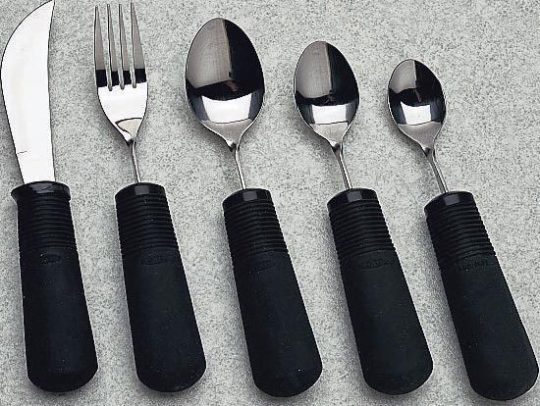
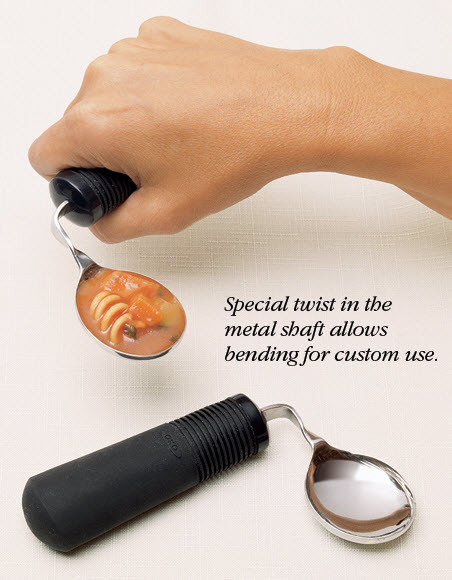
While I’m sure there are people too lazy to spin a fork, keep in mind people like this person who may be suffering from arthritis or a neurological disease or nerve damage or a thousand other conditions that might impair their ability to do things as simple as spin a fork to eat spaghetti.
These are used with people who can’t grip well:
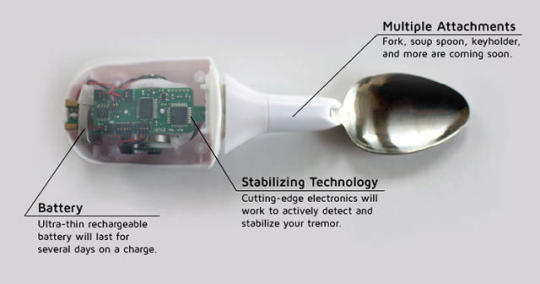
This is for Parkinsons’s:
For people who can’t even bend their joints:
Here’s a product that guides your hand from your plate to your mouth
This one holds a sandwich
Like I get it. I used to see things like the fork and think “that’s fuckin’ lazy” or that product that holds a gallon and you just tip it and pour. But then I started working around the disabled and impaired and found out that these products aren’t meant for lazy people, they’re meant for people who need help.
So maybe next time you see something, instead of thinking “Wow, are people that lazy?” just be grateful that you’re able to do the things you do every day and take for granted, like being able to feed yourself and wipe your own ass because you have enough coordination and bendy joints to do it.
feminists really need to be better about access tbh
At your supposedly radical events is there wheelchair access? that includes lifts and ample floor space as well as ramps. Is there a sensory room? Are there interpreters? Have you ensured there are no flashing lights? Is there a qualified first aider?
If you’re printing leaflets is the text readable? Is it in a dyslexic-friendly font? Is there any braille option?
On your websites do you provide image descriptions? Do your videos have subtitles? And a transcript?
Do you summarise your theory and essays? Or just expect everyone to read your 5k jargon-filled discussion?
and this isn’t an exhaustive list or even going into attitudinal barriers like please stop and think about your disabled sisters and how you are actively excluding us from your movements and what you can do to change that


 Kimchi and Justice