When we say “executive dysfunction”, I think it’s important to acknowledge to ourselves (and make clear to those who don’t struggle with it) that we’re talking about a basket of different struggles that we’re labeling with one name for convenience. One person’s executive dysfunction may not look like another person’s, even though the outcome (not being able to complete a task) may look similar from the outside.
Some people with executive dysfunction struggle to break down tasks into their component steps. Others struggle to connect cause and effect (’if I do this, this other thing will likely happen’), which makes daily life a confusing and sometimes terrifying black box. Still others can break down steps and parse out cause and effect, but they can’t start the first task (hello anxiety my old friend), or they get partway through and get distracted by a tangent or forget what the next step was because there were more than three (ah add i never miss you because you never leave), or they run out of energy before they can finish (tons of situations can cause this, both physical and mental). Sometimes people have a poor sense of how long it will take to do tasks, never seeming to budget enough because they don’t track time internally well. Others can only complete a task when they have sufficient adrenaline to spike their brain into focus, which usually means working in panic mode, which associates those tasks with Bad Feelings and further reinforces any anxiety the person may have.
And this isn’t just a few people. This is large-scale, across many groups struggling with different issues, from heavy metal poisoning to autism to add to chronic illness to anxiety to schizophrenia to mood disorders to traumatic brain injury, and more.
What we need, as a society, is to build better structures for supporting those with executive dysfunction, structures that acknowledge the multiple different types and causes. Because we cannot keep throwing the baby out with the bathwater here. We throw away incredible human potential that could help all of us because our society is set up to require a single skill which a large percentage of our teen and adult society doesn’t have and can’t easily develop (or they would have, trust me), or previously had by has temporarily lost due to injury or illness.
Instead of treating executive function as something that some people have developed and others haven’t, like artistic skills or a talent in maths or the ability to visualize systems or managing people, we treat it as a default that some people haven’t mastered because they’re [insert wrongheaded judgment here].
What if we treated the visual arts that way? If you can’t draw skillfully, you must be deficient in some way. How can you not draw? Anyone can draw. You start as a young child with crayons, what do you mean you can’t do this basic task?
Never mind that it’s a really complex skill by the time you’re expected to do the adult version, rather than the crayon version. Never mind that not everyone has been able to devote energy to developing that skill, and never mind that not everyone can visualize what they want to produce or has the hand-eye coordination necessary to accomplish it.
Now, I have friends who say that anyone can draw, and maybe they’re right on some level. But it’s hard to deny that it helps that drawing is optional. That you can opt out and no one thinks any less of you as a person. Executive function is treated as non-optional, and to some extent, since it’s involved in feeding and clothing and cleaning and educating oneself, it’s not entirely optional. But we make all of those tasks much harder by assuming by default that everyone can do them to an equal degree, and that no one needs or should need help.
If we built a society where it was expected that I might need timed reminders to eat, I would probably remember to do it more often. I certainly did as a child, when the adults around me were responsible for that task. Now that I’m an adult, the assumption is that I somehow magically developed a better internal barometer for hunger. Many people do. But I and many others did not. Recognizing that there are many of us who need help and treating that need as normal would go a long way toward building support into the basic fabric of our society.
But then, I guess that’s been the cry of disability advocates for decades; just assume this is a thing people need help with and build the entire structure with that assumption in mind.
executive dysfunction
I can never tell whether I have it or I’m just lazy (via spurisani)*waves* I don’t want to be an awkward turtle, but I noticed these tags and I kind of want to address this, since I stumble over this type of comment all the time online and off.
NGL I cry about this a lot more than people think.
This stuff is why I have a knee-jerk *snarl* response at the slightest hint of people starting with “well with Gifted kids we just need to focus on valuing effort -”
You will not get further than this around me. An absolutely flat “No.” will happen here. Swearing may ensue. A fast catch-up on the prevalence of executive function disorders, anxiety and depression in Gifted kids will almost certainly follow. Probably mixed with swearing.
When I was a pre-teen, I couldn’t practice piano.
It’s a weird statement, isn’t it? But in retrospect, it’s true. I internalized this as “I lack discipline”, and “I’m lazy”, and even outright “I’m just a horrible entitled Gifted person skating by on my Giftedness, which is even worse.”
What actually was going on is that sitting down to practice piano gave me an overwhelming anxiety attack. I didn’t know that, because like most people I didn’t realize that “anxiety” in a clinical sense doesn’t necessarily manifest as what we parse as “fear”-type behaviour. It also manifests as intense distraction, as irritability, as impatience, as anger, etc.
So experientially, I wanted to practice. I did!
But first of all I would literally forget until it wasn’t possible anymore. This is my anxiety’s WORST TRICK, and I hate it so much: it will simply misplace information about tasks that scare me and only allow me to remember after it is no longer possible to perform this task. (It is currently playing this game with making a psychiatrist appointment).
Additionally, if I did manage to force myself to sit down at the piano, I immediately became unable to focus at all. My memory totally fell apart. Every single thought became of getting away from the piano, and it felt like this was the worst, most unpleasant task in the universe. Every slip of the fingers made me feel like I was garbage. Etc, etc, etc.
So getting to the piano was this unbelievable agonizing struggle but? It was all invisible. All the effort, all the misery, was inside my head. Without diagnosis (and this being the 90s, even if I’d had one, likely without understanding) all that could be seen was a ridiculous aversion to just doing fifteen minutes of practice! Why wouldn’t I just make the effort?
You have no idea what effort looks like from the outside unless and until you know the other person. And what’s going on with them.
The ten minutes spent fighting inside your own head with the anxiety that’s stopping you from Doing The Thing? Is part of the effort you expend on it.
Tag: broken brain is broken
“your mental illness is all inside your head.” okay…but… how do i get it….. o ut
something that has usually worked for me in the Bad Times is just. Giving myself an hour. no i don’t want to wake up. but i tell myself. get up. and if in an hour we feel worse, we’ll go back to bed. i say to myself: you don’t have to like it. you just have to do it. sometimes i get to the end of the hour and go back to bed. but a lot of times after a shower and water and maybe doing some jumping jacks or stretching i feel better. there’s a lot to do in an hour that makes it a little less oppressive to breathe. picking out good clothes, putting on good music, doing your makeup so tight it forms a blade, texting a friend, making tea, trying a new hairstyle, making an omelette. it’s gotta be up though, nothing in bed, nothing still, nothing just sitting and staring into the void. it’s got to be moving. creating things helps. journalling helps. but not in bed.
i think we who are mentally ill kind of got. a double dose of inertia. and sometimes the push it takes to overcome that inertia keeps us in bed. but i have found a lot that just. starting to move. helps. even a little. because if you’re up you might as well make the bed. and you might as well go to one class – you can skip the second if the tired gets worse. and once you’re at that one class, you make it to the second because why not.
it doesn’t always work. but give yourself an hour. sixty minutes. say: okay. it’s gonna suck and that first push might take all of our effort and we might sit on the floor for an hour and if that happens, fine, we’ll go back to bed. but then you tried. you got up and tried. and something about that makes the guilt a little less harsh and makes you feel a little bit more powerful and the next time you wake up and your body wants to sit on the floor, you say: no, thanks, we did that yesterday and my hips still hurt. let’s see if i can shower. and maybe you sit in the shower instead but you did take a shower so it probably counts. there’s a lot of power in baby steps. i believe in you. and i think you can do a lot with those sixty minutes.
The most valuable thing I learned doing a Masters degree with depression, anxiety and ADHD was to change my “things I’m bad at” list to “things I can’t do on my own.” Stop thinking of them as things I could do if I tried hard enough, and accept that I can’t accomplish them by effort and willpower alone; they’re genuine neurocognitive deficits, and if I need to do the thing, then just like a blind person reading or a mobility impaired person going up a storey in a building, I need to find a different method.
I’m “bad at” working on long-term projects without an imminent deadline or someone breathing down my neck? Okay, let’s change that: I can’t work on long-term projects without an imminent deadline and someone breathing down my neck. So let’s create an imminent deadline and recruit neck-breathers. Find a sympathetic prof who will agree that 3 weeks before the due date they expect me to show them my preliminary notes and bibliography. Get a friend I trust to block off an hour to sit with me and keep asking, “Are you working on your project?” Write a blog post about my progress. Arrange to trade papers and proofread them with another student.
Accept your limitations and learn to leverage them, instead of buying the neurotypical fairytale that they’ll go away if you just try hard enough.
I’m sorry. Just like the disabled people you speak about finds a different method to help them, you should too, try a physical calendar, or even the calendar on your phone to set your own deadlines. If you need help reminding certain things use a notebook. Sitting there pushing the responsibility off onto someone else is wrong. Forcing someone to be a nag and enforcer is wrong. There are steps you can take, gadgets to help. That’s just my $0.02.
Take em back, I don’t want your shitty pennies.
For the record, given our relative physical sizes and temperaments, @star-anise‘s ability to force me (as one of the friends who has done this) to do anything is about nil.
I mean I’m literally not sure she could force me off a couch. I am just saying.
This week I tried to emotionally terrorize a squirrel who kept coming and stealing food off our picnic table. It was not much of a success.
More seriously, for anyone reading who might need some clarity: none of us MIND. The only thing that would be wrong is if @star-anise actually did push “responsibility” off on us – that is to say, blamed us if that day the strategy didn’t work, or she didn’t get things done, or we didn’t spontaneously read her mind and know she needed nagging, or even if she pitched a fit or made it our fault if on that day we have something else important to do.
That is what “pushing off responsibility” would actually be. “@violent-darts couldn’t nag me on Tuesday so it’s her fault that I didn’t get my project done!” See how that works? Mmmkay?
Otherwise, frankly, given the personalities at play, she’s just giving useful boundaries within which we can do something we’ve almost all had to break ourselves of the habit of doing unsolicited anyway. Remembering to go “oi you, work on the thing” every hour or so is hardly onerous.
Also seriously I’m pretty sure we’re all bigger and meaner than she is.
AND THIS HAS BEEN TONIGHT’S EPISODE OF FEATHER-OVERCLARIFIES-A-THING. THANK YOU AND GOOD EVENING.
Another instance of a busybody attempting to police behaviors of someone else that do not and will not affect them. Cause trust me, if you’re this vocal about Do It Yourself And Don’t Ask Anyone To Help You Because That’s Cheating, you’re already on the list of people not to ask under any circumstances.
a professor that accommodates ptsd? what is this??
Today I was talking to my professor about my ptsd and how it may affect class performance, because it’s a very participation-heavy class. The system that my professor came up with is kind of beautiful, so I want to share it with you guys.
She gave me some neon pink post-its, the kind that can be seen for miles because of how bright they are. If I’m having a flashback, dissociating, panic attack, etc., I can just put one of the post-its on my notebook, or somewhere in front of me on the desk. She’ll take that as a cue to not call on me and not expect me to participate. When I’m ready to engage in class again, I’ll just move the post-it out of sight.
I definitely appreciate having this accommodation, and I plan to use it with my future students someday. It’s simple, works when I’m non-verbal, and it doesn’t look like anything weird or attention-grabbing to classmates.
me: hello can you please tag [insert ‘obscure’ trigger] it causes me to have flashbacks
gross person: actually no. its not listed under the Official Neurotypical Approved List Of Triggers™. please try going outside !!
@all of my followers please feel free to hmu if you have an “obscure” trigger and you need me to tag something on my blog. I’ll do it straight away and I promise I won’t be upset
Dr. Gorin pauses. “You don’t. March to
a different beat. Or whatever cute phrase someone uses. What you are is
this: deeply strange. You’re extremely smart and very very weird. If
you wanted, you could go back to school. You could pay very close
attention to what everyone around you is doing and you could try to
emulate them. Eventually, you will probably succeed. You could be like
everyone else. Perhaps shaded just enough to the left to be thought a
class clown.”“Oh,” Jillian licks her lips. “Um.”
“I think that would be a goddamn shame.”
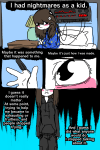
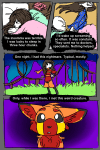
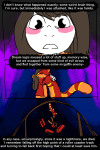


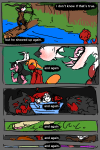


Before anyone says it, yes, I have a therapist.
In any case, this is, as you might imagine, very important to me. I say “i had nightmares when i was a kid” like i dont still get night terrors as a 22 year old adult. The first panel of this is actually based on a photo my mom took of me in a sleep study when I was fifteen. It was one of the harder times in my life, honestly, but things have been steadily getting better since then. all the dreams here are based on ones i actually had, and theres a ton of old comics and drawings of them on my old deviantart from when i was a teenager.
that’s all really, theres no end goal here, nothing im looking to accomplish other than sharing.
Can you link resources on trauma repression guardian personalities?
I… Think something clicked just now.
Would either of you happen to have resources on this or know someone who might? (tagging House of Chimeras since this seems related to system stuff.)
Unfortunately I can’t really think of any resources for guardian personalities specifically that aren’t drenched in “everyone with personalities/headpeople/etc has DID and everyone’s DID works according to this specific model”, because the idea of people with specific roles in a headspace really got bound up with that in the literature.
But I know some folks who might: @solipsistful?
(Also, I just really like this comic in general? Like, I don’t know, just the way it’s presented just feels very normalising. Just like “yeah this happens to people sometimes”.)
@star-anise, you have any potentially useful stuff on this?
So a new blog has started called “Is There Rape In It”. Basically, it’s a blog dedicated to listing movies, TV shows, and videos game that have rape in them, so that victims and survivors can avoid triggers.
Since they have just started up, they don’t have full lists yet. So if you are aware of rape in any of those forms of media, please reblog their lists and let them know!
Boost.
there is also one for suicide and self harm!
(their lists arent that long yet either so if you have anything to submit to either, please do)


 Kimchi and Justice