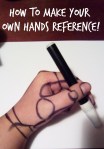
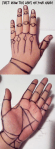
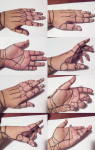
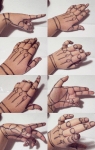
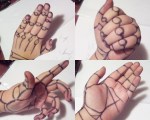
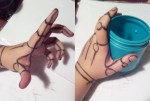
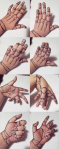
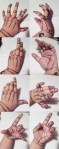

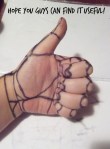
Another crap thing I do to make references, if you like it I can make more tutorials but idk if someone would find sense in my crazy stuff hahaha
You just won the Nobel Prize
Another crap thing I do to make references, if you like it I can make more tutorials but idk if someone would find sense in my crazy stuff hahaha
You just won the Nobel Prize
Hello, my friend! This is an excellent question.
You’re right: different threads will make your stitches look different. There are really very few hard and fast guidelines about “what thread to use for which stitch in ALL CASES EVERY TIME.”
Embroidery floss (like DMC or Anchor) is a great choice for lots of kinds of embroidery. You can separate the threads and use only one or two plies for cross stitch, surface embroidery, or blackwork, or you can use all six plies for canvaswork or needlepoint. You can give your stitches texture by using textured threads or make them sparkly by using sparkly threads.
Pearl cotton is a great choice for Hardanger embroidery or pulled thread embroidery, as well as for canvaswork and needlepoint. #12 pearl cotton is ideal for Hardanger fillings, pulled thread embroidery, and drawn thread embroidery. #8 pearl cotton is great for Hardanger Kloster blocks or putting buttonhole edges on things you want to finish (like placemats or table runners). #5 pearl cotton works great on canvas and in needlepoint projects, or on large-count Aida fabric to make stockings, bellpulls, or other pieces that are meant to be displayed and have practical use.
Here are some examples of threads that I have for projects from my own stash:
- Regular six-strand cotton thread, both DMC and overdyed, for samplers and other counted projects, as well as for thread painting and stumpwork
- Twisted silk threads, for counted projects
- Flat silk threads, for silk and metal embroidery and for when I want to torment myself (because they look lovely but are a pain to work with)
- Metal and metallic threads for goldwork projects
- Pearl cotton (in white and in various weights) for pulled and drawn thread projects
- Pearl cotton (in lots of colors and in various weights) for same
There are so many different kinds and weights of threads that it’s worth taking some time to mess around with them to see what you like to work with! I would recommend that you take a trip to your local needlework store (or find one when you’re out on a vacation somewhere) and buy some threads that you like. Mess around with them and see what you prefer!
Thanks again for your question – I hope this helps you out!
You also need to take into account a number of other things when choosing thread: 1) your fabric or canvas vs the thread; 2) intended use and care of the finished item; 3) the look you want to achieve; 4) your intended stitches.
To expand a bit: 1) some threads are much more sturdy than others for repeatedly being drawn through fabrics, and some fabrics are harder on threads than others. I work a lot with denim and cotton wovens, and tightly woven silk fabrics, as well as knits. Very fine lightly twisted threads (some silks and silk/wool, or alpaca, etc.) don’t stand up well to being repeatedly drawn through denim and cotton, but are great for looser weaves and canvas. Cotton flosses–like DMC–and finer weights of perl cotton are very sturdy and do well with denim and tightly woven fabrics. Rayon flosses do better with smooth fabrics, and may fray and shred when used with some of the rougher canvases or with very stiff denim and acetates. Bamboo and tightly twisted silks play well with most fabrics, but can fray at the needle eye, so require shorter working lengths.
2) For items to be worn and washed, or that will get potentially repeated abrasion–cuffs, collars, purses, etc.–cotton is probably the sturdiest and stands up well to washing and drying, as do many tightly twisted silks and most rayons (altho you have to watch for color bleed and possible shrinkage with rayon and some silks). Nylons do well too, if dried at low heat or air dried. Metallics and textured flosses generally don’t do well with repeated washing and drying, in my experience. Regular sewing thread is superb for very fine work that is sturdy and wearable. If a piece is to be displayed only, then the sky’s the limit and you can use anything, as long as you are aware of light exposure that can cause thread color to fade in time.
3) For shine, rayons and silks are awesome, as are metallics. DMC cotton floss has a shine to it, but it’s very low key. Textured threads can be used for all kinds of depth and effects, including three dimensional looks. Some flosses have a wide color range, good for color blending, and some don’t. Any floss or thread or ribbon can be couched on the surface as well.
4. Some stitches are easier with certain types of floss than with others. I mainly do freehand embroidery, not counted cross stitch or needlepoint, so my experience may be different, but cotton flosses are great for most stitches, except some Brazilwork. Rayon works more smoothly for those knotted/3-D stitches because the thread is smoother and glides better along the needle. Stitches that repeatedly go into the same place, like eyelets, some knotwork, etc., may need a sturdy thread, while tiny repeated stitches work better with fine silks. The type of stitch you’re planning on using, combined with the type of fabric, may determine which thread or floss you choose as well.
But there really are no hard-and-fast rules. If you try it and it works, and you can get the look you’re after, then it’s all good.
A fantastic (and expanded) contribution to the question that was asked earlier!
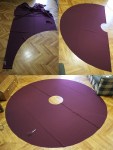
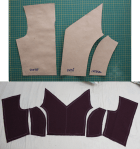
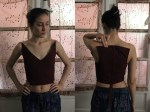
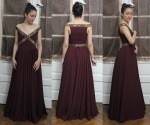
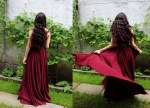
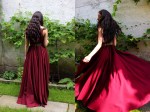
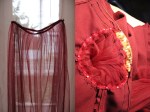
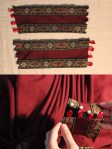
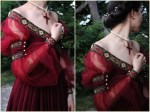
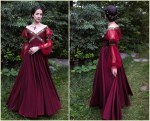
Making the burgundy dress.
Design, patterns and sewing made by me. The dress is renaissance inspired, with some personal modifications. The whole dress was hand sewn, including the hems. More pictures of it and a tutorial can be found on my blog.
I can’t even begin to express how beautiful this is
Found this GREAT embroidery tip from a Facebook cosplayer!!
https://www.facebook.com/Inusdreamcosplay
For those of you who don’t have an embroidery machine accessible to you, and don’t think you have the skill/patience to hand embroider, this is an amazing tip! Plus, if you paint over a drawn stencil, it should be pretty easy to keep everything neat and even looking!!
OH MY LORD
this is a great way to get satin embroidery perf.im keep this in mind!
ITS DONE!
…technically I still have to fill in the triceratops horns but CLOSE ENOUGH!45 hours of sewing, Special thanks to tinysketchbook who drew the beautiful original illustration~
When you’re absolutely stuck in a scene, write one of the characters in it yelling: “Makin’ pancakes! Makin’ bacon pancakes!” Then give yourself just a few minutes to write all the other characters reacting appropriately, as though that had genuinely just happened in their reality.
—–
“Why are you so unfriendly?’ said Boromir. ‘I am a true man, neither
thief nor tracker. I need your Ring: that you know now; but I give you
my word that I do not desire to keep it. Will you not at least let me
make trial of my plan? Lend me the Ring!““No! No!” cried Frodo. “Makin’ pancakes! Makin’ bacon pancakes!”
“It is by our own folly that the Enemy will defeat us,” cried Boromir. “This is no time to take bacon and put it in a pancake! How it angers me! Fool! Obstinate fool!”
—–
And then erase the goofy stuff and go back to where you were, hopefully slightly refreshed.
This is a shorter variation on Steven Brust’s trick for when he’s stuck on a major plot point. He writes a scene in which all the characters get together and have a meal, at which they bitch about their situation, about possible solutions, and about what a jerk their author is. When the characters have agreed upon a course of action, Steve deletes the meal scene and has them enact whatever decisions were made in it.
Oh Christ, the meal trick. I’m filing that one away.
 Kimchi and Justice