I’ve been having a lot of conflicted
feelings. It’s definitely one of those situations where, yes, the
original Strange was white! But to think about what they could have
done with this character…
So imagine. An Asian med
student. A Chinese guy getting mocked for being one of a thousand
Chinese students, for thinking he’s going to be special. A Filipino guy
getting laughed at and told to scrub the floors because that’s all he’s
good for, doesn’t he know that he’d have to struggle to make nurse? An Indian guy, keeping his head down and getting the work
done while people make Apu accents at him. Imagine the work he puts into
forcing his ethnicity behind him. He stops speaking Mandarin at home.
He starts throwing his mama’s pancit in the trash when she makes him
take leftovers, instead of saving it for later. He learns to love
hamburgers, ignoring his great-grandma’s ghost in the back of his head
and her horror at him consuming beef.
He finishes med
school, gets his residencies behind him, and he was right all along– he
is astoundingly skilled. A marvel. Hopeless patients thrive under his
hands. But is he going to be recognized for that? Well, I mean, he’s
Asian. He’s not special, they’re just meticulous like that. So the
recognition comes, sure, but people make jokes, even his friends, about
Surgeon Level: Asian. And the ego and the anger build up, like nacre on
a pearl, layer after layer of contempt as he gets better and better at
his skills. Contempt for the people around him. Contempt for the people
who made him. Contempt for the people he saves. Contempt, all of it,
for himself, for that nineteen-year-old pitching his mama’s pancit in
the garbage before going to bed.
And then the accident
happens. And he’s an out-of-work Asian dude. No more the protection of
his title, and everyday shit–people pulling their eyes at him or making
small dick jokes, people doing racist accents and calling him any of a
thousand slurs–hurt a lot more when he can’t say I’m a doctor.
I’m above them. Because all the work he did, he’s never going
to escape the color of his skin.
And a relative, his mom,
his auntie, seeing the darkness growing deeper and deeper in him, says
“Stephen. You need to go home for a while and get away from this.
Rest.” And he thinks about “home.” He’s second or third generation
American, this is his home, but the children of immigrants all know the
longing for a place where we fit. Where our eyes aren’t out of place and
our skin isn’t remarked upon, where we never have to hear “Where are
you from?” He thinks about being five years old, his hand–broken now,
aching–small in his mother’s as she walked him down a bright street.
He smells adobo at random, out of nowhere, another ghost calling to him.
He thinks about when things were simpler, and despite his contempt for
himself, for his mother’s people and his roots, he books a plane ticket.
And
the plane is full of people speaking the language he’s stopped speaking
to his mother, the language he was never really steady in anyway. And
something about it is comforting, and that scares him. Everything he
worked so hard to be, all in threads at the sound of the young mother
five rows ahead of him singing softly in Tagalog to her little boy.
He’s
been so angry and so sick in himself for the months since the accident
that relaxing feels wrong. But the air here smells right–the second he
steps off the plane it’s like he fills up a pair of lungs that have
been gasping for a decade. How stressful it is, to feel better and hate
yourself for feeling better.
He walks the roads his mama
took him on thirty years ago, and they’re busier than they were, the
cars are louder, but the sameness of it all is dizzying. He checks the
paper his mother gave him, the names and the addresses, and loathing
himself he goes to an acupuncturist, to a reiki master, to practitioner
after practitioner, and he hates them. I’m a doctor, I’m a doctor, these people are all quacks and
fucking idiots. he thinks, but his heart is in rags and his
hands are twisted on each other like the nightmares of an arthritic, and
so he goes.
Imagine, when he finally finds the Ancient
One. Imagine that the Ancient One has his great-grandmother’s eyes, that
the language the Ancient One speaks is the one Strange learned at his
mama’s knee and threw away. Imagine that the Ancient One–female or
male–is dark of skin, wears their traditional clothing as casually as
Strange wears a T-shirt, offers Strange a bowl of adobo and the steam rising off of it it smells just like it always did…
Imagine
Strange coming full circle, back to his roots, back to the place in
himself that he’s ignored and beaten down for all these years. Imagine
him looking at the history that belongs to him and claiming it. Imagine
him being still, yes, American. But honest to himself. No longer
fighting to be white, no longer fighting to play by the rules of white
people, recognizing that there’s power where he came from and it belongs
to him. Imagine what it it feels like, to have that sudden knowledge
opening inside your chest, to have the shame over your dark skin and
your narrow wrists and your almond eyes washed away by certainty and
confidence and a clean pride that bears no resemblance to the ego of the
master surgeon.
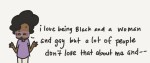
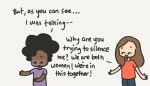
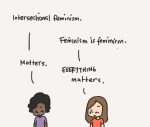
Some white women are mad about intersectional feminism the same way white men are mad when something of great importance to someone else has little or nothing to do with them.
After all, it was drag queens, Black drag queens, who fought the police at the famous Stonewall Inn rebellion in 1969. Years later, a group of nouveau-respectable gays tried to construct a memorial to Stonewall in the park across from the old bar. The piece consisted to two white clone-like thin gay men and two white, young lesbians with perfect noses. They were made of a plaster-like sustance, pasty and white as the people who paid for it. Some of us were furious. Chris called together all of the black gay and lesbian groups in the city and Feminist News for involved in the fight for a full color statue of a black drag queen throwing a brick at a cop. We didn’t get it, and frankly, I’d rather have nothing. At least that way you know what you’ve got.
“It is not my intention today to hurt anyone. I would never want to cause anyone pain.”
Jane Resh Thomas, a well-respected children’s writer of the 20th century, benefactor of a scholarship on critical analysis, and professor at Hamline University’s Master of Fine Arts in Writing for Children (MFAC) program, began her lecture, “On Kindness: Writing in the Age of Disgruntlement,” this way today.
She then spent just over an hour ardently telling students – students of color, students who are queer, students who are women, students with learning disabilities, students with mental illness, students who have backgrounds she does not know and cannot assume – that those who have been oppressed, those whose essential humanity has been denied, silenced, literally erased from history and society, must grant to their oppressors Kindness and Empathy, Because We Are All Equals.
With all due respect: no, we are not. That’s the goal. That’s the hope. I believe, even right now, in my anger, that it is also Jane’s hope. I believe that Jane believes it is true, even.
But Jane believes in that level playing field because she is granted the privilege of visibility. She is white. She is straight. She because of those privileges, she has had the opportunity to be eminent in her field. Because she has had that privilege, her voice has been heard, and heard with reverberation and influence, echoes of Jane Resh Thomas bouncing in arcs around the field of Children’s Literature to this minute. And beyond.
And that is why I am so angry that she would use that voice to say, Those who have never been heard must still hear me. People whose voices have never been heard because if they speak up, they are in danger, must allow those who put them in danger to hold the megaphone still.
I am angry that I had to listen to someone whose job is to teach me to write with clarity and empathy and resonant word choices say that the word “redneck” is comparable to the word “n******.” I am appalled that she called another professor a c**t to get a laugh. I am appalled that she got it, although I think so much of it was a funereal giggle – that laugh that bubbles up in the face of discomfort and fear of consequences. But there are no funereal jokes.
I am angry that someone whose job is to teach critical analysis argued that the historical significance of the Confederate flag meant that it earned its place to fly simply because it once flew, completely disregarding the historiographical significance that it did not fly over the South Carolina capitol until nearly a century after the Civil War and the cultural and critical implications of its continued and violent use to harm human beings. There was no attempt at the analysis of culture and place here, and that rightful outrage was spoken about like a temper tantrum.
We are children’s writers. Honestly, we need to honor the emotional validity of temper tantrums, too. Even if you don’t want to listen.
I am angry that someone who speaks every semester on writing gently and truthfully about pain placed her own need to feel heard over the pain of others – including the children we all are learning to write for. I am angry that someone with the comfort and privilege of a position of power above us students gave this lecture On High about how others’ pain can be invalid… if we cannot personally feel it. Or rather, if an old, straight, white woman cannot feel it.
“I would never want to hurt another person.”
I have seen Jane speak a number of times now, and I always come away uncomfortable with her ostensible assertion that the nature of pain is that all pain is equal and all pain is transient. Even as she spoke of the Fisher King, with his open wound, she asked for black culture to “get over” slavery. To “move past it.”
In the first lecture of hers that I saw, Jane posited that rape was not a “real” cause of trauma, that those who are strong enough can somehow “use” the experience to learn to be “better people.” Every time I have seen her speak, she asks for the (mandatory, captive) audience to write an exposure piece about their wounds. As though the place for that, for everyone, is always that place, at that time. For those wounds.
Some wounds do not close. The maggots that she talked about infesting the flesh of the burned are made of words and actions and, yes Jane, microaggressions (which are real, by the way). These maggots made of denial of privilege and leveraging of power over the powerless make a feast of all of us… but some more than most. Our, and their, pain runs the deepest and the hottest because those crawling parasites make their way past the bones and into the marrow of our culture’s consciousness. They are why an old white woman can feel that young black students opposed to any lauding of the Confederacy on their campus are “silly.”
They are why so many people in our own community jump down their own throats so far they speak out of their buttholes to defend sexist adult white men against young women calling them “sexist.” They are why people who wish to silence others can claim the word “kindness” and people trying so fucking (yes! fucking!) hard to speak cannot even claim their anger.
I am angry.
I am angry that by making her intentions a disclaimer, we are meant to act like Jane is absolved of her results.
I am angry that my safe place, for the last year, does not feel safe anymore.
But I will say that I think this experience taught our program one very, very valuable lesson about writing with “kindness” that Jane did not intend:
As content creators, as conscientious content creators, our intentions do not matter. Our executions matter. Jane did not set out to hurt people today.
But a lot of people in our community are hurting today.
And a lot of people in our community hurt all the time.
Not all wounds can be cleaned of maggots. Not even by burning them at the hot stove.

















 Kimchi and Justice