Stop writing perfect future utopia sci-fi worlds where there are no disabled people. Stop “fixing” something that wasn’t even fucking broken in the first place.
Stop writing perfect worlds where there is nothing wrong with engineering Perfect Babies, because that is a literal form of eugenics, which is a nazi-related concept.
Stop implying getting rid of people with physical disabilities, neurological disorders, mental illnesses and the like is easier than giving people with those things the accommodations they need. That’s absolutely terrifying to be looked at that way.
Y’know, if being asked to stop portraying the systematic murder of disabled people as excusable in your fiction offends you, that says A LOT about what you think of the feelings of disabled people and disabled people IRL in general. Have fun being shitballs, everybody in my inbox, you’re all disgusting
Disclaimer: Not disabled, but this shit has bothered me since FOREVER.
The options in sci-fi for dealing with disabilities always seem to fall into four categories: “We cured them”, “We fixed the ‘broken’ bits with robotics,” “I hand-wave them out of existence,” or “My dystopia kills them all.” Let’s take them one by one.
1) LOADS of problems with this. For starters, some people with disabilities do not need/want ‘curing,’ e.g., the Deaf community, the autistic community, the Aspergic community. Secondly, there are some conditions where any cure, short of eugenics, is impossible. Take Down Syndrome for example – the disability is in an extra chromosome. You can’t get rid of that without straight-up changing a massive amount of someone’s DNA, which brings up a lot of ethics about whether changing that much DNA is the same as changing someone’s personhood. Finally, while I’m sure there are plenty of, for example, paraplegics who’d love a medical cure that’d enable them to walk, there’s always going to be some people who, for various medical, religious, or personal reasons, can’t or won’t use your sci-fi-future-magic treatment. They should be around too.
2) I am totally down with prosthetics becoming more responsive, badass, and generally awesome, but if you’re just going to be giving everyone robo-legs/eyes/arms that are functionally indistinguishable from fleshy ones, then you’re really just using disabled people for colorful future-scenery. No robotic part, however badass, will ever be exactly the same as one you’re born with, in some ways that are good and in some ways that are bad. If (here’s lookin’ at YOU, Star Trek) you’re going to show off how your blind character can now see UV and infrared light as well as visual-spectrum light thanks to his robo-prosthetic, you should probably also talk about how he can’t take it with him to the pool, or when it breaks, how expensive it is/long it takes to replace, or how edges get blurry when its batteries are running low. In general, you need to ask yourself if that character you wrote with the super-strong-robo-arm (here’s lookin’ at YOU, Cowboy Bebop) is there so you can waggle your fingers and go “FUUUuuuuUUUUttuuuRRReee,” or so you can actually represent people with disabilities.
3) I understand the impulse to do this because pretty much every single piece of popular culture ever made does exactly this, and it’s just so darned easy to say “there happen to be no disabled people anywhere in my story because shut up.” But, it still means you’re reinforcing a status quo that erases the experiences of people with disabilities, which makes you kind of a dick.
4) This trope, done right, could create a horrifying, thought-provoking dystopia. More often than not, though, it’s just thrown in to avoid dealing with people with disabilities. To figure out which camp you’re in, just answer this question: are you going to take a significant amount of time to address and give examples of how horribly fucked up this is? Like, more than two pages/3 minutes? If not, gtfo.
for some disabled ppl their disability is a gift that they feel they’re a better person for having & they wouldn’t change it for the world
for some disabled ppl their disability is the worst thing that ever happened to them & they’d give anything not to have it
for most disabled ppl their disability is neither or both. their feelings are somewhere inbetween or all over the map. completely neutral or shifting between the extremes
all of these are perfectly valid relationships to have w/ your disability. none of them are wrong or right or inherently healthy or unhealthy. they just are what they are. if you wanna improve your relationship w/ your disability that’s fine. if you don’t that’s fine too.
the only thing that’s not fine is telling someone that their relationship w/ their own disability is wrong
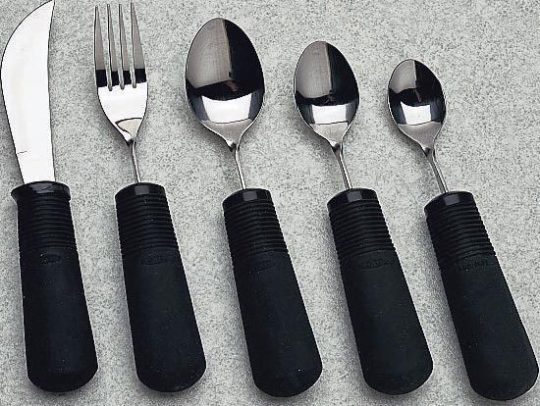
While I’m sure there are people too lazy to spin a fork, keep in mind people like this person who may be suffering from arthritis or a neurological disease or nerve damage or a thousand other conditions that might impair their ability to do things as simple as spin a fork to eat spaghetti.
These are used with people who can’t grip well:
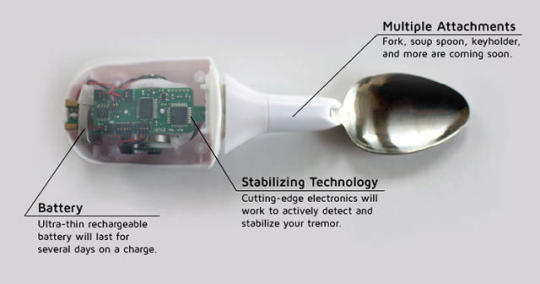
This is for Parkinsons’s:
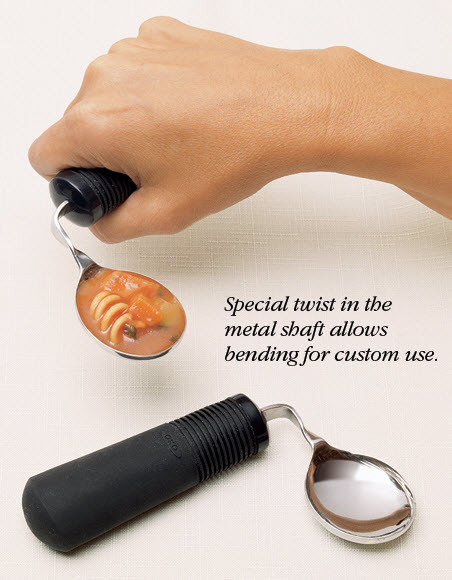
For people who can’t even bend their joints:
Here’s a product that guides your hand from your plate to your mouth
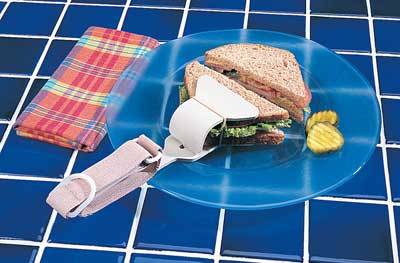
This one holds a sandwich
Like I get it. I used to see things like the fork and think “that’s fuckin’ lazy” or that product that holds a gallon and you just tip it and pour. But then I started working around the disabled and impaired and found out that these products aren’t meant for lazy people, they’re meant for people who need help.
So maybe next time you see something, instead of thinking “Wow, are people that lazy?” just be grateful that you’re able to do the things you do every day and take for granted, like being able to feed yourself and wipe your own ass because you have enough coordination and bendy joints to do it.
For anyone who needs to use crutches to aid their mobility but struggles with regular crutches check out smart crutch UK. These are especially good for those with Hypermobility syndrome and ehlers danlos syndrome.
I’m actually going to be getting a black pair of these and I’m so excited
When I hear you say that we have no language,
it’s as strange and sad to me as if you had said
There are no stars, because you’ve never
been out in the country at night. Never lain out
in predawn dark in a frozen roadside field
to see the Leonid showers.
–
That the pulsing lights of fireflies
are meaningless chemical blips,
not love songs in Morse code.
–
It makes me think you’ve never known
the easy comfort of reading together,
sharing a porch filled with morning sunlight.
–
Not known the thrill of the first time
you realize you’re sharing a thought
without even a glance.
–
Never spent a Friday night looking up
radio interviews for the pleasure
of hearing your own accent,
your own native dialect of metaphor,
spoken for just a few minutes.
–
It’s like hearing you insist that the feeling of walking
barefoot through soft grass can’t exist
because you’ve never done it.
–
That you’ve never gotten a letter in the mail, only catalogues and bills.
–
You’ve never read poetry; your school library had only textbooks.
There are no fairy tales in Icelandic, because you don’t speak it.
–
Never heard the soft fractal murmur of breeze
in oak and elm and walnut boughs in August,
the heartbeat drone of cicadas.
–
It’s always been winter.
Chavisory, “When I hear you say,” at Chavisory’s Notebook (for Autistics Speaking Day 2014, quoted in entirety with permission)
when people think if they carefully explain to you why being disabled is socially inappropriate, you will stop being disabled
It extends far beyond the “socially inappropriate” reasoning, too.
If you just understand well enough why you have to do this thing, then you will be able to do it, is some of the scariest reasoning of medical personnel that I have ever encountered.
Yes, this.
And at least in medical contexts, this increases the more disabilities you add in (or the more things your disability affects). No, I can’t stop being developmentally disabled just because it’s outside your specialty.
“No I can’t stop being developmentally disabled just because it’s outside your speciality.”
feminists really need to be better about access tbh
At your supposedly radical events is there wheelchair access? that includes lifts and ample floor space as well as ramps. Is there a sensory room? Are there interpreters? Have you ensured there are no flashing lights? Is there a qualified first aider?
If you’re printing leaflets is the text readable? Is it in a dyslexic-friendly font? Is there any braille option?
On your websites do you provide image descriptions? Do your videos have subtitles? And a transcript?
Do you summarise your theory and essays? Or just expect everyone to read your 5k jargon-filled discussion?
and this isn’t an exhaustive list or even going into attitudinal barriers like please stop and think about your disabled sisters and how you are actively excluding us from your movements and what you can do to change that

 Kimchi and Justice