those ao3 “kudos” emails where someone has gone through and read pretty much all of your stories, one after the other: blessings upon you and your household
don’t authors find that weird though? i don’t do that, just because i always figured it might seem stalkery, going story by story through people’s older work (which of course i do ~all the time~ because awesome fic is addictive)
if people are happy to have the kudos, i will totally start leaving them as i read
I mean, I can only speak for myself here, but no, I don’t find it creepy. Someone I’ve never met going through my old instagram selfies and systematically liking them – creepy. Someone I’ve never met obsessively reading my old fics and liking them – my favorite person of the day. Just MHO.
seeing the same person’s name on a string of kudos for your fics because they’ve obviously read through your back catalogue is one of life’s great joys
xcziel, there’s nothing I like more as a writer than someone who is obviously reading everything.
Well, maybe comments. Yes, on old fic too.
Seriously this is the BEST. As is long rambly headcanons about something that happens in your fic, and derivative works.
I am seriously still not REALLY on tumblr right now beyond fic-announcements but I feel like this one I really WANT to add: when you kudo/comment all my stuff, it tells me you KEPT LIKING my stuff and I didn’t suddenly disappoint or disgust you or something.
(I mean no obligation, and I DO mean that: I never, ever want someone to do or say anything in re: my writing because they feel obligated. But a string of kudos on everything, or a string of comments on nearly everything, just means that I know that you not only liked whatever bit spontaneously brought you to my page, but that you a. liked it enough to go look for other stuff I’ve written, and then b. KEPT LIKING what I’ve written. And as someone with brain-weasels about “oh she did a COUPLE things okay to start with but then she turned into total fail”, that’s soothing to my brain.)
no seriously it is the best thing. One morning I’ll get “x left kudos on a work” and the next morning I’ll get “x left kudos on THE ENTIRE REST OF YOUR CATALOG” and it just makes my week.
a man wrote an article about this mysterious new Fan Fiction craze, and oh boy did we all learn a lot from it.
okay but that should be a folk blessing though?
may your days be bright, your nights be sweet, and your sense of self-importance equivalent to a middle-aged man writing about a topic he doesn’t understand and hasn’t bothered to research.
how is it possible to love fictional characters this much and also have people always been this way?
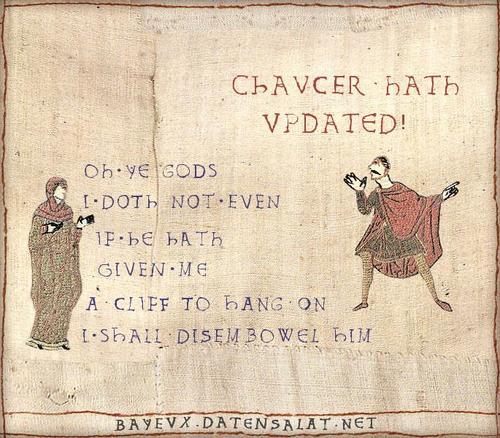
like, did queen elizabeth lie in bed late sometimes thinking ‘VERILY I CANNOT EVEN FOR MERCUTIO HATH SLAIN ME WITH FEELS’
was caesar like ‘ET TU ODYSSEUS’
sometimes i wonder
oh my GOD
the answer is yes they did. there’s a lot of research about the highly emotional reactions to the first novels widely available in print.
here’s a thing; the printing press was invented in 1450 and whilst it was revolutionary it wasn’t very good. but then it got better over time and by the 16th century there were publications, novels, scientific journals, folios, pamphlets and newspapers all over Europe. at first most were educational or theological, or reprints of classical works.
however, novels gained in popularity, as basically what most people wanted was to read for pleasure. they became salacious, extremely dramatic, with tragic heroines and doomed love and flawed heroes (see classical literature, only more extreme.) books in the form of letters were common. sensationalism was par the course and apparently used to teach moral lessons. there was also a lot of erotica floating around.
but here’s the thing: due to the greater availability of literature and the rise of comfy furniture (i shit you not this is an actual historical fact, the 16th and 17th century was when beds and chairs got comfy) people started reading novels for pleasure, women especially. as these novels were highly emotional, they too became…highly emotional. there are loads of contemporary reports of young women especially fainting, having hysterics, or crying fits lasting for days due to the death of a character or their otp’s doomed love. they became insensible over books and characters, and were very vocal about it. men weren’t immune-there’s a long letter a middle-aged man wrote to the author of his favourite work basically saying that the novel is too sad, he can’t handle all his feels, if they don’t get together he won’t be able to go on, and his heart is already broken at the heroine’s tragic state (IIRC ehh).
conservatives at the time were seriously worried about the effects of literature on people’s mental health, and thought it damaging to both morals and society. so basically yes it is exactly like what happens on tumblr when we cry over attractive British men, only my historical theory (get me) is that their emotions were even more intense, as they hadn’t had a life of sensationalist media to numb the pain for them beforehand in the same way we do, nor did they have the giant group therapy session that is tumblr.
(don’t even get me started on the classical/early medieval dudes and their boners for the Iliad i will be here all week. suffice to say, the members of the Byzantine court used Homeric puns instead of talking normally to each other if someone who hand’t studied the classics was in the room. they had dickish fandom in-jokes. boom.)
I needed to know this.
See, we’re all just the current steps in a time-honored tradition! (And this post is good to read along with Affectingly’s post this week about old-school-fandom-and-history-and-stuff.
Ancient Iliad fandom is intense
Alexander the Great and and his boyfriend totally RPed Achilles and Patroclus. Alexander shipped that hard. (It’s possible that this story is apocryphal, but that would just mean that ancient historians were writing RPS about Alexander and Hephaestion RPing Iliad slash and honestly that’s just as good).
And then there’s this gem from Plato:
“Very different was the reward of the true love of Achilles towards his lover Patroclus – his lover and not his love (the notion that Patroclus was the beloved one is a foolish error into which Aeschylus has fallen, for Achilles was surely the fairer of the two, fairer also than all the other heroes; and, as Homer informs us, he was still beardless, and younger far)” – Symposium
That’s right: 4th Century BCE arguments about who topped. Nihil novi sub sole my friends.
More on this glorious subject from people who know way more than I do
Man I love this post.
And to add my personal favourite story: after reading Samuel Richardson’s Clarissa in the 18th century, Elizabeth Echlin decided that she was NOT HAPPY with the ending and basically wrote her own fix-it fic. No-one dies and Lovelace (the villain) was totally reformed and became a super nice guy. It’s completely OOC and incredibly poorly written and it’s beautiful.
Also, so many women fell in love with the villain, Lovelace, and wrote to Richardson about it, that he kept adding new bits with each edition to highlight what a hideous person Lovelace was. So it’s almost unsurprising that reading novels in this period was actually considered dangerous because it gave women unrealistic ideas about men and made them easier prey for rakes.
Basically, “I want my own Christian Grey” has been a thing for hundreds of years.
Also a thing with fix-it/everyone lives AUs: at various points in time but especially in the mid 1800s-early 1900s (aka roughly Victorian though there were periods of this earlier as well) a huge thing was to “fix” Shakespeare (as well as most theater/novels) to be in line with current morality. Good characters live, bad characters are terribly punished – but not, you know, grusomely, because what would the ladies think? So you have like, productions of King Lear where Cordelia lives and so do Regan and Goneril, but they’re VERY SORRY.
Aka all your problematic faves are redeemed and Everyone Lives! AUs for every protag.
Slightly tangential but I wanted to add my own favorite account of Chinese fandom to this~ I don’t know how many people here have heard of the Chinese novel A Dream of Red Mansions (红楼梦), but it is, arguably, the most famous Chinese novel ever written (There are four Chinese novel classics and A Dream of Red Mansions is considered the top of that list). It was written during the Qing dynasty by 曹雪芹, but became a banned book due to its critique of societal institutions and pro-democracy themes. As a result, the original ending of the book was lost and only the first 80 chapters remained. There are quite a few versions of how the current ending of the book came to be, but one of them is basically about how He Shen, one of Emperor Qian Long’s most powerful advisers, was such a super-fan of the book, he hired two writers to archive and reform the novel from the few remaining manuscripts there were. In order to convince the Emperor to remove the ban on the book, he had the writers essentially write a fanfiction ending to the book that would mitigate the anti-establishment themes. However, He Shen thought that the first version of the ending was too tragic (even though the whole book is basically a tragedy) so he had the writers go back and write a happier ending for him (the current final 40 chapters). He then presented the book to the Emperor and successfully convinced him to remove the ban on the book.
According to incomplete estimates, A Dream of Red Mansions spawned over 20 spin offs, retellings, and alternate versions (in the form of operas, plays, etc.) during the Qing Dynasty alone.
In 1979, fans (albeit academic ones) started publishing a bi-monthly journal dedicated to analysis (read: meta) on A Dream of Red Mansions. In fact, the novel’s fandom is so vast and qualified and rooted in academics of Chinese literature that there is an entire field of study (beginning in the Qing dynasty) of just this one novel, called 红学. Think of it as Shakespearean studies, but only on one play. This field of study has schools of thought and specific specializations (as in: Psych analyses, Economics analyses, Historical analyses, etc.) that span pretty much every academic field anyone can think of.
(That being said, I’ve read A Dream of Red Mansions and can honestly say that I’ve never read its peer in either English or Chinese. If for nothing else, read it because you would never otherwise believe that a man from the Qing dynasty could write such a heart-breakingly feminist novel with such a diverse cast of female characters given all the bitching and moaning we hear from male content-creators nowadays)
the beauty of archival research *sigh*
Not a really interesting addition to this post compared to the above comments, but Jane Austen’s Northanger Abbey has the effect of reading overly dramatic Gothic literature on an impressionable young girl’s state of mind as a major theme. And there was a lot of concern in the regency period about the suitability of these novels for young women, because there was a concern that they reacted to the stories too strongly. (Subtext here being that there was a certain amount of anxiety that some of the available works of fiction were FAR too salacious for ladies)
Allow me to add Goethe and the Werther Effect – people (young men) cosplayed as Werther and were absolutely obsessed, some apparently to the point of suicide (although there is little proof for that), people wrote fix it-fics, Goethe hated them for it (there’s nothing like a good literary feud), the book was banned, people wrote more fic in the style of Werther, so called Wertheriaden ect. The Sturm und Drang period is a really good one for such episodes – people were very, very passionate about their books.
I love that “homage,” “pastiche,” “reboot,” “retelling,” and “fanfic” all mean the same damn thing, except that the last one is written primarily by women for free, and often includes sex, especially queer sex, so it’s delegitimized in the eyes of society.
And by “I love” I mean “I don’t love” because apparently we can just pick and choose what words mean
I totally agree with the point being made by the OP, but want to point out the irony in the politics of remix being described here.
You see, “homage,” “pastiche,” “reboot,” “retelling,” all tend to be less <i>original</i> than fanfiction. And I use the word “original” knowing how loaded, and potentially meaningless it is — it’s the criteria used by copyright law for a text worthy of being covered by copyright, and also as part of the definition of plagiarism. Works in the genres of “homage,” “pastiche,” “reboot,” “retelling,” are nearly always assumed to be original enough to be copyrightable in their own right, despite being derivative works.
These remix categories are all expected to explicitly rework a story while adding in a few new frills, and yet somehow, magically, that re-working makes them “original”. Yet that magic does not apply to fanfiction, which is seen as much more derivative and less worthy of respect.
Here’s the irony I mentioned. Fanfiction often jumps off from the source and tells a new story, or fills in a gap in the story it’s responding to (commonly with queer romance or sex). In many cases, fanfiction, while still a derivative work, is fundamentally much more “original” than the mainstream and more legitimate forms of remix, as it is telling a new story altogether.
Interesting, isn’t it, that the form of remix which is often most “original”, in that it offers more than just a retelling with new frills, is derided as the most derivative.
As the OP says, it’s not a coincidence that fanfiction is the version of remix currently considered least clever or worthy of respect, and is primarily a women’s genre and often also a queer genre.
Way back in 1985, Joanna Russ (one of the first feminist literary critics to take slash writing seriously) wrote that slash fanfic was “…is the only sexual fantasy by women for women that’s produced without the control or interposition of censorship by commercial booksellers or the interposition of political intent by writers or editors.” In the same essay, she wrote what slash writers wanted was “…the freedom to choose, a love that is entirely free of the culture’s whole discourse of gender and sex roles….” (From “Magic Mommas, Trembling Sisters, Puritans and Perverts: Feminist Essays”.)
how is it possible to love fictional characters this much and also have people always been this way?
like, did queen elizabeth lie in bed late sometimes thinking ‘VERILY I CANNOT EVEN FOR MERCUTIO HATH SLAIN ME WITH FEELS’
was caesar like ‘ET TU ODYSSEUS’
sometimes i wonder
oh my GOD
the answer is yes they did. there’s a lot of research about the highly emotional reactions to the first novels widely available in print.
here’s a thing; the printing press was invented in 1450 and whilst it was revolutionary it wasn’t very good. but then it got better over time and by the 16th century there were publications, novels, scientific journals, folios, pamphlets and newspapers all over Europe. at first most were educational or theological, or reprints of classical works.
however, novels gained in popularity, as basically what most people wanted was to read for pleasure. they became salacious, extremely dramatic, with tragic heroines and doomed love and flawed heroes (see classical literature, only more extreme.) books in the form of letters were common. sensationalism was par the course and apparently used to teach moral lessons. there was also a lot of erotica floating around.
but here’s the thing: due to the greater availability of literature and the rise of comfy furniture (i shit you not this is an actual historical fact, the 16th and 17th century was when beds and chairs got comfy) people started reading novels for pleasure, women especially. as these novels were highly emotional, they too became…highly emotional. there are loads of contemporary reports of young women especially fainting, having hysterics, or crying fits lasting for days due to the death of a character or their otp’s doomed love. they became insensible over books and characters, and were very vocal about it. men weren’t immune-there’s a long letter a middle-aged man wrote to the author of his favourite work basically saying that the novel is too sad, he can’t handle all his feels, if they don’t get together he won’t be able to go on, and his heart is already broken at the heroine’s tragic state (IIRC ehh).
conservatives at the time were seriously worried about the effects of literature on people’s mental health, and thought it damaging to both morals and society. so basically yes it is exactly like what happens on tumblr when we cry over attractive British men, only my historical theory (get me) is that their emotions were even more intense, as they hadn’t had a life of sensationalist media to numb the pain for them beforehand in the same way we do, nor did they have the giant group therapy session that is tumblr.
(don’t even get me started on the classical/early medieval dudes and their boners for the Iliad i will be here all week. suffice to say, the members of the Byzantine court used Homeric puns instead of talking normally to each other if someone who hand’t studied the classics was in the room. they had dickish fandom in-jokes. boom.)
I needed to know this.
See, we’re all just the current steps in a time-honored tradition! (And this post is good to read along with Affectingly’s post this week about old-school-fandom-and-history-and-stuff.
Ancient Iliad fandom is intense
Alexander the Great and and his boyfriend totally RPed Achilles and Patroclus. Alexander shipped that hard. (It’s possible that this story is apocryphal, but that would just mean that ancient historians were writing RPS about Alexander and Hephaestion RPing Iliad slash and honestly that’s just as good).
And then there’s this gem from Plato:
“Very different was the reward of the true love of Achilles towards his lover Patroclus – his lover and not his love (the notion that Patroclus was the beloved one is a foolish error into which Aeschylus has fallen, for Achilles was surely the fairer of the two, fairer also than all the other heroes; and, as Homer informs us, he was still beardless, and younger far)” – Symposium
That’s right: 4th Century BCE arguments about who topped. Nihil novi sub sole my friends.
Note that the printing press in China is invented much earlier and it has basically the same effect. Social conservatives in the censor bureau censored huge amounts of literature and poetry because of the devastating effect it had on the literati class (who formed most of the government bureaucracy, let’s not forget: So your state governor can’t work this week because he’s having Baoyu / Daiyu feels.) This did not stop it from leaking out anyway, in secret editions and hand-copied versions. And OMG the feels that these people have. There’s basically a constant struggle between the censors and this underground fandom, most novels are copied chapter-by-chapter, with people inserting fanfic chapters when they don’t have all the material (so if you have chapters 2, 3, 4, 10, 12 of your favorite book you might write your own 5-9 and circulate them) or just writing straight-up fanfic (famously in Water Margin and Red Chamber it _becomes canon_ after the author’s death.)
This post is the best thing, every part of it. Nothing to add except wow.
… One of these days, someone needs to make a documentary series about about literary fandoms throughout history.










 Kimchi and Justice