Today I found out that yarners think crocheting socks is subversive and controversial and I just…on one hand, why the fuck not, I guess yarners are allowed to have their controversies, but on the other, how much time do you have in your FUCKIN DAY??
My main concern is how they would feel but Maggie u know yarn fandom gotta think about something while knitting five miles of stockingnette for a sweater
Look, you can’t just leave it at that, why is it subversive and controversial? *gets popcorn*
I mean, I’m taking this on good faith, and I’m not saying this is my own personal belief. I believe in all crafts.
But…the structure of the stitches and the resulting fabric is pretty different between crochet and knitting. You get different effects between them, which lends themselves to different crafts. And none of the effects of (most) crochet stitches lend themselves naturally to socks. You’re (usually) going to end up with something either stiff and bulky, or full of holes that will Not Feel Good to walk on. Whereas knitted socks will just…BE elastic and comfortable.
Sure you CAN do it. And there are people and patterns that do it well!!
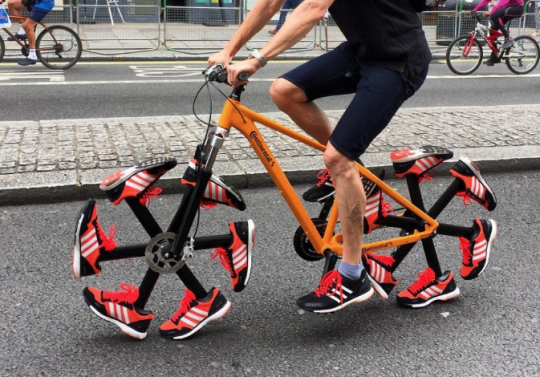
But MOST crochet socks are a bit like calling this a bicycle
I mean… Okay? But people are going to Talk.
But this is BABY controversy, this is nothing. You haven’t even touched on the good shit like RHSS or that time the Olympic Committee dissed us.
Iiiinteresting. So one of those “just because you CAN doesn’t mean you SHOULD” things.
Also I know very little about the yarn fandom except for that bit where a woman had to fake her death and had a nervous breakdown over selling homespun/dyed yarn so like, I already have big expectations.
Was that the one that “died” of leukemia or the one that “died” of lupus, or the one that overdosed?
From what I know of the narrative as it was described to me, I want to say the one that overdosed, but I am intrigued and vaguely concerned that there are multiple distinct individuals the above situation could apply to.
hey umm, what the fuck
the fake deaths thing: indie yarn dyer gets popular, gets overwhelmed by orders, can’t refund money because of shitty bookkeeping, decides faking online death is the only way out.
i’m sure some of them are unintentional rather than premeditated scammers but they’re all still thieving assholes who shouldn’t be running businesses and need to give all the money back.
the olympics commitee: ravelry, well-known knitting (fiber arts in general) site, held a contest they called the ‘ravelympics’ to drum up olympic support then get a cease-and-desist letter for copyright infringement, and the letter said that calling it that ‘denigrates the true nature of the Olympic Games’ and was ‘disrespectful to our country’s finest athletes’
except, you know, ravelry had like 2 million users who all, by nature of ravelry being a website, have basic tech literacy. the social media backlash was so bad that the olympics board had to make 2 official apologies because the first wasn’t good enough.
RHSS: Red Heart Super Saver is cheap Walmart-level yarn. some people hate it because it used to be just really fucking awful and they haven’t bothered updating their opinions. some people hate it because they hate non-natural yarns. some people hate it because they’re yarn snobs(which, btw, comes in two flavors: the disdainful assholes and the people who just don’t see the point if you have the money and don’t indulge yourself). a lot of people defend it because it’s cheap and widely locally available and honestly not that bad after a wash and some fabric softener.
crocheted socks: exactly what kaitoukitty said. people who crochet socks tend to either be new crocheters who are not aware crochet is not the best medium for socks or experienced crocheters who are pushing the boundaries of the medium.
babies on fire: i can’t believe we’re talking about yarncraft controversies and no one mentioned babies on fire. that’s my favorite controversy.
so when deciding what material to make baby blankets out of, in addition to considerations like softness, ease of washing, and allergy concerns quite a lot of people like to consider what would happen to the baby if the blanket was set on fire. yes, really.
wool has the problem of hand-wash only blankets for a new mother (superwash wool exists but that’s a whole ‘nother paragraph), allergy concerns, and also
real fucking expensive if you want quality not-itchy-on-baby-skin wool. but pro-wool-blanket people insist that because wool actually resists being set on fire pretty well and also can self-extinguish, it’s the only sensible choice.
acrylic on the other hand is cheap and you can throw it in the washing machine, and while bad quality acrylics might be stiff and plastic-y they’re not itchy, but if it gets set on fire it will melt onto the baby’s skin. pro-acrylic people insist that if your blanket is on fire, you probably have bigger problems than what the blanket is made of.
wow I didn’t expect such a detailed response. thank you!
Fiber Arts Just Be Fucking Like That.
Humans Just Be Fucking Like That.
I mean, seriously, we will do this this shit in literally any goddamn community you care to conceive of and some you haven’t. The human condition, man. It’s literally everywhere humans are and has been since we started being human. so, like, a couple million years.
Part 1: How Differences in Gauge Affect Your Final Project
Here’s some quick plug-and-chug ways to figure out what will happen if you can’t quite get the right gauge (or just don’t want to find a better gauge).
(All written on paper and shown as pictures because I’m bad at computers)
The second one picture is very important if you’re doing a simple repetitive stitch but it has a design worked in either via colors or knit/purl.
Additional Note: as long as you measure your gauge and the original gauge with the same units, the original pattern units can be whatever. Your answer will be in whatever units the original pattern size units were.
example: a scarf pattern is 6 feet but your gauge and original gauge are in inches, your answer will be in feet
Feel free to send me questions if you have any! I hope to do more of these in the future, as well as a really basic quantity algebra one to help you figure out your own things!
Too much task switching. My autie/adhd brain can’t handle it. Switching from knitting or sewing to weaving and back again eliminates the flow state which is what i knit for in the first place.
This is turning out even more beautiful than I imagined – Thanks to this gorgeous yarn! @RedHeartYarns Boutique Unforgettable is my jam 🙂 Keep an eye out for the pattern and tutorial this weekend!
So the other night during D&D, I had the sudden thoughts that:
1) Binary files are 1s and 0s
2) Knitting has knit stitches and purl stitches
You could represent binary data in knitting, as a pattern of knits and purls…
You can knit Doom.
However, after crunching some more numbers:
The compressed Doom installer binary is 2.93 MB. Assuming you are using sock weight yarn, with 7 stitches per inch, results in knitted doom being…
3322 square feet
Factoring it out…302 people, each knitting a relatively reasonable 11 square feet, could knit Doom.
Hi fun fact!!
The idea of a “binary code” was originally developed in the textile industry in pretty much this exact form. Remember punch cards? Probably not! They were a precursor to the floppy disc, and were used to store information in the same sort of binary code that we still use:
Here’s Mary Jackson (c.late 1950s) at a computer. If you look closely in the yellow box, you’ll see a stack of blank punch cards that she will use to store her calculations.
This is what a card might look like once punched. Note that the written numbers on the card are for human reference, and not understood by the computer.
But what does it have to do with textiles? Almost exactly what OP suggested. Now even though machine knitting is old as balls, I feel that there are few people outside of the industry or craft communities who have ever seen a knitting machine.
Here’s a flatbed knitting machine (as opposed to a round or tube machine), which honestly looks pretty damn similar to the ones that were first invented in the sixteenth century, and here’s a nice little diagram explaining how it works:
But what if you don’t just want a plain stocking stitch sweater? What if you want a multi-color design, or lace, or the like? You can quite easily add in another color and integrate it into your design, but for, say, a consistent intarsia (two-color repeating pattern), human error is too likely. Plus, it takes too long for a knitter in an industrial setting. This is where the binary comes in!
Here’s an intarsia swatch I made in my knitwear class last year. As you can see, the front of the swatch is the inverse of the back. When knitting this, I put a punch card in the reader,
and as you can see, the holes (or 0′s) told the machine not to knit the ground color (1′s) and the machine was set up in such a way that the second color would come through when the first color was told not to knit.
tl;dr the textiles industry is more important than people give it credit for, and I would suggest using a machine if you were going to try to knit almost 3 megabytes of information.
Once again, knitting machines are not the origin of punch cards. Looms are.
^ yes, looms!
Chaining together several punch cards was the clever part of the Jacquard loom. Here’s a picture of chained punchcards, ready to instruct a pattern. This is the forerunner of a computer program:
From the 1700s to the 1960s, punched cards were a Thing Used to Store Data. The early association of women with computer programming was possibly due to the fact that women were already familiar with creating and using textile punch cards.
And then we all forgot.
And then we apparently all decided that computing must have been invented by men in the 1980s, in a single bolt of enlightenment, when Bill Gates had a dream?? I don’t know, it seems to be how people treat it.
But anyway, yes, textiles are absolutely the origin of the data entry methods we use today, though to be perfectly accurate, the craft was weaving.






 Kimchi and Justice