On a hot day many years back, I was riding on a city bus when I noticed a blind man coming down the sidewalk. He climbed into the bus at the stop, patted his way to a seat across from mine, apologizing as he passed all of the people who had to stand, and sat back with every evidence of weariness. I was in a pretty crummy mood to begin with, and felt what could be described as a physical wave of cynicism when I realized that he was wearing an attractive watch. He’s not blind! I thought, scandalized.
I was young and stupid. That is not an excuse for thinking somehow that blindness was binary, that either a person could see or they were blind. But I felt a tiny outrage, at the idea that this man had faked needing his cane, that he’d bumped into that woman on purpose, so that he could secure a seat on a packed bus.
And then, eyes closed, he reached to his watch wrist with the other hand, pressed a button on the gold rim, and the watch popped open. He brushed his first two fingers across the face, frowned, and snapped the watch shut again.
And I felt like an idiot. Justifiably ashamed. I’d been so sure that I understood how life works, that watches only work for people who can see, that I’d actually felt superiority over a man who I thought was a liar. If I’d ever known a blind person, maybe I would have had a little more understanding–but that’s no excuse, and every bit of the fault was entirely my own. I made an assumption, based on no understanding whatsoever of what his life was like, and I deserved my embarrassment.
Perhaps somewhere along those lines, Slate has just dropped an article about sensitivity readers. For people who haven’t heard of them, a sensitivity reader is a sort of editor who will go through your manuscript to make sure you’re not saying anything particularly misguided or dehumanizing about a particular group. For instance, I’ve been a sensitivity reader for an acquaintance who wrote a story with a bisexual protagonist; the author was straight, and wanted to be sure that they weren’t making any ugly mistakes in their depiction of the character’s inner life.
There are even online forums dedicated to this sort of editing. You can find editors who are of just about any minority–different ethnic groups, religious beliefs, sexual orientations and identities, young teenagers and septuagenarian war vets. Basically, if you’re writing a character from a group you’re not part of, you can find someone to look through your manuscript and catch things that you didn’t think about.
(You wouldn’t write a novel about wartime Prussia without consulting historians, either through their own writings or through direct communication with them; it’s no less egotistical and wrongheaded to assume that you understand what it’s like to experience life as a blind Native American woman.)
I want to be clear that I’ve had a LOT of respect for Victoria Strauss’ hard work over at Writer Beware. She’s put an astounding number of hours in to protecting inexperienced authors from predators, and from making their own stupid mistakes. She’s clearly passionate about making publishing as a whole a safer place. And that’s part of why this is so frustrating. Because, frankly,
she should know better.
She put “offense” in scare quotes. But sensitivity readers aren’t about offense, they’re about not making ugly, stupid mistakes.
There’s a post going around Tumblr right now about how “male authors need to stop doing this.” In it there are a series of quotes from various male authors writing female protagonists, wherein the protagonists are just laughably wrong. Thinking constantly about the bouncing of their own breasts, about the way their tight skirts nip in just right at the waist, about their own full lips. You know, thinking about themselves through the male gaze, because their authors are incapable of imagining that women might see themselves differently than the authors do.
A few months back there was Keira Drake’s novel “The Continent,
” which was pulled from publication when the author Justina Ireland got her hands on an advance copy and saw what somehow
no one else had noticed
up until that point; that the book was hideously racist and colonialist on several levels, so deeply flawed that the immediate reaction of the internet at large was one of rage. So many people protested that the publisher took the book back into the editing stage, and it remains to be seen if it will be released.A sensitivity reader or three would have saved Keira Drake the bad publicity storm, because the problems in the manuscript would have been caught before it ever got out to the public. A set of female eyes could have saved the laughably awful male writers from writing things that are now being roundly mocked by hundreds of thousands of readers.
Just like any other good editor, sensitivity readers aren’t there to
squash the author’s voice, to police their language, or to render the
text toothless. They’re not there to reduce a piece to pablum. A
sensitivity reader is there to tell you when you’re writing something
that is just flat wrong.It’s not a matter of offending people or not offending people, it’s a matter of not fucking up. It’s a matter of not being so egotistical that you assume, without even thinking, that you understand what it’s like to try to navigate the world as a disabled EMT, or a fourteen-year-old biracial farmboy, or a Chinese-American college student. It’s a matter of understanding that there are a million things you simply do not know, and consulting someone who does.
Tag: field guides for white people
Listen y’all, being anti-racist is not like a one time “I saw the light and I’ll never be racist again” deal, racism is something that has to be actively and constantly unlearned. Every day you have to challenge your thinking.
if you are white, please refrain from venting to your friends of color about racist white people you encounter. we already deal with enough racist white people in real life, so hearing about even more racist white people after we’ve managed to get away from them is really tiring.
#it’s true we fucking hate when you do this #like i get sometimes we all need to vent but save it for the bigger things #i dont wanna hear about every bigoted comment your pal tim makes #venting to me is not a substitute for calling him out #especially when we both know you’re still gonna stay friends with him anyway
honestly its a microaggression
we’re really not here to absorb your stories about your racist family and friends you’re never going to try to correct…while we already have to live with direct racism like every day
This is basic ring theory, people. Help IN. dump OUT.
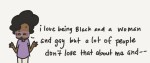

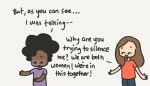



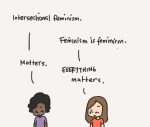


Some white women are mad about intersectional feminism the same way white men are mad when something of great importance to someone else has little or nothing to do with them.
Two non-offensive alternatives to the term “spirit animal”
- Daemon – The only one you’re appropriating is Pullman and by appropriating Pullman you’re upsetting no-one, save possibly the Pope.
- Patronus – Wizards everywhere are more than willing to lend you this term and the geekiness is an added bonus. I just read that geeks are sexy, or so the Metro, so, there you go, a patronus is clearly your next ascribed accessory.
I will reblog this over and over till everyone on my dash switches to one of these.
yupp. I use patronus.
If you are non-NDN, you shouldn’t be using the term “spirit animal.”
In the 19th and 20th centuries the apparent assumed inferiority of blacks would become cloaked in supposedly scientific racist theories, such as those of Joseph Gobineau and Adolph Hitler, which consciously echoed the earlier language of Kant. Reservations about the character of blacks, even when not spoken, have been among the reasons for limiting entry of blacks into Europe and for opposing racial mixture.
On the other hand, this low opinion has only added to the popularity of blacks as symbols, because the commercial use of blacks as symbols tended to reinforce their dehumanization. In the course of the 19th century, industries throughout the Western world began to adopt trademarks featuring blacks; for example, those for tobacco products, cleansers, coffee, liquor, rice, shoe and metal polish, and toothpaste. Those for raw materials and foods were especially prominent. These trademarks were additional embellishment of imagery already manifested in the popular culture in literature, song, and story. This seems to reflect an association of blacks with the primitive and often with the sensuous. Similar attitudes can also be seen in the appreciation of blacks as athletes and entertainers. The ambivalence of Europeans, like their white American counterparts, toward equal acceptance of blacks in major sports and the exploitation of jazz music in the 20th century are good examples.
Thus, deeply embedded stereotypes have continued to overshadow the real role of blacks in European history and culture.
How does a teacher end a course on such a gloomy note without leaving the serious student with a sense of despair? How should an instructor respond to the skeptical white student who suspects that the black professor has biased the selection of information in order to make a point; or to the embarrassed black student who believes the professor is dredging up dated, sordid history that is better left forgotten? One approach is to admit to the first that there are also negative stereotypes about whites; but they are surrounded by enough positive images to leave a more balanced perspective.
For both students’ objections, resort to a medical school analogy can be useful: examination of a diseased cadaver has great value despite all the difficulties of stomaching it, just as the history of racism must be confronted before it can be properly addressed in the present. It might also be added that what is learned in this examination may be instructive concerning other forms of social bias, beyond that involving blacks and beyond Europe.
Allison Blakely, professor of European and comparative history at Howard University, is the author of Blacks in the Dutch World (Indiana University Press, 1994) and Russia and the Negro (Howard University Press, 1986).
(via medievalpoc)
(via medievalpoc)
 Kimchi and Justice