I read about this in History of California class last semester. They also had a Filipino Repatriation Program where the U.S. government gave Filipino-Americans the choice to stay in America or get paid thousands of dollars to return to the Philippines and not be allowed to go back to America as a resident. Being that Japan invaded and colonized the Philippines after Pearl Harbor, repatriated Filipino-Americans were basically being sent into a war zone.
probably the constant reminders that throughout time and regardless of time, place, language, religion, ideology, system of governance or dominant school of thought, people remain fundamentally people
like i know that sounds really glib but it’s like – when i was doing this after alexander course last year, right, we looked at this thing called the zenon papyri, a huge stash of administrative documents from greek-ruled egypt addressed to an official called zenon, which was preserved because the winds changed and the building they were kept in was buried under a massive sand dune. and there’s one which we called the krotos papyri, which is a letter from a native egyptian writing to zenon telling him how he had been mistreated by greeks, who laugh at him because he doesn’t know how to “act like a greek” and call him a barbarian and refuse to pay him his proper wages. which is very familiar. and when you look at the actual papyrus fragment, the writing at the top is big and clear and spaced-out, but as it gets towards the bottom of the page it gets smaller and more cramped and the lines are all squint, because this nameless egyptian guy who does something with camels in the 250s BC hadn’t worked out how long his letter was going to be and he’s realised halfway through that he’s going to run out of space
and in first year i went on this trip to hadrian’s wall, and it started snowing while we were standing on it and the wind was blowing a gale right into our faces, and afterwards we heard a lecture about the vindolanda tablets, and there’s one, tablet 346, a letter to a soldier stationed there – and the soldiers stationed there could come from anywhere in the empire, rome or egypt or north africa, hot places, basically, and the wall is fucking cold – which is maybe from his wife or mother or sister, which reads as follows:
“… I have sent (?) you … pairs of socks from Sattua, two pairs of sandals and two pairs of underpants, two pairs of sandals … Greet …ndes, Elpis, Iu…, …enus, Tetricus and all your messmates with whom I pray that you live in the greatest good fortune.“
and that’s not some kind of “people don’t change” idea. people do change, have changed. you read the stuff these civilisations produced and some of it is so, so alien to us, so hard to understand, so strange. but then in amongst it you find things like people running out of space on their last bit of paper, or sending their son more socks because he’s got a job somewhere cold. and we remember it, these weird small human things, by total random chance! no-one sat down and thought ‘let’s keep this’ – the wind changes and an entire archive of papyri is preserved under a sand dune for 2000 years. the excavators who found the vindolanda tablets thought they were wood shavings. there’s a pot of roman face cream in the museum of london which still has fingerprints in the cream, which was found hidden in a ditch outside a temple. and in the meantime, we have no firsthand accounts of the campaigns of alexander, one of the most influential series of events in western history, because… we just don’t. they existed, but they’re lost. for some reason, somehow, presumably though some kind of enormous cosmic joke, we have a fragmentary letter from an anonymous person sent to an anonymous soldier telling him his pants are in the post and to say hello to his friends, but we don’t have callisthene’s deeds of alexander or ptolemy’s memoirs. isn’t that infuriating? isn’t that great?
I’ve been trying to think of a good term for the “weepy movies about tragic queer people aimed at straight audiences” subgenre, and I think I’ve got it:
dead gays for the straight gaze
eh? eh??
queers die for the straight eye
SO YOOOO who wants to learn why this is a thing because the history is actually really fascinating and ties into some of my favorite shit ever?
Okay, so like, back in the mid-twentieth century, when being queer was still totally a crime everywhere in the United States, queer writers started working in pulp fiction–starting with Vin Packer (she is awesome)–and writing pulps to tell our stories.
So one day over lunch, her editor asks her, “Hey, Vin, what’s the story you most want to write?”
And she goes, “Well, I’d like to write a love story about lesbians because I’m, you know, gay.”
He says, “Hey, that’s awesome, I will publish it. One thing, though, the homosexuality has to end badly and the main character has to realize she was never gay in the first place. We can’t seem to support homosexuality. I don’t actually think that’s cool, but the government will literally seize our book shipments and destroy them on the basis of the books being ‘obscene’ if you don’t, so if we want this story actually out there, and not burning in a bonfire somewhere, it’s what you gotta do.”
So Vin goes home and writes Spring Fire, the book that launched the entire lesbian pulp genre. And while one character ends up in an insane asylum and the other ends up realizing she never loved her at all, it’s massively successful, and queer women everywhere snap it up and celebrate quietly in their closets across the nation because HOLY SHIT THERE’S A BOOK ABOUT ME? I’M NOT ALONE and it starts a huge new genre.
But: every publisher is subject to those same government censorship rules, so every story has to end unhappily for the queer characters, or else the book will never see the light of day. So, even though lesbian pulp helps solidify the queer civil rights movement, it’s having to do so subversively or else it’ll end up on the chopping block.
So blah blah blah, this goes on for about twentyyears, until finally in the seventies the censorship laws get relaxed, and people can actually start queer publishing houses! Yay! But the lesbian pulps, in the form they’d been known previously, basically start dying out.
MEANWHILE, OVER IN JAPAN! Yuri, or the “girls love” genre in manga, starts to emerge in the 1970s, and even starts dealing with trans characters in the stories. But, because of the same social mores that helped limit American lesbian pulp, the stories in Japan similarly must end in tragedy or else bad shit will go down for the authors and their books. Once more: tragic ends are the only way to see these stories published rather than destroyed.
The very first really successful yuri story has a younger, naive girl falling into a relationship with an older, more sophisticated girl, but the older girl ends up dying in the end, and subsequent artists/writers repeated the formula until it started getting subverted in the 1990s–again, twenty years later.
And to begin with cinema followed basically the same path as both lesbian pulps and yuri: when homosexuality is completely unacceptable in society, characters die or their stories otherwise end in tragedy, just to get the movies made, and a few come along to subvert that as things evolve.
But unlike the books and manga before them, even though queer people have become sightly more openly accepted, movies are stuck in a loop. See, pulps and yuri are considered pretty disposable, so they were allowed to evolve basically unfettered by concerns of being artistic or important enough to justify their existence, but film is considered art, and especially in snooty film critic circles, tragedy=art.
Since we, in the Western world, put films given Oscar nods on a pedestal, and Oscar nods go to critical darlings rather than boisterous blockbusters (the film equivalent of pulps, basically), and critics loooove their tragedy porn, filmmakers create queer stories that are tragic and ~beautiful~ that win awards that then inspire more queer stories that are tragic and ~beautiful~ until the market is oversaturated with this bullshit.
The Crying Game? Critical darling, tragic trans character.
Brokeback Mountain? Critical darling, tragic queer (? not totally sure if they’d consider themselves gay or bi, tbh?) characters.
And so on and so on VOILA, we now have a whole genre of tragedy porn for straight people, that started out as validation for us and sometimes even manages to slip some more through the cracks occasionally, but got co-opted by pretentious ~literary~ types. While tragic ends made these stories more acceptable to begin with, and in the mid-to-late nineties that started getting subverted a little bit (Chasing Amy, But I’m a Cheerleader), eventually that became the point, as more straight audiences started consuming these narratives and got all attached to the feels they got from the ~beauty of our pain~.
Queer history is crucial
Reblogging to mention Vito Russo’s important work, The Celluloid Closet, first published in 1981. You’ll never read a more comprehensive look at American cinema and the queers. Dated now (of course) but all the more stirring for the relentless stream of tragic stories, slightly flavored here and there with characters played for laughs, horrible depictions of broken, tormented or evil people, and a few fair, reasonable or positive roles. Russo died in 1990, after issuing an updated version of the book in 1987. Always concerned with how the LGBT community was depicted in the media, he was one of the co-founders of Gay and Lesbian Alliance Against Defamation (GLAAD).
Rob Epstein and Jeffrey Friedman made a documentary from the book in 1995 and it’s lovely. Lots of clips, some interviews, it’s a real eye-opener. Amazon can stream it. (GLAAD) gives an award called the Vito Russo Award to openly gay or lesbian people within the Hollywood film industry who advance the cause of fighting homophobia.
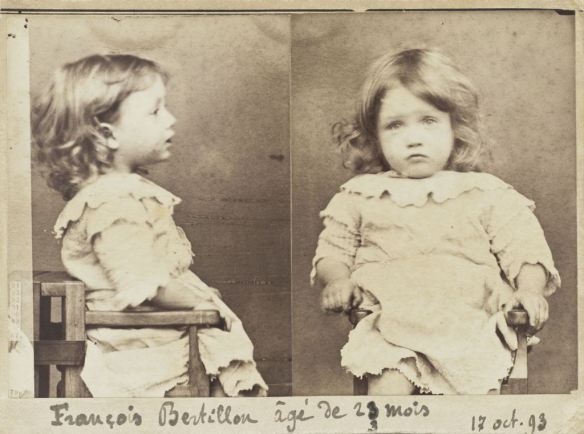
Alphonse Bertillon was a French police officer and the world’s leading expert in forensics. He’s the man that invented the mug shot. That picture of his son,
François, was a joke. His crime? Gluttony, nibbling all the pears from a basket
Here’s Alphonse’s own mug shot:
Since this turned into a bit of a history lesson, I’ll add that some of his other notable achievements in his field were the creation of the following forensic techniques: QD examination, compounds to preserve footprints, ballistics, and the dynamometer which determines the degree of force used when breaking and entering.
He’s even mentioned in The Hounds of Baskervilles, where one of Sherlock’s clients refers to Sherlock as the “second highest expert in Europe” after Bertillon. That’s saying something.
ok but i feel like after hamilton i can’t take the founding fathers seriously anymore like
mention john adams and all i think about is ‘tell my wife john adams doesn’t have a real job anyway’
mention james madison and all i think about is ‘madison u made as a hatter so take ur medicine’
mention thomas jefferson and all i think about is ‘stayin mellow doin whatever the hell it is u do in monticello’
mention george washington and all i think about is [jefferson voice] daddy’s calling’
idk this is becoming a problem
tbh I don’t really see it as a problem? like the founding fathers are not serious they’re ridiculous and petty and self absorbed and absolutely flawed human beings and i think the musical does a great job of conveying that! and it’s important is because everyone tries to portray the founding fathers as this monolithic group of intelligence and justice and bravery and they really…. weren’t. gouverneur morris literally dies by shoving a whalebone up his dick. aaron burr tries to start his own empire in the southwest and is tried for treason (and if I’m not mistaken i think one of his defense attorneys is luther martin, aka the former attorney general of maryland and most abrasive– but also most strongly anti-slavery– asshole at the constitutional convention). alexander hamilton literally tries to fight the entire democratic-republican party. like, these guys are ridiculous and they all have vastly different viewpoints and everyone glorifies them and tries to use them in their political arguments (take a shot every time u hear someone say “but the founding fathers believed” like which fucking founding father i want citations) and it’s popular media like hamilton that humanizes them, that makes people realize that they really weren’t just a bunch of boring marble statues who were somehow more enlightened or superhuman than the rest of us.
so like this is all true, but I just want to add that one of the most frustrating/hilarious parts of doing constitutional law is that a huge amount of the time when even super eminent people say “the Founding Fathers believed” they mean “the Federalist Papers say.” Aka “Hamilton specifically writing in his most propagandistic mode believed”. Aka “the man with the most opinions in the history of opinions believed, and probably no one else.”
I am mostly into (as u say @crossedwires) the mythological retelling aspect of the musical but if ONE originalist sees this show and thinks “wait…….these documents were not delicately handcrafted out of marble and a lot of the people who wrote them were habitual liars and the best interpretive guide we have to the Constitution was written by a guy whose idea of compromise was the Reynolds Pamphlet…………” I will be very satisfied.
wait can we go back to the thing about morris
you can’t just casually drop “dies by shoving a whalebone up his dick” into the discourse and then move on
[MI5 Officer] Mary Sherer met Phyllis McKenzie, who had worked for British intelligence in New York during the war, and the two women became inseparable. They lived together for the rest of their lives, ‘perfect foils for each other’. Within MI5 they were assumed to be lesbians or, rather, Lesbians [always capitalized in MI5 documents, possibly as a holdover of classical education]. Together they moved to Rome and opened the Lion Bookshop on Via del Babuino near the Spanish Steps. ‘Mary was a very fast runner and would think nothing of pursuing the rather numerous petty thieves that abounded in Rome during and after the war. She loved a challenge.’ This formidable pair of English ladies, known as ‘the Lionesses,’ spent their days surrounded by books and a large posse of dogs: Pekinese, French bulldogs, and pugs, ‘all of which Mary doted on’.
Double Cross: The True Story of the D-Day Spies by Ben Macintyre (via hesperos)
PS: now that the important stuff is out of the way I’m been doing some super interesting and possibly breakthrough science, nbd, thought you might find it interesting tho.”
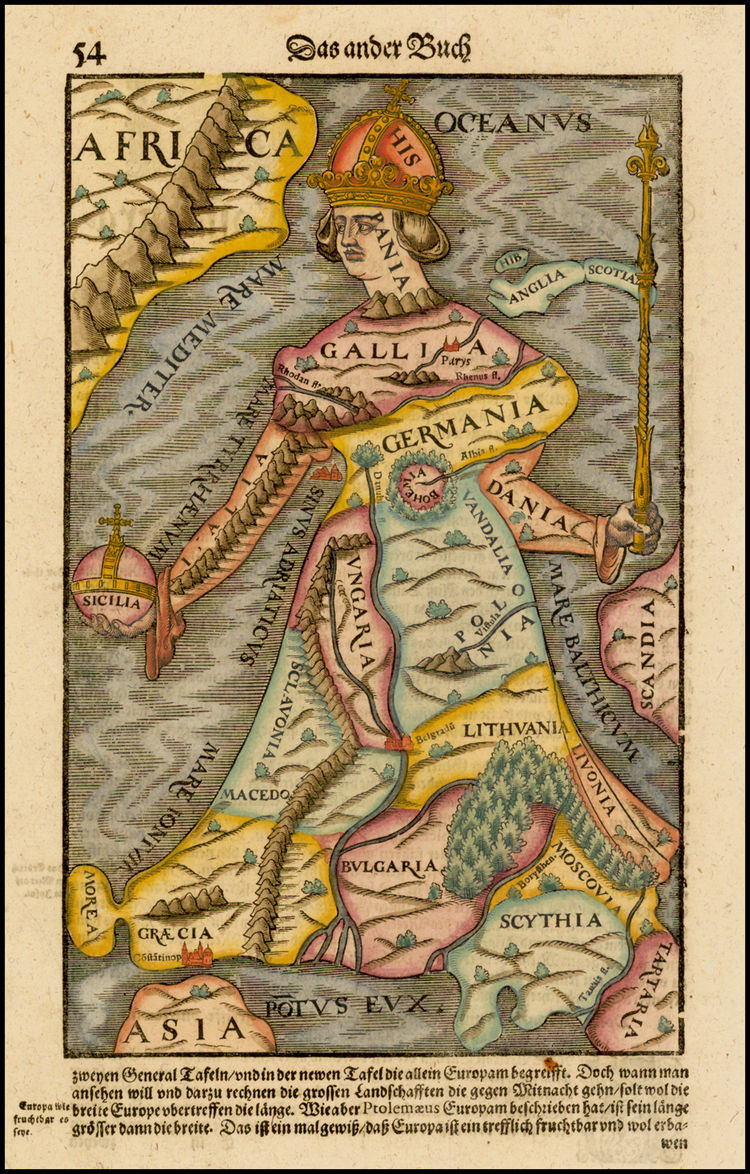
Europe as a queen: During the late 16th century, a few map makers created these now highly prized map images, wherein countries and continents were given human or animal forms.
Never forget that chainsaws were invented to aid in childbirth.
what
GATHER ROUND, FRIENDS, IT’S TIME FOR HISTORY
In 1830 a German doctor by the name of Bernhard Heine created a small, hand-cranked chainsaw called the osteotome. It was used for symphysiotomy, a procedure in which the cartilage of the pubic bone is cut to widen the pelvis to help deliver babies.