what she says: i’m fine
what she means: it’s 2 am and I can’t stop thinking about the Pied Piper. Initially i thought it was just an old faerie tale but i’ve been reading up on it and it turns out that at some point in the town of Hamelin, a bunch of children really did go missing all at once in fact a stained glass window in the local church in 1300 was made to tell the story AND Hamelin’s written history literally BEGINS in 1384 with the sentence “it is 100 years since our children left.” There are a ton of theories about what the piper could actually represent but historians are pretty much convinced that something did take away children en masse in the 1200s in Hamelin and to this day we still use the phrase “it’s time to pay the piper.” When will we pay him? Who was he???? Like okay I see the theories but what if some flute paying faerie really just led a bunch of kids away in 1284 I cannot get over this.
Tag: history ftw
Dauphin (dolphin in French) was a sort of pet name that the son of the Count of Vienne, Guigues, was given by his English mother when he was a child. When Guigues inherited the title and lands of the Count of Vienne, he formally called himself “The Dauphin,” and had a dolphin as his motif on his arms. The territory he ruled became known as the “Dauphiné.” When it was later purchased by the King of France, he gave the land, and the title, to his son and heir. Which is why to this day thee heir to the throne in France is called the “dauphin.”
Hey let’s destroy the pernicious myth that preteens were regularly marrying in medieval and early modern Europe and were having children as young teenagers. It’s just not true. Church records show the typical age people got married was around 18-23. Sure, around a third of brides were pregnant at the time of their marriage, but premarital sex was actually completely fine in medieval and early modern Europe if the couple intended to marry. (Oh look! Another historical fact the Victorian period completely mangled!)
Very young girls were not having babies in medieval times, people. The only people who ever bring this non-fact up are paedophiles looking to defend their dangerous paraphilia. So cut it out. Stop spreading this myth. It’s not historical, it’s not factual, it’s not true.
By the way the texts in support of these facts are here and here.
“Emerging evidence is eroding the stereotype of medieval child marriage. Goldberg and Smith’s work on low- and lower-middle-status women has refuted Hajnal’s argument for generally early marriage for medieval women. Even Razi’s ‘early’ age at marriage for girls in Halesowen hardly indicates child marriage, as a large portion of his sample married between the ages of eighteen and twenty-two… . Goldberg has offered evidence from fourteenth and fifteenth-century Yorkshire showing that urban girls tended to marry in their early to mid twenties and rural girls married in their late teens to early twenties, and both groups married men who were close to them in age.” (Kim M. Phillips, Medieval Maidens: Young Women and Gender in England, c. 1270-1540, p. 37 (x).
Bolded for emphasis.
As far as i can recall, the only instances of child marriages in the Middle Ages i ever remember reading about were amongst the nobility, where marriages were arranged for political advantage over any other consideration. (And even in those cases, contracts frequently specifically stated that the marriage was not to be consummated for several years.)
I think a lot of the problem in conceptions comes from the way history has often been written. It’s only relatively recently that the “common people” have been considered worthy of consideration when writing history – for a lot of the span between the Middle Ages and now, history was basically a genealogy of rulers ( in the words of Barbara Tuchman). the concerns of the lower classes were basically ignored – and a side effect of this is that the habits of the documented group are assumed to be representative of all groups. So, yeah, child marriages existed – but they existed among a tiny minority of the population whose daily lives and concerns were wildly different from those of everyone else.
Before I go to bed tonight, I want you all to know that I spoke to Barbara Howard (founder of the Women on 20’s movement) earlier and she told me that the Treasury is apparently super embarrassed that they launched a campaign to change the $10 right when ‘Hamilton’ became popular
They called it “that play in New York” and their PR department is reeling so badly that Secretary Lew has had to backtrack and say that “a woman will be on the currency” rather than “a woman will be on the ten” whenever people ask about it
She also said that they’ve been flooded with emails from Hamiltonians, fans of the musical, and Andrew Jackson’s actual descendants supporting Hamilton and condemning Jackson (his own family!! wild!!)
Anyway isn’t that just the best thing
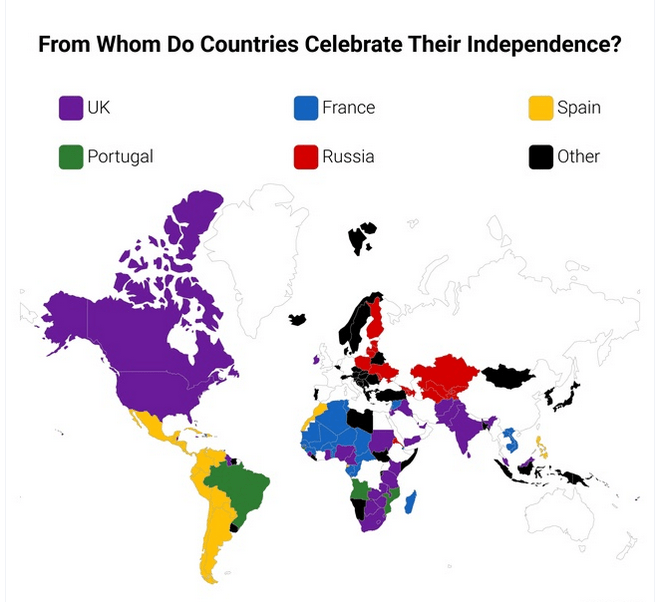
From whom do countries celebrate their independence?
#OH WEIRD #DO SOME COUNTRIES NOT HAVE AN INDEPENDENCE DAY #HAVE LITERALLY NEVER THOUGHT OF THAT BEFORE #FUCKIN COLONIALISM ON A MAP RIGHT HERE (via @thetimesinbetween)
America is now wholly given over to a damned mob of scribbling women, and I should have no chance of success while the public taste is occupied with their trash—and should be ashamed of myself if I did succeed.
nathaniel hawthorne whining and pissing himself in eighteen fifty five over the fact that women were writing better and more popular stories than his shit shit shit trash shit piece of shit awful didactic shit novels (via sashayed)
this again bc //selfie culture// in 1855
(via bananaleaves)
#REAL TALK #women have been very successful writers since the eighteenth century at least#like commercially #making bank #and COMPLETELY COINCIDENTALLY around the same time we see the rise of a new definition of ‘culture’ #that begins to separate out the idea of ‘real’ art from commercial success #HMMMM #always distrust that rhetoric #100% of the time (via zlot)
^^^^^YEP. i think a lot of people are under the impression that like, the reason there are so few women on class reading lists and in anthologies when it comes to pre-WWII american literature is just because it was difficult and rare for a woman to get writing published, and extra hard for a woman to become a critical and/or popular success as a writer. THIS IS LITERALLY A HUGE LIE.
in america in particular, during the nineteenth and early twentieth centuries it’s super common to see literary magazines publishing more poetry and fiction written by women than by men. the number of women publishing books of poetry, essays, fiction, social commentary, you name it, was like…ridiculous it’s so big. an actual fuckton of the best-selling american novelists, poets, and essayists of the nineteenth century were women. and this carries through into the beginning of the 20th century. and it’s not solely upper-class white women getting published: between like, 1860-1935/40, a number of black women were publishing works of fiction, non-fiction, and poetry, a few native american women were getting published, LITERALLY LIKE A MILLION “pioneer moms” published memoirs (so. many. pioneer. mom. memoirs.), and working class women were writing nonfiction, social commentary, memoirs, and poetry. SO MUCH THINGS.
the reason this isn’t reflected in people’s class reading lists or in big “canon” anthologies is basically because pretentious “literary” white mens have spent the last half-century or more writing AND teaching that ENTIRE nineteenth century genres/styles of literature are the definition of trashy bad unoriginal cliched writing.
and those ENTIRE genres/styles they summarily kicked out of the “real literature” club just happen to be disproportionately made up of works written by women. so much very coincidences, right? hahahaha NOT. just some 100% prime calculated misogyny, racism and classism.
but it’s not like i have feelings about that or anything. nope. no feelings here. feel free to move along, nothing to see here, have a nice day.
Women have always been healers. They were the unlicensed doctors and anatomists of Western history. They were abortionists, nurses, and counselors. They were pharmacists, cultivating healing herbs and exchanging secrets of their uses. They were midwives, travelling from home to home and village to village. For centuries women were doctors without degrees, barred from books and lectures, learning from each other, and passing on experience from neighbor to neighbor and mother to daughter. They were called “wise women” by the people, witches or charlatans by the authorities. Medicine is part of our heritage as women, our history, our birthright.
Witches Midwives and Nurses: A History of Women Healers – Barbara Ehrenreich & Deirdre English (via northernmade)
imagine if steampunk was “actually” punk and not just fucked up empire fetishism
#i think about this a lot #steampunk is based on the idea that the world wars never happened and the industrial revolution never stopped #so imagine that the social movements that were born in the aftermath of ww1 and 2 never happened #imagine if steampunk focused on the colonised countries and the secret technologies and hidden gagdets #that the resistance work on; bitter and disillusioned they cut open their hands on whatever metal gears they could sneak off #to build whatever kind of weapons they can cobble together to defend themselves against the white colonisers #imagine if steampunk focused on the disastrous consquences of a white supremacy that cannot be stopped in its tracts #b/c let’s face it; this is a much more likely to turn into a world-wide dystopia than anything cyberpunk gave us #cyberpunk was about the struggle for personhood in a corporate-dominated future but so many stories are white power fantasies #imagine if steampunk was about the struggle for personhood in colonialism disguised as gentility (via stardust-rain)
The Victorian Era was not just a time of rampant colonialism, but of counter colonial movements and social justice. This was the time that saw the rise of Socialism, women’s suffrage movements as well as the first movements towards racial equality. Some of this shows up in the history as well as the literature.
This is something that gets buried, and something that fascinates me about this particular era in history.
If we’re rewriting the laws of physics, can’t we rewrite history so that the British Empire never existed and Britain made it’s wealth by selling awesome inventions and it’s cool and multicultural?I started writing a buncha words about alternate history and then decided to make them their own post, but in essence: Yes.
Real life Victorian Britain was surprisingly diverse. There’s a veil that disguses the actuality of the day from us, and it’s the reams of writing that British Victorians produced about how they felt the world should be.
It was a world of unceasing change where strangers from overseas were moving into the “homeland” and life was becoming increasingly global. Third sons who once might have gone to London or the Continent were going to India to make their fortunes. Goods were being imported from across the ocean – by the end of the 19th century, meat was successfully being imported to London from America and Australia. It felt like the world had gotten bigger overnight, and that it was filled with people who shared no common customs with good ol’ Englishmen. Change was happening at what felt like an ever-increasing rate, and the human effects were visible all around. If you ventured into the East End of London, you would see a sea of non-English faces, and you might not hear English spoken all day.
And that was fucking terrifying to many middle-class white Britons. It felt like too much, too soon, and dozens of writers pushed back against the individual issues they were disturbed by. Sometimes this was poverty and the mistreatment of workers in an increasingly mechanized world. Sometimes it was non-white immigrants existing and women moving from at-home cottage-level work to factories.
If I had to define Victorian Britain in one word, it would be backlash. That intense focus on propriety, privacy, keeping oneself to oneself, all of it grew out of backlash against the rapidity of the industrial revolution going on all around, and to the “looser” moral codes of the 18th century. There was a feeling that things had gone much too far and it was time to refocus on the “traditional” home and traditional English way of life (do I have to tell you that they were inventing these things as they were praising them). And when I say English I mean English. Wales was pretty thoroughly Anglicized, ditto Scotland, and Ireland continually restless and very angry at being under the English thumb.
That’s why all those writers you read are hammering so hard for non-whites to be kept ground down, for women to stay in the home, for men to take up the white man’s burden, for “traditional Englishness” to remain paramount. They were scared of the progress that was actually happening.
A lot of steampunk writers stop at the surface layer of what writers wanted their time and place to be, and just rewrite every shitty Victorian novel you ever read, but with gears glued on things. Very few look further and realize that there was only a thin scrim of that uptight Victorianism, that its maintainers fought very hard to keep it there, and that there’s every bit as much exciting unrest and rapid change to pick at in Victorian London as there is in any given cyberpunk setting.
 Kimchi and Justice