Henry never really wanted to marry Anna von Kleefes in the first place. He was cajoled and coaxed into it by his council. He was, after all, a king and his marriage ought to bring some benefit his kingdom. Henry whined about it. he even tried to get other nations to send their princesses so he could look them over in person before deciding, something that would cause deep personal embarrassment to the women rejected and to their kingdoms, but Henry thought he should be an exception to a thousand years of royal marriage traditions.
Their first meeting was a disaster of epic proportion. He wouldn’t wait for Anna’s party to arrive and for them to be formally introduced. He was impatient to meet her and wanted to “nurture love” by getting to know her before she reached London. He decided to play one of the pranks of his youth, the games he used to play with Katharine of Aragon. In those long-ago days, he would dress up as a highwayman and invade Katharine’s chamber, demanding to dance with the queen. Katharine always pretended to be surprised when he took off his disguise.
Henry dressed himself in a “mottled,” or ragged, cloak and hood, and went to Rochester. He called aside her steward and announced he had come to meet his new wife. Henry may have been remembering the romantic stories of French and early English monarchs who had first checked out their brides while in disguise and then revealed themselves to them. The romantic outcome was that the princess was supposed to fall in love with the “stranger” because their hearts would know one another, even if their eyes were fooled.
Did anyone tell the king it might not be a good idea to “introduce” himself in such a way to a girl who came from a far away land that didn’t have the same courtly traditions, and hadn’t read the same romances he had? If they did, it didn’t deter him.
Anna was in her chamber, gazing out her window, watching a bear-baiting outside staged for her amusement. Henry entered and announced he had a gift for her from the king. With that, he grabbed her into his arms and kissed her.
Anna was shocked at being manhandled by this obese, uncouth peasant. It’s not hard to imagine she had a look of disgust on her face as she recoiled. She turned away from him and stared out the window, likely unsettled and unsure of what to do.
It was probably the only time Henry had ever seen a look of repulsion aimed in his direction. He was surrounded at all times by trained courtiers who gazed at him in adoration and assured him he still was the most handsome prince in Christendom. Anna brutally shattered that illusion in a single moment. She did not swoon and fall instantly in love with him. She did not pretend coy delight. She showed him – stripped of courtly pretense or artifice – what she thought of him, and it wasn’t flattering.
What must Anna have been thinking? It must have been bewildering and frightening to her. She was a royal princess who had just been assaulted in her new homeland, and no one was doing anything about it. Her servants hadn’t thrown out the stranger. Was this the kind of lack of respect she would have to learn to expect here?
Henry left the room and returned dressed in his kingly robes. Anna was deeply embarrassed; Henry probably was, too. But he played his part.
And when the lords and knights saw his grace they did him reverence…. and then her grace humbled herself lowly to the king’s majesty, and his grace saluted [kissed] her again, and they talked together lovingly…
Behind the scenes, Henry was fuming. His pride had suffered a brutal blow, and as Henry usually did when hurt or angry, he deflected it on others. Anna was the one who was repulsive, not him!
“I like her not! … She is nothing as well as she was spoken of.”
Henry had a litany of complaints about his new bride. She looked old. She smelled bad. Her clothes were terrible. He added darkly, “I am not well handled.”
He began to blame those who had “deceived” him into marrying her, and as his courtiers usually did, they hastened to agree with him that Anna was hideous. However, disinterested parties such as the French diplomat, Charles de Marillac, described Anna as beaulté moyenne, “medium beauty,“ which is better than he rated Katheryn Howard, who Henry thought was a knock-out.
Henry tried to wriggle out of the marriage, scrambling to find reasons why it might be invalid. But nothing could be uncovered. All of her paperwork was in order. Henry whined:
“Is there no other remedy, but that I must needs, against my will, put my neck in the yoke?”
Henry was deeply resentful when forced to do anything, but in this case, there was no escaping it. To annul the proxy marriage that had already taken place when she reached English shores and eject Anna from England would be to alienate his new German allies, whom he needed desperately since the Emperor was now allied with the French. Another way would have to be found to rid himself of her.
Oddly, he never blamed the portrait’s artist, Hans Holbein, or said the portrait was inaccurate. Henry continued to give him commissions. It was Cromwell who would bear the brunt of the king’s displeasure.
I always wondered why he wasn’t angry at Holbein! That is so odd! I mean if it was truly an inaccurate depiction you’d think that’s who he’d be angry with, not Cromwell.
Oh, Henry did even worse than that. He also said, and I`m not kidding, that her breasts were so saggy that he didn`t believe she was a virgin.
WTF, Henry VIII? You disgust me beyond words.
Yeah seriously! And no one mentioned what she thought of him, i mean whatever he found wrong with her, she had it a LOT worse than he did!
Yes. At least she had manners.
Like I just said – I edited my response just now – somehow I wish Margaret Beauford would still have been alive when that happened. I can just about imagine her reaction.
And Henry`s mama wouldn`t have been pleased either.
It`s bad enough he divorced her for such ridiculous reasons – and completely selfish reasons at that – but that he had to be so absurdly offensive about it! Imagine poor Anna – suddenly everyone was discussing intimate details, calling her ugly, smelly etc.
Oh, he got even MORE uncouth than that. After he told his doctors he hadn’t consummated his marriage because her breasts were saggy and there were “other tokens” that made him doubt her virginity, he got a little nervous lest someone think he wasn’t “up to the task,” so to speak. Henry was VERY touchy where his virility was concerned.
He could do it, he assured them, just not with Anna. He told his doctors that he had not just one, but two wet dreams that night while he lay next to his untouched bride.
Anna may have heard the king was casting aspersions on her chastity, so she decided to subtly fight back and defend her reputation. When Jane Parker, Lady Rochford, asked her about the possibility of an heir, Anna said that the king came to her every night and kissed her hand before going to sleep. Wasn’t that enough?
It’s doubtful Anna was actually ignorant of how babies are made. (Unlike the Victorians, people of the Tudor era didn’t equate sexual ignorance with sexual innocence.) Anna was pointedly saying, “I’m such a virgin, I don’t even know what sex is.” This became important later in the annulment proceedings, because Anna had to be untouched if the king was going to claim non-consummation. And so Jane’s recollection of the conversation was included in the records.
Henry probably regretted those nasty comments about Anna’s droopy breasts when it came time to annul the marriage.
Anna did have manners, and more importantly, she had brains. When the commissioners came to her with the annulment papers, she fell into a dead faint, likely terrified it was a warrant for her arrest. When she found out what the king was proposing, she pretended reluctance to lose such an awesome husband, but agreed to his terms. Henry was flattered, and so he was generous to her afterwards. She kept his favor, and he actually turned to her for advice on a few occasions, so impressed with her grasp of European politics that he said he wished he could make her a council member.
After Katheryn Howard was executed, Anna pretended to want to become Henry’s wife again, going as far as to encourage some ambassadors to approach the king about it. She made sure that her “interest” in remarrying Henry was public. It was so well known that a pamphlet was printed on the Continent, bemoaning Anna’s sad and lonely fate of being without her husband.
Henry rejected her again, of course, but his ego had been stroked, the benefits of which outweighed any embarrassment Anna might have had at this very public second rejection. She remained firmly in the king’s favor, which was the important part. After that, she retreated from court to her new estates where she had a jolly good time, by all reports. She was well-liked, had many friends, and was financially independent. In the end, Anna was the most fortunate of Henry’s wives.
Wooooow….
(Though expecting sense and logic out of Henry VIII at that point is just … yeah, he didn’t have any left, if he’d ever had any at all.) (Anna has always been my favourite, and very likely the only woman to get away from Henry undamaged; Katharine Parr lived, but, well. Undamaged is not how I’d describe her.)
We’ve gotten a ton of requests to talk about the Ghost Army lately, probably because of an article at Mental Floss called “The Most Amazing Lie in History.” It is amazing, and today’s episode is a totally different angle on the story. During World War II, the U.S. Army formed a top-secret military unit with one goal: Use artistic and theatrical skills to confuse the enemy. And while the inflatable tanks used to this end get most of the publicity, there was a lot more to this (very effective) deception.
do you think in the 1700s there were people who were like nah man Mozart’s a total sellout I only listen to peasants beating things with sticks it’s way more authentic
I know this is a joke post but as a music major I can actually answer this with a resounding YES THIS HAS LITERALLY ALWAYS BEEN THE CASE
When the violin was invented people were pissing on its tone for being too loud and it lacking the ‘authenticity’ of the viola da gamba. People (especially French people) reacted to new Italian technologies like the freaking violin like Vivaldi was part of a heavy metal band– which would have been awesome, by the way.
Also, in the romantic period, literally every single symphony ever had a “pastoral” section where the strings are supposed to sound like bagpipes to imitate the pure, rural peasant life and reject the upper class for being too materialistic.
The long and short of it is music listeners have always been assholes and humanity is exactly the same way it was in the 1600s. Hell, when the REALLLY early French composers first heard the interval of a third (brought over from England) they were like “WHAT IS THIS DEVILRY, THE ONLY PURE INTERVALS ARE THE FOURTH AND FIFTH.” That’s right. The interval “do”-“mi” was too new age shit for them to handle.
I was watching the Stonewall Uprising documentary and the name Marsha P. Johnson was not mentioned once considering she was a leader of the 1969 Stonewall Riots. So I felt like posting these Polaroids of her taken by Andy Warhol to show remembrance of her as the significant trailblazer that she was in making the Stonewall Riots happen. It’ll be 46 years since the riots on June the 28th and 45 years since the first gay pride march took place in New York City as a result of the Stonewall Riots. Thank you Marsha. RIP.
In the 19th and 20th centuries the apparent assumed inferiority of blacks would become cloaked in supposedly scientific racist theories, such as those of Joseph Gobineau and Adolph Hitler, which consciously echoed the earlier language of Kant. Reservations about the character of blacks, even when not spoken, have been among the reasons for limiting entry of blacks into Europe and for opposing racial mixture.
On the other hand, this low opinion has only added to the popularity of blacks as symbols, because the commercial use of blacks as symbols tended to reinforce their dehumanization. In the course of the 19th century, industries throughout the Western world began to adopt trademarks featuring blacks; for example, those for tobacco products, cleansers, coffee, liquor, rice, shoe and metal polish, and toothpaste. Those for raw materials and foods were especially prominent. These trademarks were additional embellishment of imagery already manifested in the popular culture in literature, song, and story. This seems to reflect an association of blacks with the primitive and often with the sensuous. Similar attitudes can also be seen in the appreciation of blacks as athletes and entertainers. The ambivalence of Europeans, like their white American counterparts, toward equal acceptance of blacks in major sports and the exploitation of jazz music in the 20th century are good examples.
Thus, deeply embedded stereotypes have continued to overshadow the real role of blacks in European history and culture.
How does a teacher end a course on such a gloomy note without leaving the serious student with a sense of despair? How should an instructor respond to the skeptical white student who suspects that the black professor has biased the selection of information in order to make a point; or to the embarrassed black student who believes the professor is dredging up dated, sordid history that is better left forgotten? One approach is to admit to the first that there are also negative stereotypes about whites; but they are surrounded by enough positive images to leave a more balanced perspective.
For both students’ objections, resort to a medical school analogy can be useful: examination of a diseased cadaver has great value despite all the difficulties of stomaching it, just as the history of racism must be confronted before it can be properly addressed in the present. It might also be added that what is learned in this examination may be instructive concerning other forms of social bias, beyond that involving blacks and beyond Europe.
Fun fact: Though being gay in the 40s sucked, being gay in the military was easier, and pretty common. There were apparently, at one point in time time so many lesbians in the military that when they tried to crack down on it, the girls wrote back and said “Look I can give you the names, but you’ll lose some of your best officers, and half your nurses and secretaries.” And they pretty much shut up about it unless you were especially bad at subtlety. (Source: Odd Girls and Twilight Lovers. A good source for gay history from 1900s onwards.)
Sergeant Phelps worked for General Eisenhower. Four decades after Eisenhower had defeated the Axis powers, Phelps recalled an extraordinary event. One day the general told her, “I’m giving you an order to ferret those lesbians out.’ We’re going to get rid of them.”
“I looked at him and then I looked at his secretary. who was standing next to me, and I said, ‘Well, sir, if the general pleases, sir, I’ll be happy to do this investigation for you. But you have to know that the first name on the list will be mine.’
“And he kind of was taken aback a bit. And then this woman standing next to me said, ‘Sir, if the general pleases, you must be aware that Sergeant Phelps’s name may be second, but mine will be first.’
“Then I looked at him, and I said, ‘Sir, you’re right. They’re lesbians in the WAC battalion. And if the general is prepared to replace all the file clerks, all the section commanders, all of the drivers—every woman in the WAC detachment—and there were about nine hundred and eighty something of us—then I’ll be happy to make the list. But I think the general should be aware that among those women are the most highly decorated women in the war. There have been no cases of illegal pregnancies. There have been no cases of AWOL. There have been no cases of misconduct. And as a matter of fact, every six months since we’ve been here, sir, the general has awarded us a commendation for meritorious service.’
“And he said, ‘Forget the order.’
– The Gay Metropolis: The Landmark History of Gay Life in America
I’ve reblogged this before but it didn’t have these comments and HOLY HOT DAMN DID IT NEED THEM.
… by which I mean Person A slipping something into Person B’s food or drink; accidents, industrial problems, and medical murders are outside the scope of this essay.
Classically, poisoning was seen as a woman’s weapon; manly men just stabbed you or whapped you over the head or strangled you, as one does. Poisoning was sneaky and evil because you didn’t, however briefly, see it coming. For 17 years in the 16th century, poisoning was prosecuted as high treason and earned you death by boiling. (Presumably without arsenic or other additives.) Anybody who reads Golden Age murders will be intimately familiar with the varying symptoms of arsenic, strychnine, digitalis, and various substances unknown to science – the last being also outside our scope.
Nowadays you’re much more likely to be shot (in the U.S.) or blunt/pointy/flammable objected (elsewhere) than poisoned. This makes murder mystery authors sad. What happened?
Easy divorce
Improved availability of contraception
Physical mobility of the population
Regulation of poisonous substances
The birth of forensic medicine
For much of English and American history, most of the population were stuck wherever they were brought up. In particular, many people lived in multi-family houses, with the resource-controlling ancestors, descendants, and a passel of babies all stuffed together under one roof. If you couldn’t stand your mother-in-law, too bad; she was going to be sneering at the dinner table until she passed on, and frankly she was healthier than you were. If your husband was beating you or just driving you up a tree, too bad; “till death do us part” was pretty much the rule, unless you were male, very very wealthy, and able to buy a divorce. If you kept having babies you couldn’t feed, abortion was haphazard and depended on knowing the right people/plants.
All of these problems were most easily solved by murder. You couldn’t move away; you couldn’t divorce and remarry; you couldn’t stop the babies coming. (For babies, there was the bonus that you could insure them and collect the money.) You were stuck with your family. If female, you were at least supervising and very likely cooking the meals. The solution was obvious. The solution was made even more obvious when you consider that most households contained lethal substances for killing flies, rats, and weeds. You would naturally keep arsenic around to solve these problems, as well as for cosmetic uses. You got arsenic – or strychnine, or prussic acid, or whatnot – by strolling up to the apothecary and requesting it. If questioned, you’d just explain that you wanted to get rid of rats; you would prudently not append “Like the one I married”.
Irritant poisons, like arsenic, do nasty things to the digestive system, causing noxious substances to issue from both ends. However, in a pre-sanitation age, people died of gastrointestinal ailments all the time. If no doctor is called, or if the doctor isn’t suspicious, there’s no reason to think that the guy who just died was poisoned. (Strychnine being a quite spectacular exception.) Even if the servants or the doctor are suspicious, the only way to prove that the food was poisonous is – if somebody saved the food or the fluids – to feed them to an unfortunate animal, usually a dog.
So, motive, means, and opportunity. The authorities tried to give the poisonee (or his/her estate) a sporting chance by regulating the sale of certain poisons. Arsenic had to be colored so that it was easily distinguishable from sugar or salt or whatever; people who bought certain poisons had to register at the place of purchase. The major change, however, was the invention of forensic testing; Wikipedia has a nice summary of the progress in detecting arsenic. (Readers of Dorothy Sayers’s Strong Poison will be familiar with the Marsh test.) Detecting arsenic and other inorganic chemical compounds happened fairly early; detection of strychnine, digitalis, and so on required substantial advances in chemistry. As sanitation moved on, there were far fewer “gastroenteritis” deaths, and so poisonings were less-well camouflaged. By the mid-19th century, at least in urban areas, poisoning somebody had a higher, if by no means absolute, risk of sending you to the gallows.
And now we come to mobility, divorce, and contraception. Trains made it far easier for the middle classes to move from one city to another; labor migration to the cities made it easier to move from one house/apartment to another. Again for the middle classes, the gradual loosening of divorce laws made it much more possible to get away from your horrible spouse. And contraception made it possible to prevent a crowded house before rather than after the birth. Banning the insurance of infants removed a financial incentive. Put all these together, and it’s much harder to write a cozy poisoning in 2015 than in 1925.
I highly, highly recommend Katherine D. Watson’s Poisoned Lives: English Poisoners and Their Victims and Deborah Blum’s The Poisoner’s Handbook: Murder and the Birth of Forensic Medicine in Jazz Age New York if you want to know more about the sociology of poison in the United Kingdom and the USA.
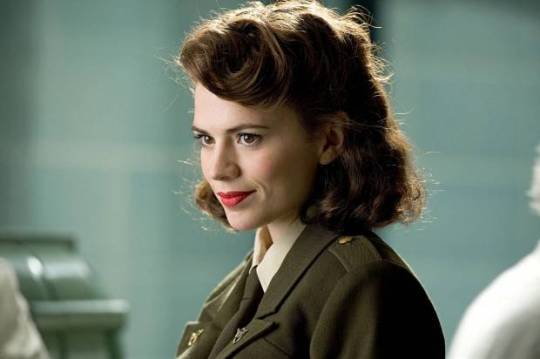
How the heck did her hair get braided like that? Did she and the other officers just have a braiding train at night? ????
do you think Peggy carter needs anyone to braid her hair? she does it herself. The right hand’s nail polish? my girl has it covered. Zipping and unzipping the back of the dress? pff… Peggy Carter can do anything. Liquid Eyeliner? in one try. Peggy carter can do anything.
anything.
a n y t h i n g.
That’s not a braid. It’s a roll. It is one of the most beautiful hair styles to come out of the 40s and is incredibly simple. The hair styles you should be impressed with are these.
Waves: I had a 1920s themed dance last month, and I wore my hair in waves. I sat in a chair with a professional stylist for AN HOUR for FOUR of those beauties. I see at least eight. And she does those regularly for work.
Victory curls: I can do victory curls. Two, to be exact. Not counting practice, I have worn my hair in V-curls exactly twice. It took me an hour and a half last time, and I didn’t even curl the ends, just two v-curls on the top of my head, and they weren’t nearly this amazing. Again, another casual work look.
Do you think Steve curled her hair? Fat chance. Be in awe of Peggy Carter. Be in awe.

 Kimchi and Justice