An announcement regarding the tomb of Aristotle in Ancient Stageira in northern Greece was expected to be the highlight at an international conference held in Thessaloniki on Thursday.
International delegates attending the “Aristotle 2400 Years” World Congress on Thursday were expected to hear that archaeologists carrying out a 20-year excavation at the ancient Macedonian city believe the site’s most important finding to be the Greek philosopher’s tomb. Aristotle, who was born in the same city in 384 BC, died in Evia in 322 BC.
The conference is organized by the Interdisciplinary Center for Aristotle Studies of the Aristotle University of Thessaloniki. (source)
So while doing some pirate research for the play I’m writing I stumbled upon one of the most amazing things I’ve ever read. In the 5th century A.D. there was a Scandinavian princess called Alwilda who’s father tried to set her up to marry Alf, the Prince of Denmark. Alwilda wasn’t cool with this so she and some female companions dressed as men, stole a ship, and sailed away. Eventually they met a company of pirates who were in need of a new captain and they were so captivated by her that they elected her as their new leader. Her crew became so infamous that Prince Alf was sent out to stop them. When their ships met he took Alwilda prisoner and she was so impressed by Alf’s skill that she agreed to marry him after all and eventually became the Queen of Denmark.
I stopped caring whether this was factually accurate about halfway through because it’s completely AWESOME.
Medievalist here for triumphant fact-checking: this story is, if not true, at least true according to the history of the Danes (Gesta Danorum) written in the 12th century by Saxo Grammaticus. You can read his account of Alwilda’s story in the original Latin here, or in English translation here. Highlights include:
She exchanged woman’s for man’s attire, and, no longer the most modest of maidens, began the life of a warlike rover. Enrolling in her service many maidens who were of the same mind, she happened to come to a spot where a band of rovers were lamenting the death of their captain, who had been lost in war; they made her their rover captain.
I love the implication that there were lots of Danish maidens just WAITING for the opportunity of a life of piracy…
Reblogging my old post for this A+ addition to it
Sweet mother, I cannot weave –
slender Aphrodite has overcome me
with longing for a girl.
This is probably going to get me some odd looks, but this makes me think about Jane Austen!
It’s so funny, but so deeply dependent on this specific moment in time, in 2016, when Adele is all over the damned radio, and nobody (in this really specific cultural sphere) needs context for the joke, and part of the joke is that nobody needs context for the joke.
There’s a bit in Pride and Prejudice where Elizabeth and Caroline are walking on the grounds at Netherfield, and they bump into Darcy and Mrs. Hurst. Caroline, who’s trying really hard to get Darcy to put a ring on it, immediately attaches herself to his free arm, leaving Lizzie kinda awkwardly stranded, since the path in the garden is only wide enough for three. Darcy’s embarrassed by this blatant rudeness, and tries to say, “Hey, let’s go walk someplace else, where we can all fit,” but Lizzie, who thinks they’re all a bunch of boring losers and wants an excuse to ditch them, retorts, “You are charmingly group’d, and appear to uncommon advantage. The picturesque would be spoilt by admitting a fourth.”
The year Austen wrote P&P, everybody was obsessed with this guy named William Gilpin and his ideas about art and nature appreciation. “Picturesque” was the word used to describe ideal landscapes, and by ideal Gilpin et al literally meant things like “that hill is adorned with the correct number of cows.” Three is a pleasing number for cows on hillsides (and otters on otterslides!); four is gauche.
And that example was so well known that that is certainly what Lizzie was alluding to, and all four characters, and most of Austen’s educated readership, would have known it. Lizzie just called them a bunch of cows and ran off.
This is why Jane Austen is my favourite.
Tumblr, you are my other favourite.
This has been a post.
And in a maybe-nicely-circular moment, @stultiloquentia, I didn’t even parse what the picture was saying until I read you saying ‘Adele’…
On this day in 1881, the nurse Mary Seacole died in London aged
76. Originally from Jamaica, the young Mary was taught her nursing
skills by her mother. When war broke out in the Crimea, she applied to
give medical assistance to wounded servicemen but was refused, and so
gave treatment independently. Her patients admired ‘Mother Seacole’ and
helped raised money for her after the war when she was left destitute.
Despite her exemplary national service and popularity in Britain,
Seacole faced discrimination at home due to her race, and was unable to
vote or hold public office. She has thus often been forgotten and placed in
the shadow of famous Crimean War nurse Florence Nightingale, however, in
2004 Seacole was voted the greatest black Briton.
Okay, this is in incredibly petty nitpick, but: if you’re writing a fantasy setting with same-sex marriage, a same-sex noble or royal couple typically would not have titles of the same rank – e.g., a prince and a prince, or two queens.
It depends on which system of ranking you use, of course (there are several), but in most systems there’s actually a rule covering this scenario: in the event that a consort’s courtesy title being of the same rank as their spouse’s would potentially create confusion over who holds the title by right and who by courtesy, the consort instead receives the next-highest title on the ladder.
So the husband of a prince would be a duke; the wife of a queen, a princess; and so forth.
(You actually see this rule in practice in the United Kingdom, albeit not in the context of a same-sex marriage; the Queen’s husband is styled a prince because if he were a king, folks might get confused about which of them was the reigning monarch.)
The only common situation where you’d expect to see, for example, two queens in the same marriage is if the reigning monarchs of two different realms married each other – and even then, you’d more likely end up with a complicated arrangement where each party is technically a princess of the other’s realm in addition to being queen of her own.
You’ve gotta keep it nice and unambiguous who’s actually in charge!
Okay, I’ve received a whole lot of asks about this post, so I’m going to cover all of the responses in one go:
1. The system described above is, admittedly, merely one of the most common. Other historically popular alternatives include:
The consort’s courtesy title is of the same rank as their spouse’s, with “-consort” appended to it: prince and prince-consort, queen and queen-consort, etc. This is how, e.g., present-day Monaco does it.
The consort is simply styled Lord or Lady So-and-so, and receives no specific title. I can’t think of any country that still does it this way, off the top of my head, but historically it was a thing.
(Naturally, your setting needn’t adhere to any of these, but it would be highly irregular for it to lack some mechanism for clarifying the chain of command.)
2. The reason why the consort of a prince is historically a princess even though those titles are the same rank is basically sexism. This can go a couple of ways:
In many realms, there was no such thing as being a princess by right; the daughter of a monarch would be styled Lady So-and-so and receive no specific title, so the only way to be a princess was to marry a prince.
In realms where women could hold titles by right, typically a masculine title was informally presumed to outrank its feminine counterpart. So, e.g., kings outrank queens, princes outrank princesses, etc.
In either case, no ambiguity exists.
(Interestingly, this suggests that in a more egalitarian setting where masculine titles are not presumed to outrank their feminine counterparts, or vice versa, you’d need to explicitly disambiguate rankings even outside the context of same-sex marriages. Food for thought!)
3. It would also be possible to have two kings or two queens in the same marriage without multiple realms being involved in the case of a true co-monarchy. However, true co-monarchies are highly irregular and, from a political standpoint, immensely complicated affairs. If you’re planning on writing one of those, be prepared to do your research!
4. The next rank down from “countess” is either “viscountess” or “baroness”, depending on which peerage system you’re using.
(Yes, that last one actually came up multiple times. Apparently there are a lot of stories about gay countesses out there!)
I had kind of a nerd-out this morning. But I felt like everyone needed to know about this.
I feel the need to drop some Black history on y’all since we on the subject of hair in the 1700s: in New Orleans/Louisiana slave women could hire themselves out (meaning they worked for someone other than their masters but the master kept a portion of the pay and the rest they kept to pay for their own upkeep) as hairdressers. Many of them made enough to buy their way out of freedom. And the fancy hair thing was huge in New Orleans among the Creole and free Black people. Their hairstyles were so elaborate and beautiful in the 1700s and 1800s that a law was passed requiring WoC to cover their hair in public. After this law WoC started rocking fancy and elegant fabric for hair wraps.
on the Northern side of things free Black women owned wig factories as early as 1700s in New England
First of all, this is not an argument that women’s armor in media should be the same as dudes’ armor. Most main characters are supposed to look attractive most of the time they’re on screen; whether because of social or biological conditioning, the bulk added by armor on dudes’ chests and shoulders hottens them up. Dudes in practical armor still meet the hotness standards they’re held to. Women, however, genuinely are trickier to armor up without losing the hourglass figure or lean lines expected by their hotness standards. That’s a thing. Whatever you may think of it, it’s a thing. And it’s not like anybody ever gets a closed-face helmet.
TRICKIER. Not impossible, and I’m looking at you, director Patty Jenkins and costume designer Lindy Hemmings of Wonder Woman.
Honestly, I would have just let this bullshit armor go as typical Hollywood bullshit armyr, but Jenkins made the mistake of arguing, “To me, they shouldn’t be dressed in armor like men […]It should be different. It should be authentic and real – and appealing to women.”
Authentic and real, my functional-armored ass, and yes, I have armor for swordfighting, and yes, it’s damn well functional because I have a thing about avoiding cracked ribs and collarbones. They hurt.
Jenkins is open about the heels and leg exposure being wish-fulfillment, which is stupid, because you can show off muscle without showing flesh (*cough* Superman *cough* Batman *cough* every Superdude costume ever), but fine, we’ll let it go. What I will NOT let go is the belief that this armor is functional, or that you can’t have sexy AF armor that shows no skin whatsoever, AND is entirely functional.
But, Scarlet Librarian, What Exactly is “Functional?”
Let’s be clear on this before we jump in. There’s a lot of bits armor needs to protect, but for the purposes of this discussion, we’ll mostly be talking about breastplates, the biggest offender of Stupid Armyr Bullshit. The point of a breastplate is to protect the squishy bits like the heart, liver, lungs…do you know how high up in the torso lungs go?
THAT HIGH. The lungs are higher up than the bust stops, which is why a functional breastplate does not STOP at the breasts, it needs to cover the full torso in order to prevent getting stabbed or shot in the lung, which is frequently lethal, by the way, almost certainly in a premodern context. Mail usually doesn’t stop an arrow, although it can reduce the damage done. That’s what plate is for.
Any breastplate that does not protect the lungs is completely non-functional, and will not be discussed here. We shall pretend these abominations simply do not exist.
Also important, although less vital, are the collarbones, which I trust you can find yourself. They’re right where many a sword swing tends to go, and yes, a piece of rebar swung at full-strength into your collarbone is going to crack if not snap it, and even mail is only going to help so much. If you are very, very lucky, you will be so hopped up on adrenaline you won’t register the pain until after it’s no longer necessary to use both your arms to protect yourself. You’ll still lose strength and mobility in that arm, and if you’re very, very unlucky, there will be nerve damage rendering it useless.
Stupid Hollywood Bullshit, But Demonstrates That a Completely Armored Woman Can Still Be Sexy AF
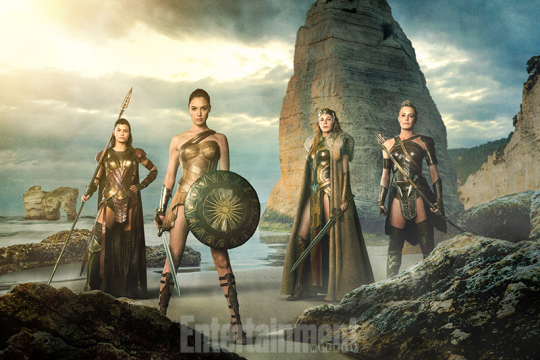
As many people have pointed out already, cleavaged breastplates (as seen on Gal Gadot and co. as Wondwoman), which make a dip or crease in between the boobs, are not actually functional. They’ll direct a strike, and all the force behind it, directly into the sternum, rather than deflecting it like an outwardly curved shape. As such, the following are not entirely functional, but still cover everything without rendering the wearer a shapeless hag.
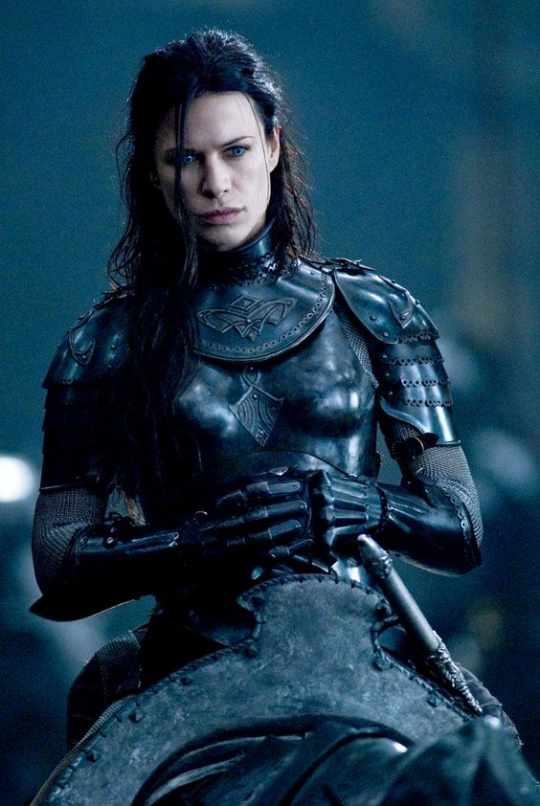
Sonja (Rhona Mitra), Underworld: Rise of the Lycans. She is awarded compensation points for her excellent gauntlets, and especially for the heavy gorget protecting her neck.
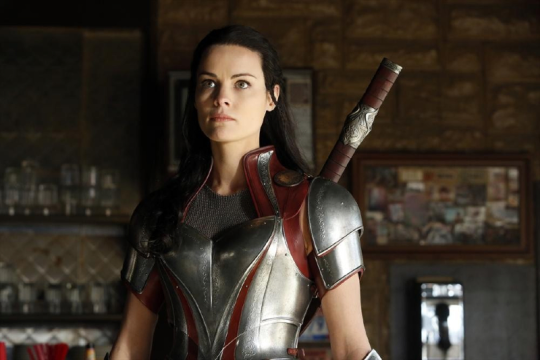
Lady Sif (Jaime Alexander) from Thor. I don’t like this aesthetically, personally, and the whole “oh, we’ll just put some stupidly-light mail over her upper chest and that will take care of the GAPING OPENING at her upper chest” is bullshit, as is having mail directly over skin with no fabric or leather beneath (you’ll have mail shaped bruises and abrasions if you take a hit there, and it’s just uncomfortable even if you don’t). However, once more, completely covered (the mail at least covers the skin), still shapely.
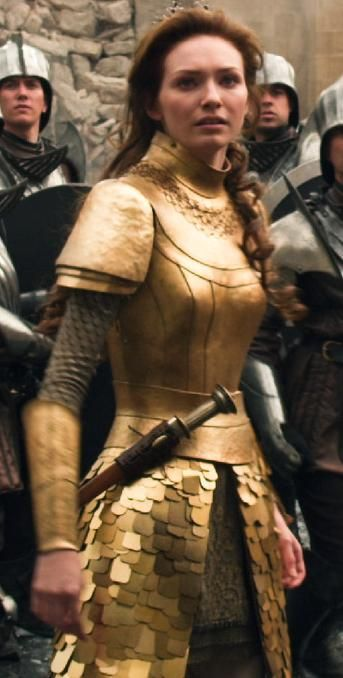
Isabelle (Eleanor Tomlinson) in Jack and the Giant Slayer. The cleavage here isn’t excessive (especially in comparison to Gadot and co., whose boobs are damn near mummified), but it’s enough I can’t put it in the other categories. I also have maneuverability concerns–the pauldrons are attached at the shoulder weirdly, and the integrated turtleneck, as opposed to a separate gorget, could be problems. How the hell do you get into this thing, anyway? Body armor is typically a breastplate, which is attached to a matching backplate if you can afford it, not a bronze tunic thing. Seriously, where are the openings?
Fantasy, But Included For the Sake of Argument
Stuff that, while not entirely functional, covers everything without making the wearer look a shapeless hag, or whatever these costumers are so afraid of.
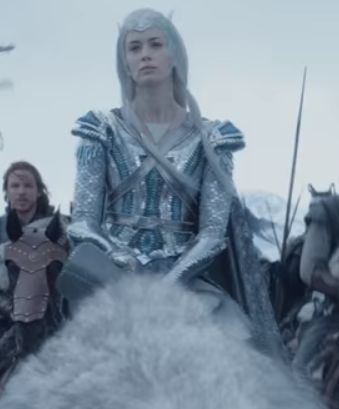
Emily Blunt as Freya in The Huntsman: WInter’s War. Again, no neck armor, and the neckline itself is a little low for my liking, but most of her torso is covered, along with her arms, which have both pauldrons on the shoulders and bazuband-style vambraces protecting her forearms and elbows. The scales are really small, which won’t protect her as well as more historically-based lamellar (see below) would, but this is is probably as good as mail, and the point remains that she’s completely covered in metal and still looks damn good. It’s also worth mentioning Freya is a scary-ass winter witch with guards around her RIDING A GODDAMN POLAR BEAR, so while this is fantasy armyr, it doesn’t have to be functional so much as look badass and sexy, and it’s doing just fine with that. While still being more functional than a lot of hands-on-Warrior-Chick armor is.
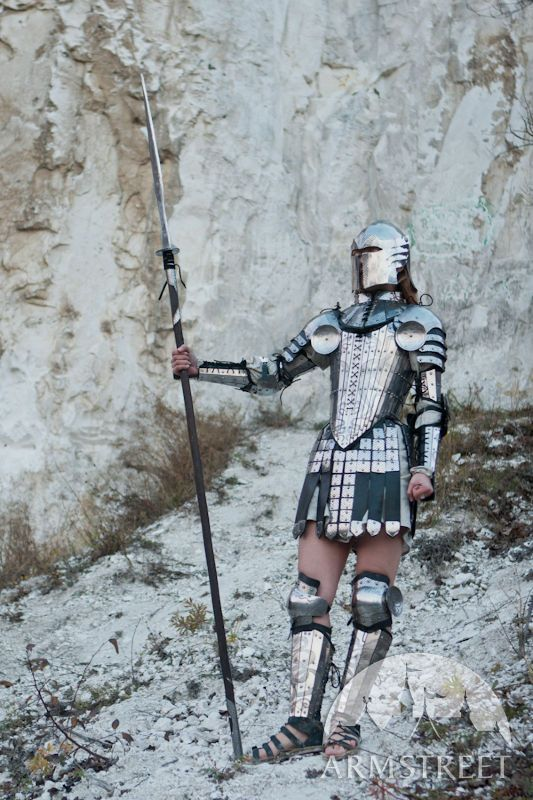
For sale by Armstreet, this is…okay, this is a really weird bastard child of late 16th-17th century stays and someone’s perception of Greek armor. I wouldn’t want to wear this in any actual combat situation, since mobility is pretty restricted, and my god, please wear some pants and something with sleeves or that shit is going to chafe, but again–Female torso, fully covered, even her neck, still a very feminine look. (And it comes with a helmet!)
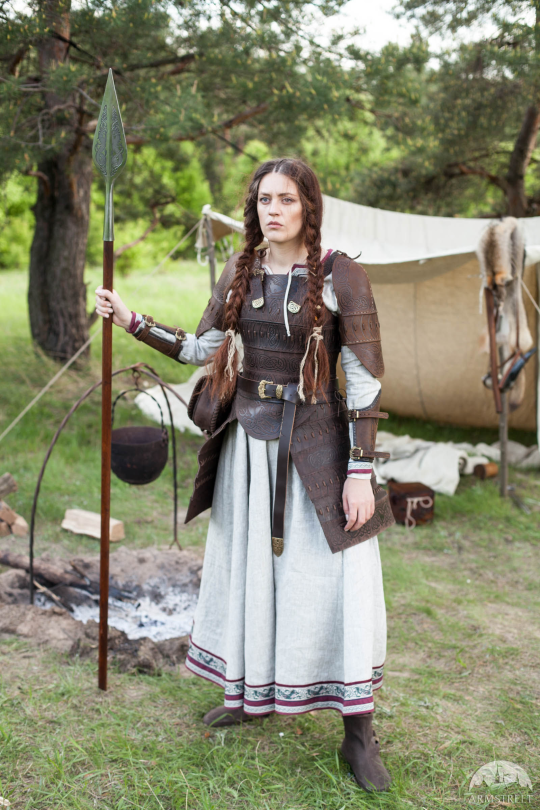
Also from Armstreet. She has been granted, of all shocking things, clothing under her armor! Heavens to betsy. I’m not a huge fan of those pauldrons and the way they fit, and for this to be a wholly protective kit she’d need a chainmail coif (like a hood that also pools around the neck and upper shoulders), but we’ll roll with it, especially as the coif would cover the armor that it’s advertising here.
Really, Not Bad
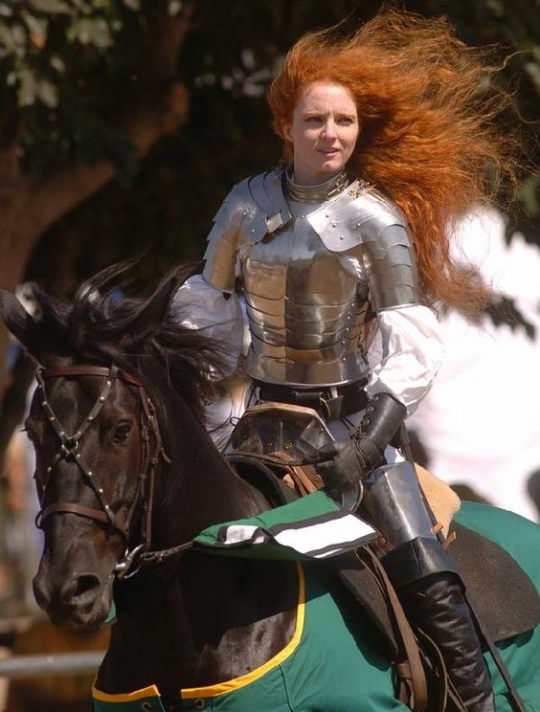
Virginia Hankins, stuntie and performer at the Southern California Renaissance Pleasure Faire (and who thought that was a good name for it?). This is clearly costume armor that’s never been hit in its life (she doesn’t joust, as we’ll get to later, but rides around hitting targets, which, yes, is very difficult, and how the hell she does it with that hair I’ll never know, because mine would be trying to strangle the horse, but doesn’t require impact-resistant armor). It’s too tight-fitting to be entirely functional, because the idea here is to look badass and feminine on horseback from a distance. Fully covered. Still clearly woman-shaped.
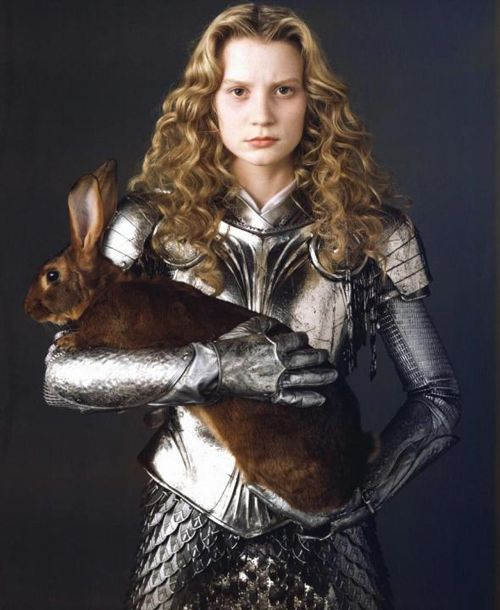
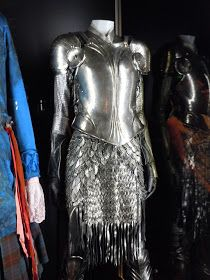
Mia Wasikowska as Alice in Alice in Wonderland, really weird pseudo-mail sleeves that the vambrace bits are just sort of riveted to, but whatever, quite reasonable pauldrons, and even gauntlets!
Sans bunny.
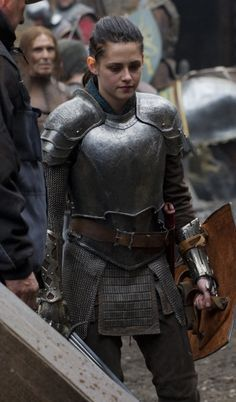
Kristen Stewart as Snow White in Snow White and the Huntsman, with surprisingly better-looking mail. It’s less girly, both in the shorter and less fluffalous skirts over the hips and thighs, the embellishments, and the overall design, but SW and the H has a weird attempt to be gritty and realistically semi-medieval thing going on (which is hilarious on multiple levels). Honestly, they may have been going for borrowed dude armor here, but, again, completely covered, still looks fine. (Okay, except for that hair, nobody ever looks good with their hair scraped back directly from their forehead. That has nothing to do with the armor, the armor is fine.)
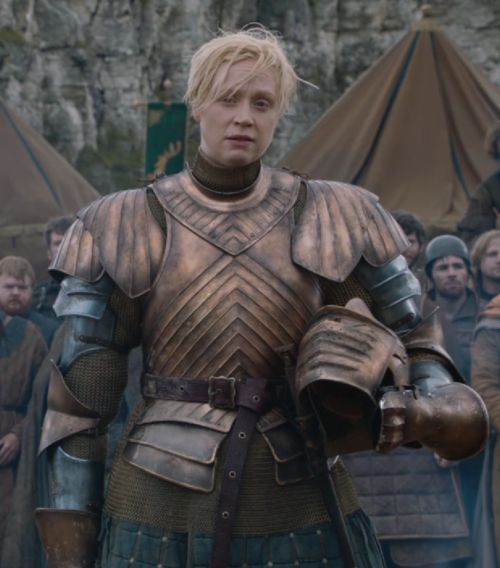
Gwendoline Christie as Brienne of Tarth in Game of Thrones, in a padded gambeson, mail (still stupidly light, but mail), and even a helmet! The lobstered plates coming down over her hips are too short and too narrow, but she does have something. She can’t really be described as “shapely,” but she’s not supposed to, the point is she’s mistaken for a guy with her face hidden in the helmet anyway (nor is Gwendoline Christie the most hourglassy lady to begin with). The design of the breastplate could very easily be altered to taper in more at the waist as well if you really wanted to girl up the look. (Also included because a number of fighting female friends would beat the crap out of me if I didn’t, this armor is BELOVED among them. And it really is quite schnazzy.)
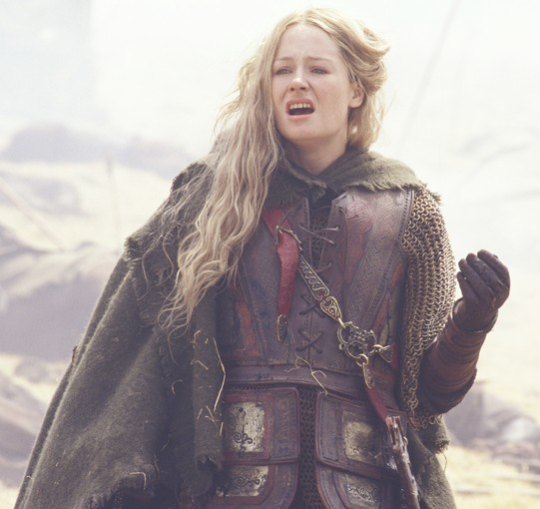
Miranda Otto as Éowyn in The Lord of the Rings, also disguised as a dude, and it’s hard to get a cuirass like this to fit really snugly when it’s over accurately-sized mail. So while she doesn’t look all that girly here, she’s not supposed to, and again, like Brienne’s, this armor could be feminized without losing functionality. (There is, however, NO excuse for this hair being all over the place, NO excuse whatsoever. Tolkien SPECIFICALLY refers to her hair being braided, besides the fact that you do not, ever, want long hair around mail, because it WILL get caught and it WILL hurt; long hair worn down on your neck is really hot and sweaty and gross if you stick a metal pot on it and then run about in a very active manner; and two words, ladies and gentleman: HELMET HAIR. It’s real. It’s sweaty. It’s gross. It’s at least a little tangly even if you braid your hair, which is what very nearly every long-haired (and by that I mean even to the shoulders) woman I know who sticks her head in a metal pot and then bounces around excitedly while wearing heavy, warm protective clothing does, because HELMET HAIR. Would you play hockey, or roller-derby, or any other active sport that requires a helmet, with waist-length hair left to its own devices? I’m not even talking about how it looks when you don’t have a professional team making sure you look rugged and a bit tousled but, not, you know, sweaty and gross and afflicted by HELMET HAIR. This is just about how nasty it feels.)
Historically-Based
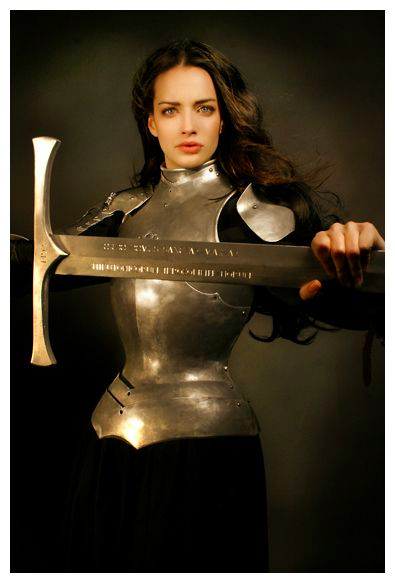
Nicole Leigh Verdin in Shroud. While cinched in at the waist to an impractical degree, it still follows the lines of the late-fifteenth-century Gothic armor I promise I’m getting to, so it still keeps EVERYTHING COVERED.
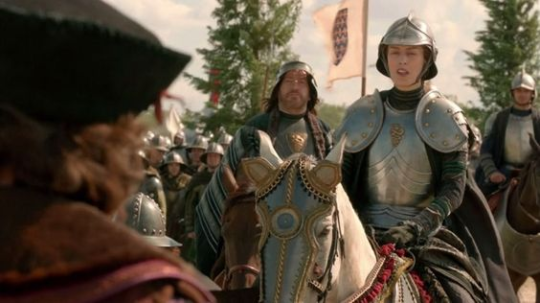
Valentina Cervi as Caterina Sforza Riario in Borgia, set in the 1490s. See what I mean about Brienne’s thigh protection?
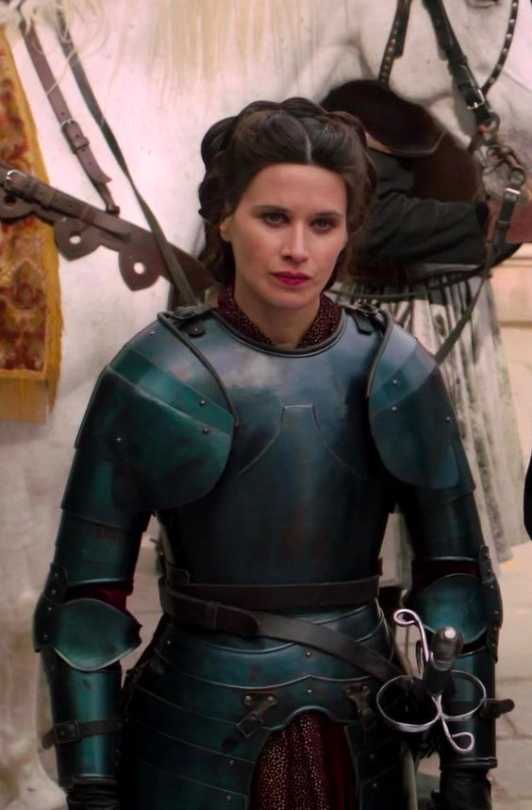
Gina McKee as Caterina Sforza Riario in The Borgias, yup, still 1490s. Both the pauldrons and helmet are weird, but the breastplate is decent, and that’s the main culprit in bullshit female armor.
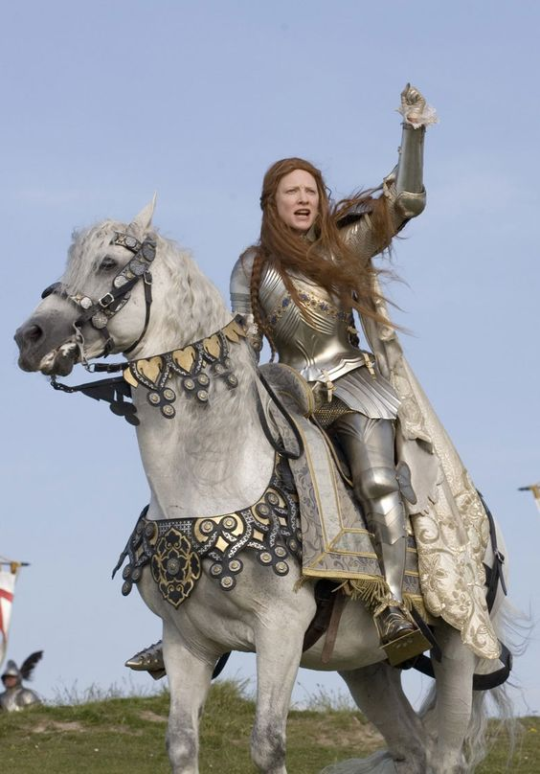
Cate Blanchett as Elizabeth I in Elizabeth: The Golden Age. This armor is more than a century too early, but put her in period-accurate armor and you get…
Helen Mirren in Elizabeth I, an HBO minseries. The costuming in this miniseries is damn near reproduction quality, and I’m happy they went with an accurate peascod shaped breastplate because I’m an accuracy geek, but nobody has ever looked good in either a peascod doublet or a breastplate shaped like one, which is why the costume team on the appealing-to-a-broad-audience-that-just-wants-to-see-Cate-Blanchett-Look-Hot-In-Armor Golden Age went all Gothic instead.
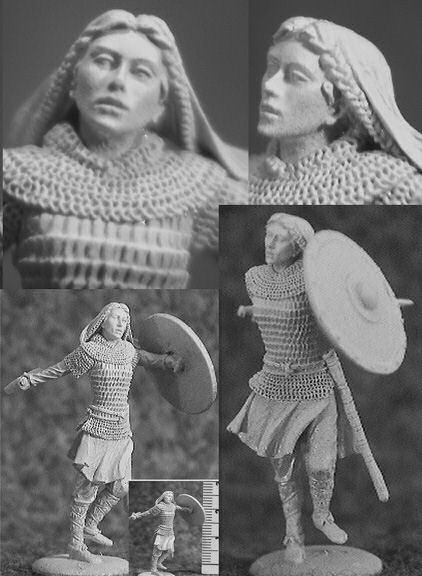
So this is actually a gaming mini made by Thunderbolt Mountain, designed to be 12th century Rus, including lamellar (interlocking plates) armor over mail. This is actually pretty accurate except for some weird draping in the mail coif over her neck and head (and the fact that there’s nothing between the mail and her hair–DO NOT LET MAIL TOUCH YOUR HAIR, you will be very, very sad and possibly bald). Lamellar, which is I what I wear for several practical reasons not all to do with the Girl Body Thing, is awesome for female armor because of how easy it is to adjust the fit as you make it, and because of its flexibility once it’s made. My quibble here is actually that she only has a sword belt, not another belt cinched in snug around the natural waist, because that makes a HUGE difference for both men and women by getting some of the weight to settle on the hips rather than hanging off the shoulders and back.
Actual Damn Armor
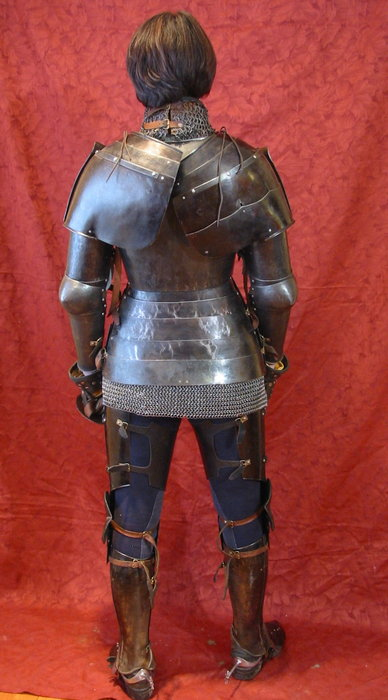
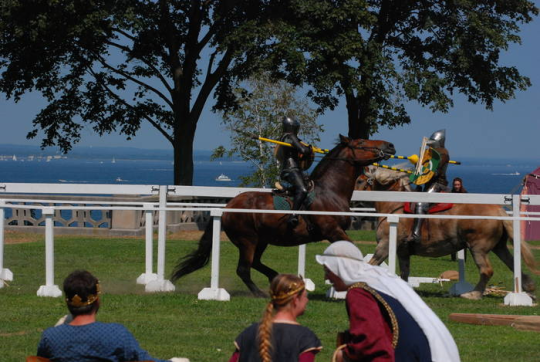
Armorer Jeff Wasson’s wife Stacey, wearing early- to mid-15th century armor. As armor. Because she’s not an actress or performer, she’s a legit jouster (this is why she has the larger pauldron on the left shoulder, where she’s most likely to get hit).
Here she lands a hit on her opponent. This group used balsa-wood inserts in the lances that are designed to break on impact, the idea being that you get hit but don’t, you know, die (this is historically accurate; tournament lances were designed to break themselves, not break people). That being said, you’re still being hit with a bigass stick by someone on a galloping horse; I would bet money she’s not only taken hits in that armor but also fallen off the horse in it.
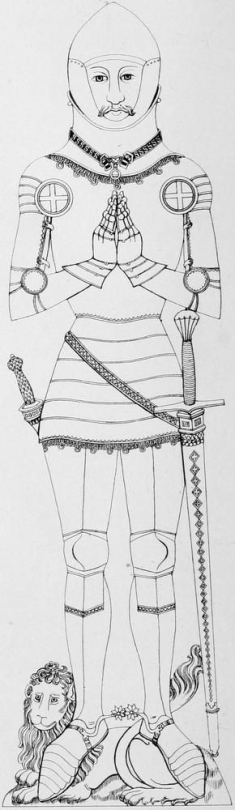
(Thomas Swynborn Dating 1412 Church of St Peter and St Paul, Little Horkesley, Essex, England.) What dude armor from the same period as Wasson’s is based on. The hourglass was in for guys as well as women, to the point that men’s clothing heavily padded the shoulders and chest to exaggerate it, which is what makes the 15th century a great period to base feminine-looking female armor on.
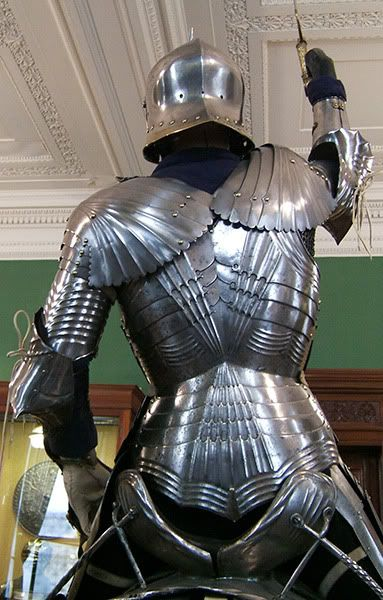
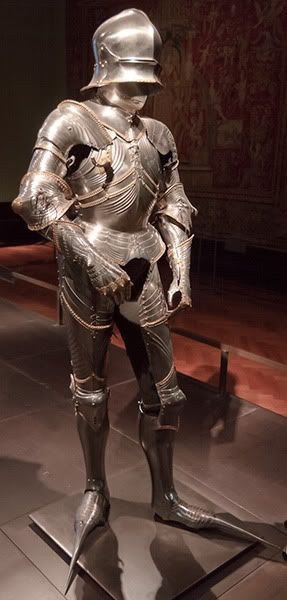
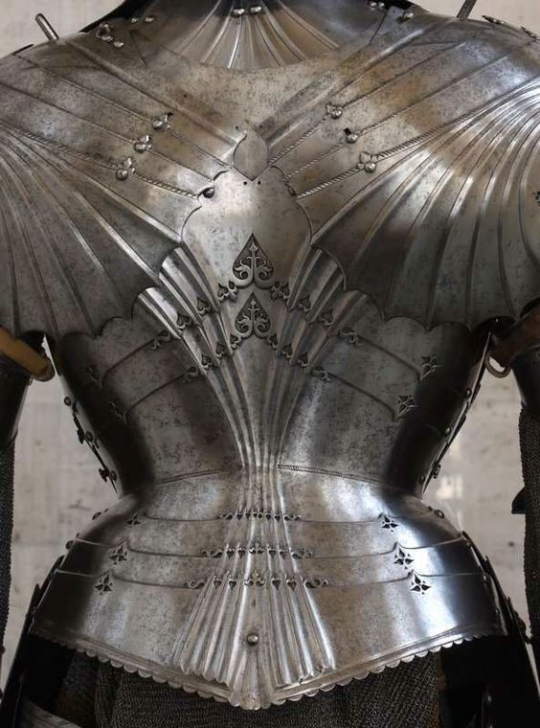
Other examples of extant (and thus made for dudes) armor that would make excellent inspiration for functional and feminine armor, JUST SAYING, PROFESSIONAL COSTUMERS, is from the late 15th century, google “gothic armor” for more:
15th c. German,courtesy of Dr. Andrea Carloni (Rimini, Italy), AAF ID.
1470 Leeds, UK, Royal Armouries, II.168, composite armour “alla tedesca”, breastplate formerly in Churburg, Milano and Brescia Images courtesy of Igor Zeler*, AAF ID.
1484 – Vienna, Austria, Kunsthistorisches Museum, A 62, armour for Archduke Sigismund von Tirol, by Lorenz Helmschmid, Augsburg Front image courtesy of Blaz Berlec, AAF ID.
No attribution, but typical of late 15th c. and holy shit, gorgeous. Look at me, I’m a pretty, pretty badass!
In Conclusion
Armor: Can be feminine, functional, and hot at the same damn time, without showing any skin. And while I’m of the opinion that armor needs to look functional for the wearer to be badass, and that wearing a metal swimsuit makes the wearer look ridiculous and neither badass nor sexy, I recognize that when catering to mainstream audience, female characters frequently need to look sexy as well as functionally badass. That’s the reality in Hollywood right now, like it or not. I do NOT recognize that skin is necessary for this, or that bullshit fantasy armyr is, because holy shit, how hot would Lady Badass look in some of that Gothic stuff? SMOKING hot. All the more so because it would be completely functional.
Just saying, costume designers and denizens of the internet. Just saying.
When creating fictional female armor, the designers can go literally anywhere on the scale between “Stupid Hollywood Bullshit” and “Actual Damn Armor” and not worry about the character losing her femininity or sex appeal, if they do their job right. All without showing an inch of randomly exposed skin.
Things like flaunted cleavage or suspiciously uncovered thighs are a dead giveaway that whoever approved the costume just opted for “sexy” shortcuts. They really highlight that the sole priority was to convey generic “hotness”.
So I’m on AO3 and I see a lot of people who put “I do not own [insert fandom here]” before their story.
Like, I came on this site to read FAN fiction. This is a FAN fiction site. I’m fully aware that you don’t own the fandom or the characters. That’s why it’s called FAN FICTION.
Oh you youngins… How quickly they forget.
Back in the day, before fan fiction was mainstream and even encouraged by creators… This was your “please don’t sue me, I’m poor and just here for a good time” plea.
Cause guess what? That shit used to happen.
how soon they forget ann rice’s lawyers.
What happened with her lawyers.
History became legend. Legend became myth…. And some things that should not have been forgotten were lost.
I worked with one of the women that got contacted by Rice’s lawyers. Scared the hell out of her and she never touched fandom again. The first time I saw a commission post on tumblr for fanart, I was shocked.
One of the reasons I fell out of love with her writing was her treatment of the fans… (that and the opening chapter of Lasher gave me such heebie-jeebies with the whole underage sex thing I felt unclean just reading it.)
I have zero problem with fanart/fic so long as the creators aren’t making money off of it. It is someone else’s intellectual property and people who create fan related works need to respect that (and a solid 98% of them do.)
The remaining 2% are either easily swayed by being gently prompted to not cash in on someone else’s IP. Or they DGAF… and they are the ones who will eventually land themselves in hot water. Either way: this isn’t much of an excuse to persecute your entire fanbase.
But Anne Rice went off the deep end with this stuff by actively attacking people who were expressing their love for her work and were not profiteering from it.
The Vampire Chronicles was a dangerous fandom to be in back in the day. Most of the works I read/saw were hidden away in the dark recesses of the internet and covered by disclaimers (a lot of them reading like thoroughly researched legal documents.)
And woe betide anyone who was into shipping anyone with ANYONE in that fandom. You were most at risk, it seemed, if your vision of the characters deviated from the creators ‘original intentions.’ (Hypocritical of a woman who made most of her living writing erotica.)
Imagine getting sued over a headcanon…
Put simply: we all lived in fear of her team of highly paid lawyers descending from the heavens and taking us to court over a slashfic less than 500 words long.
all
of
this
Reblogging because I can’t believe there are people out there who don’t know the story behind fan fiction disclaimers.
Yeah, back in the old days we were all afraid of being sued, especially since the whole ~internet fandom~ thing was fairly new and we didn’t have copyright laws for online content. We didn’t have social media to make discussing your favourite thing such a common occurrence that the limit to how much you can engage with it would be stretched.
That whole Anne Rice business was freaking scary for any fanfic writer, because it could be the end for all of us. But well, we’re still here, so fuck you, Anne Rice (don’t sue me).
Nowadays, unless you’re making money, it’s impossible to lose if an author is stupid enough to sue you over fan work. I don’t write disclaimers anymore, it’s sort of unnecessary.
(And btw, no disclaimer would protect us if they decided we were trespassing copyright laws. Luckily that didn’t happen.)
Also worth mentioning:
– Copyright stuff is part of what the OTW (aka the Organization for Transformative Works, aka AO3′s parent org) does. OTW: making fic-reading non-profit and easier on the eyeballs AND making fandom a safer environment for creators.










 Kimchi and Justice