The real question is when can I buy all these? ;A;
WELL-
I just re-printed all of these into a new book, which you could by at MOCCA, Fresh Meat(the website will update in the next few weeks), or Baltimore Comic Con– BUT i’m also gonna be setting up my online store this summer (after 78 years).
I am still unbelievably thrilled at my mini commission from @kendrajk from katsu omg
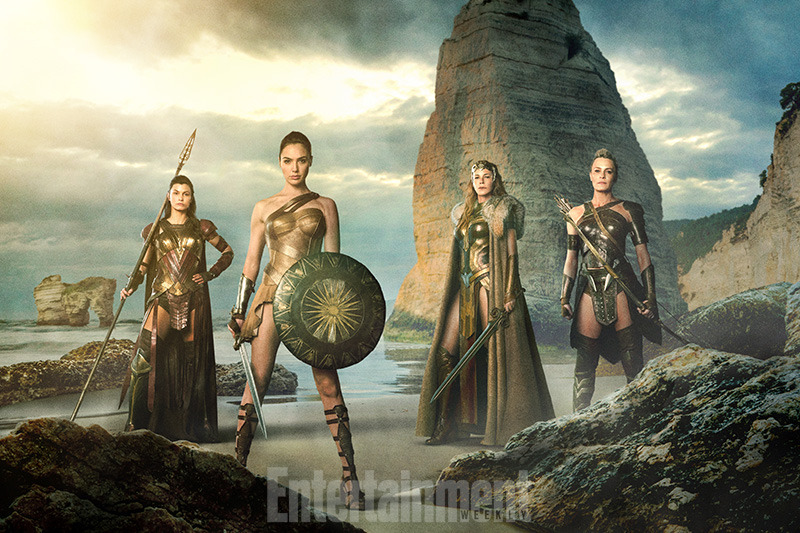
Not to mention leaving open thighs and arms in critical areas with no armour.
Sure just go sword fight people with arteries available for them to stab it’s fine. So long as men get to see you’re women and you’re sexy it’s fine.
The only reason I can see to leave your legs exposed like that is to air out the privates since that island is probably hot af. I’d probably go around wearing a dress and sandals all day if I was told I couldn’t be naked.
Aren’t the Amazons based in Greek mythology? If so, weren’t there gladiatorial fights where women could be naked too? If so, technically they could all just be fighting naked. It’s only training and they’re friends/comrades in arms.
I do have a beef with them high heeled boots though. Fairly sure the didn’t have those in Greek times. So inaccurate.
(If anything and everything I’ve typed here is untrue, feel free to correct me politely or with funny af gifs XD)
OMG I’m a classicist this is my JAM
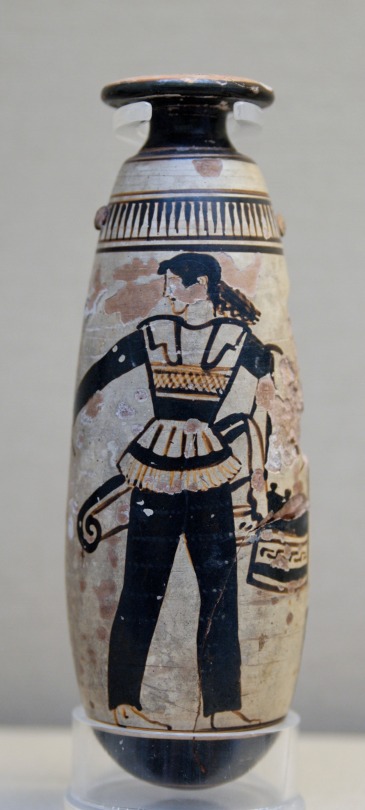
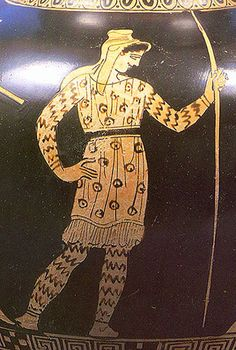
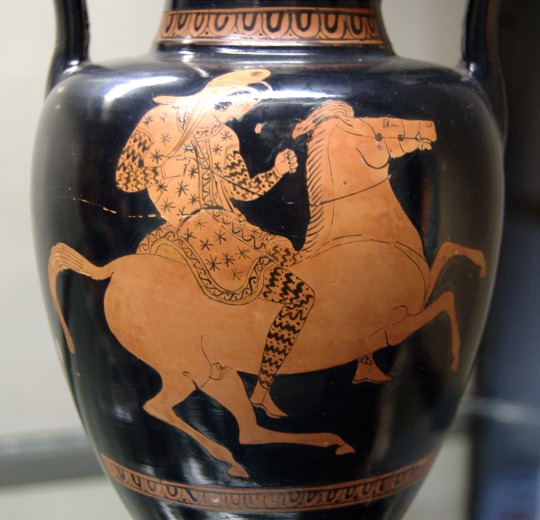
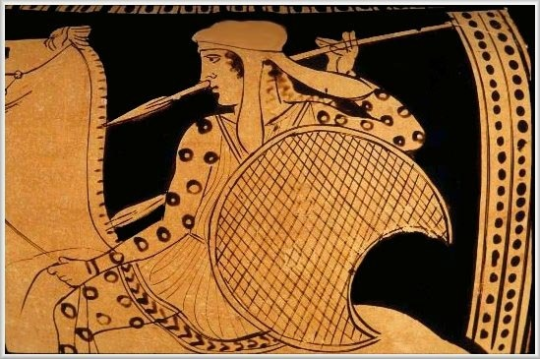
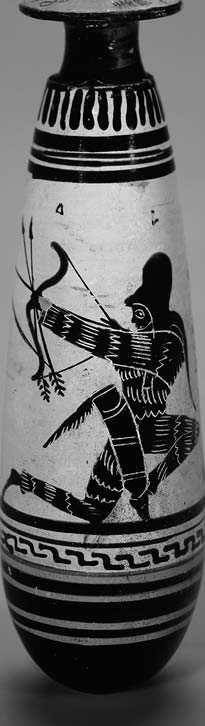
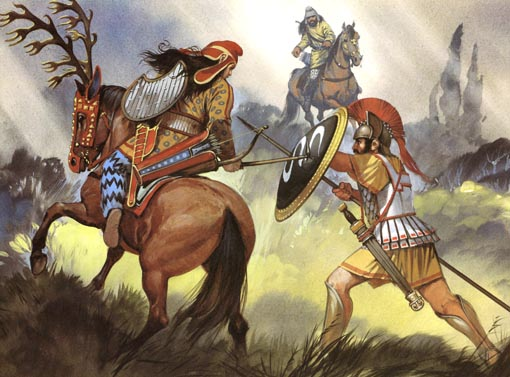
You aren’t the wrongest. (You are the rightest about the high-heeled boots. Those are a nope in terms of practicality and historicity). The Amazons were a semi-mythic group of warrior women who hailed from Thrace and/or Scythia (basically, “North-east ish”). Whether there actually were warrior women from that area is debatable. Greek depictions of Amazons varies quite a bit. In early art, they were depicted as female versions of Greek hoplites, with the same costume- think tunic-y thing with very short skirt, torso armor (but not with boob cups, and definitely covering the shoulders because how the hell else it it gonna stay up), greaves, helmets, big-ass shields, and knifesticks spears.Over time, elements of Thracian and Scythian costume made their way into depictions of Amazons- things like bows and javelins, a fuckton of horses, patterned tunics, boots, pointy hats, and stripey pants. And maybe tattoos (It’s kinda hard to tell if some craftsmen were trying to depict sleeves and sucked at it, or were genuinely trying to draw people with ink in their skin). The most common depiction of Amazons was as an archer on horseback, with a recurve bow, wearing long-sleeved tunic, belt, furry hat, trousers, and boots. Optional but popular is a half-moon shield.
This one’s pants are boring, but you can see her quiver kinda behind her:
This one clearly shows the hat, pants, tunic, and sassy attitude:
On a horse, bomb-ass christmas tunic, fancy pants fancier than any fancy pants you will ever wear:
horse, half-moon shield, aerial knifestick javelin, complete lack of fucks:
pants and/or furry onesie, big hat, recurve bow, ancient speed-shooting techniques only recently rediscovered:
As for nudity, Amazons were rarely depicted naked (except for the odd stray boob) until the Hellenistic era (300′s BC), and on into the Roman Era, especially during it’s midlife crisis phase (the century surrounding 0 AD, roughly) and it’s post-midlife-crisis have-sex-with-everyone, kill-all-your-neighbor’s-chickens-and-eat-them-deep-fat-fried-all-at-once, act-surprised-when-you-contract-500-venereal-diseases-and-clog-your-arteries phase (Nero-ish onwards-ish. And yes, that is definitely the actual term used to refer to that period of Rome’s history, and not simply a sweeping generalization).
Gladiators were purely a Roman thing. You do get arenas and gladiators in Greece and Turkey and whatnot, but that’s only because the Romans invaded and put them there because bloodsport made them less homesick or something, I guess. Female gladiators were certainly a thing, and may have fought naked for entertainment value (TBH I’m too lazy to go look it up at the moment), but the thing is, gladiatorialism was a sport, just like modern taekwondo, judo, and fencing are sports. Yeah, people are going to get injured, but they didn’t die nearly as often as our modern popular image would have you think, and their fighting style wouldn’t really be all that useful on a battlefield, because they had rules to follow and their purpose was NOT to kill their opponent, but rather to provide an entertaining fight. Gladiators actually considered it a point of pride to never kill an opponent in the arena.
Back to pants, because pants are interesting. To the Greeks and Romans, pants were just about the weirdest fucking thing they’d ever seen. Literally all of their clothes consisted of drapey rectangles. If they were feeling fancy, they’d stick a belt or a nice brooch on it. Pants are a complicated, relatively form-fitting garment and it just freaked those poor Greeks right out. Pants were a visual signal for “really fucking foreign”. The furry-hat-and-pants depiction I mentioned above was also the exact same costume that male Scythian warriors were depicted in, and the androgyny also freaked out the poor androcentric Greeks. Often, in vase art and such, the only way to tell an Amazon from a male Scythian is that the women have white skin. They lack of visible gender differences screamed “foreign” to the Greeks. There are several mythic stories about the origins of pants, and they all attribute their invention to women. One story even has Medea (of “fuck you Jason, I’m going to murder our kids to get back at you you utter fuckpile” fame) inventing pants.
Historically speaking, pants were invented because people found themselves needing to ride horses to get places, and not-pants are really inconvenient for that. Since both men and women rode horses, both men and women wore pants. (There’s also a fair bit of merit to the theory that the Amazon legend comes from actual Scythian female horse-archers, since once you put a person on a horse and give them a recurve bow, upper body strength advantages don’t mean shit). Pants were actually a key bit of military technology. Ancient China was having a hell of a time fighting off all these pants-wearing horse nomads (this was like 300-200 AD-ish) until the state of Qin finally decided to collectively put on pants and get on horses. They then preceded to kick the nomad’s pants-wearing asses and unify the warring states of China. Because pants.
Of course, because of bullshit, pants came to symbolize femininity and barbarianism to the Greeks and Romans. They think you look very silly in your uncivilized female legsleeves. Funny sidenote, the Romans avoided pants whenever they could, but when they kept invading more northerly places, shit kept getting colder. Winters in Northern Gaul (modern day France) were cold enough that soldiers actually had to put on pants, and the Romans thought this was significant enough that they called the region “Gallia Bracata”, which translates to “Trousered Gaul”, or, if you’re slightly more imaginative, “Pants France”.
(This is just the first image that came up when I googled “pants france”)
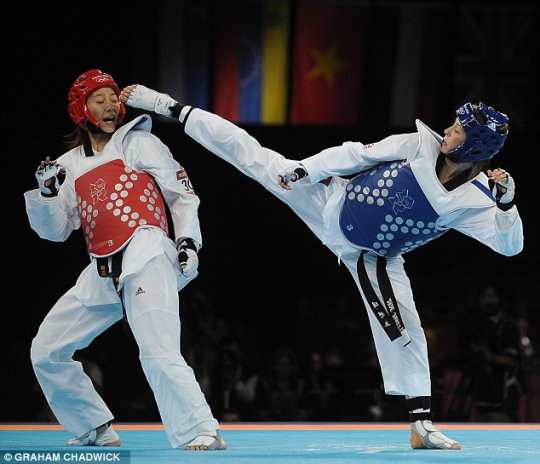
So, to bring this all back around to Wonder Woman, I’m really not a fan of those costumes. They aren’t practical and they aren’t accurate, and they’re also cliche and just like every other sexy STRONG female warrior in fantasy media (I will direct you to @bikiniarmorbattledamage for more details and feminist rants). They could have kept the definitely necessary to show thigh skin by dressing them as Greek hoplites, but then they’d have had to give them helmets and cover their precious hair, and give them actual for reals breastplates that protect above the breasts (seriously collarbones aren’t made of steel and PROTECT YOUR SHOULDERS did you see what happened to poor Bucky), and aren’t molded to the torso (seriously- if it’s stiff enough that you can’t stab through it, it’s stiff enough that you can’t move in something that tight). And even if it is only training, and for some reason they’re not hitting anywhere that’s exposed (maybe training to hit only really small target areas? IDK), the armor depicted wouldn’t work- there’s clearly no cushioning under it, and armor (any kind, really, plate, mail, scale, all of it) really doesn’t work unless you’ve got a layer of padding beneath it. Modern combat sports with limited target areas don’t have form-fitting breast-cupping gear, they have thick pads that protect. For instance, two women competing in Taekwondo:
Not at all coincidentally, here’s some modern body armor worn by female soldiers:
Incidentally, the Scythians also had similar armor, made of scales, woven leather, or some form of lamellar.
Anyway, the movie makers could have their characters showing a bit of thigh (if it’s that important that they be sexy somehow) and maintain some sense of accuracy with thick torso armor, which at least protects the vitals, If they wanted to really get back to the idea of Amazons as terrifying warrior women who act as equals to men and fight as equals to men, and keep the Ancient Cultures motif, these ladies would be wearing stripey pants and furry hats.
Basically, I think it would be awesome to put Wonder Woman in stripey pants.
Alrighty, so I just spent an hour looking up stuff about ancient pants. You don’t have to dislike DC’s costumes just because I do, though- they’re just not very accurate to either ancient Greek culture, or to ancient Greek depictions of Amazons. And there’s no pants.
TBH now I kinda want to redesign Wonder Woman to be a Scythian Amazon. Lemme know if you want me to tag you or whatever if I end up posting a drawing of Wonder Woman in stripey pants.
ok but did every kid have a certain historical time period that they were REALLY into?? like I was super into the california gold rush when I was 9 for no reason
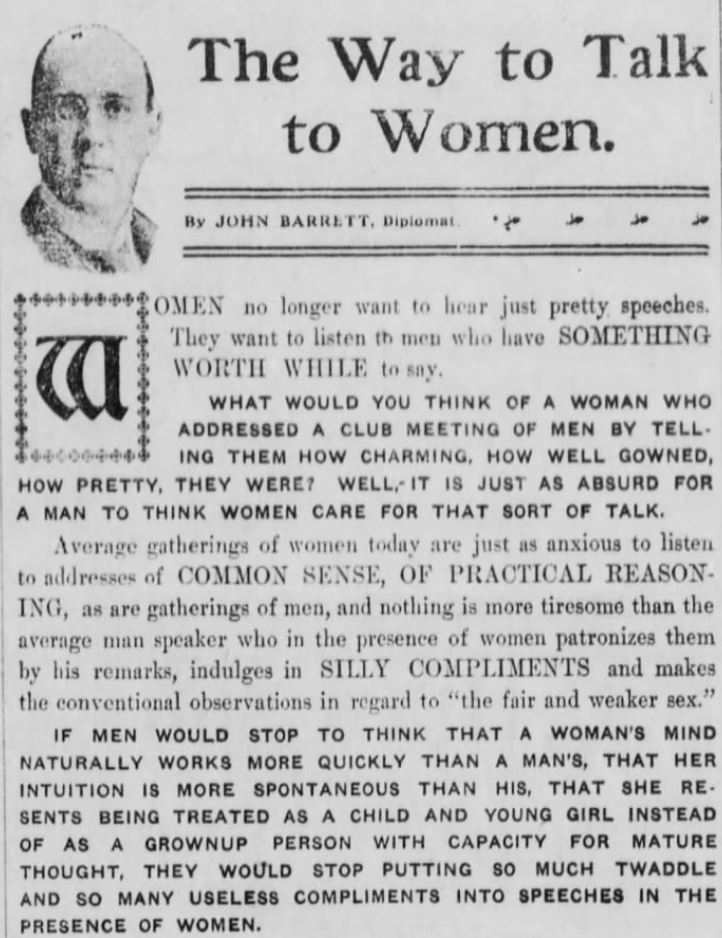
what would you think of a woman who addressed a club meeting of men by telling them how charming, how well gowned, how pretty, they were?
This is why I really like books that are set in oldey times with people who have views like this, and why it annoys me when people say but that’s not historically accurate
tbh, half the time ‘not historically accurate’ is code for ‘i wish things were still like my imaginary version of 19th century England only minus the cholera’
This just makes me absurdly happy, especially because it’s written by a man calling out other men for this shit.
“But they didn’t know better” you sure about that?
dude was so mad about this he was snarking in all caps
Four for you, John!
it’s back!
I went home and Googled the statue to see what the internet had to say about this mysterious black man, and I found that the New York City Parks Department website did not mention the presence of a second human being in the monument at all. Instead, it read:
“The work, set in a picturesque pink granite steele designed by architect Henry Bacon, features a heroic-sized Lafayette standing next to his horse.”
Lafayette and his horse. His horse. Nary a mention of the grown man standing there, blanket over his shoulder and a look on his face like he’d rather be someplace else. I was perplexed, and then angry, and then curious. I went to the library.
The statue, by Daniel Chester French, had been commissioned when a Frenchman turned Brooklynite named Henry Harteau died and left the city $35,000 to cast a monument to his celebrated countryman. (Lafayette and Harteau are identified on the statue’s base, and it was dedicated in 1917.) He asked that the statue be based on a painting called Lafayette at Yorktown by Jean-Baptiste Le Paon. The painting was actually of two men named Lafayette; one was the familiar marquis, and the other was named James Armistead Lafayette. The marquis was white and James was black. Still, I wondered: Were they brothers? Why did they share a last name?
It turns out that James Armistead was an enslaved man from Virginia who enlisted to fight against the British and ended up working as a double agent. The information he acquired helped to win the battle of Yorktown; hence, the heroic painting. He served under Lafayette, and the two men became such close friends that the marquis successfully petitioned to have James made a free man, after James’s own request for manumission was denied. (Apparently, they were only freeing “slave-soldiers” who fought in the war; being a “slave-spy” didn’t qualify.) James Armistead then took the name of his friend out of affection and gratitude. He lived a long life and become a farmer and a family man.
Hair washing and care in the the 19th century
Hair washing is something that almost every historical writer, romance or not, gets wrong. How many times have you read a story in which a heroine sinks gratefully into a sudsy tub of water and scrubs her hair–or, even worse, piles it up on her head to wash it? Or have you watched the BBC’s Manor House and other “historical reenactment” series, in which modern people invariably destroy their hair by washing using historical recipes?
Historical women kept their hair clean, but that doesn’t mean their hair was often directly washed. Those who had incredibly difficult to manage hair might employ a hairdresser to help them wash, cut, and singe (yes, singe!) their hair as often as once a month, but for most women, hair-washing was, at most, a seasonal activity.
“Why?” you might ask. “Wasn’t their hair lank, smelly, and nasty?”
And the writers who embrace ignorance as a badge of honor will say, “Well, that just goes to show that people used to be gross and dirty, and that’s why I never bother with that historical accuracy stuff!”
And then I have to restrain myself from hitting them…
The reason that hair was rarely washed has to do with the nature of soaps versus modern shampoos. Soaps are made from a lye base and are alkaline. Hair and shampoo are acidic. Washing hair in soap makes it very dry, brittle, and tangly. Men’s hair was short enough and cut often enough that using soap didn’t harm it too much and the natural oils from the scalp could re-moisturize it fairly easily after even the harshest treatment, but in an age when the average woman’s hair was down to her waist, soap could literally destroy a woman’s head of hair in fairly short order.
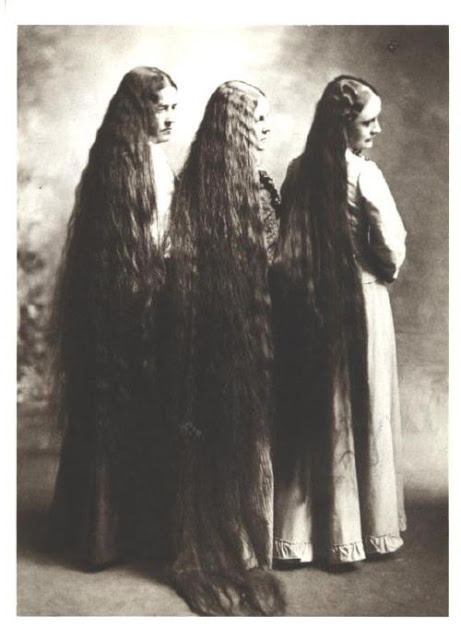
Instead, indirect methods of hair-cleaning were used. Women washed their hair brushes daily, and the proverbial “100 strokes” were used to spread conditioning oils from roots to tips and to remove older or excess oil and dirt. This was more time-consuming than modern washing, and this is one of the reasons that “good hair” was a class marker. The fact that only women of the upper classes could afford all the various rats, rolls, and other fake additions to bulk out their real hair was another. (An average Victorian woman of the upper middle or upper class had more apparent “hair” in her hairstyle than women I know whose unbound hair falls well below their knees.) Women rarely wore their hair lose unless it was in the process of being put up or taken down–or unless they were having a picture specifically taken of it! At night, most women braided their hair for bed. Now that my hair is well below my waist, I understand why!
The first modern shampoo was introduced in the late 1920s. Shampoos clean hair quickly and also remove modern styling products, like hairspray and gel, but the frequent hair-washing that has become common leaves longer hair brittle even with the best modern formulations. (From the 1940s to the 1960s, many if not most middle-class women had their hair washed only once a week, at their hairdresser’s, where it was restyled for the next week. The professional hairdresser stepped into the void that the maid left when domestic service became rare. Washing one’s hair daily or every other day is a very recent development.) That’s where conditioners came into play. Many people have wondered how on earth women could have nice hair by modern standards before conditioners, but conditioners are made necessary by shampoos. Well-maintained hair of the 19th century didn’t need conditioners because the oils weren’t regularly stripped from it.
Additionally, the oils made hair much more manageable than most people’s is today, which made it possible for women to obtain elaborate hairstyles using combs and pins–without modern clips or sprays–to keep their hair in place. This is why hair dressers still like to work with “day-old” hair when making elaborate hairstyles.
There were hair products like oils for women to add shine and powders meant to help brush dirt out of hair, but they weren’t in very wide use at the time. Hair “tonics”–mean to be put on the hair or taken orally to make hair shinier, thicker, or stronger–were ineffective but were readily available and widely marketed.
If you have a heroine go through something particularly nasty–such as a fall into a pond or the like–then she should wash her hair, by all means. This would be done in a tub prepared for the purpose–not in the bath–and would involve dissolving soap shavings into a water and combine them with whatever other products were desired. Then a maid would wash the woman’s hair as she leaned either forward or backward to thoroughly wet and wash her hair. Rinsing would be another stage. The hair would NEVER be piled on the head. If you have greater than waist-length hair and have ever tried to wash it in a modern-sized bathtub, you understand why no one attempted to wash her hair in a hip bath or an old, short claw foot tub! It would be almost impossible.
A quick rundown of other hair facts:
Hydrogen peroxide was used to bleach hair from 1867. Before that, trying to bleach it with soda ash and sunlight was the most a girl could do. Henna was extremely popular from the 1870s through the 1890s, especially for covering gray hair, to such an extent that gray hair became almost unseen in certain circles in England in this time. Red hair was considered ugly up until the 1860s, when the public embracing of the feminine images as presented by the aesthetic movement (Pre-Raphaelite Brotherhood) gained ground, culminating in a positive rage for red hair in the 1870s to 1880s. Some truly scary metallic salt compounds were used to color hair with henna formulations by the late 19th century, often with unfortunate results.
Hair curling was popular in the 19th century and could either by achieved with rag rolls or hot tongs. Loose “sausage” rolls were the result of rag rolling. Hot tongs were used for making the “frizzled” bangs of the 1870s to 1880s–and “frizzled” they certainly were. The damage caused by the poor control of heating a curler over a gas jet or candle flame was substantial, and most women suffered burnt hair at one time or another. For this reason, a number of women chose to eschew the popular style and preserve their hair from such dangers! Permanents were first in use in the 1930s.
(From: http://www.lydiajoyce.com/blog/?p=1022)
Amazing post, thank you!
Super helpful for anyone that writes historical stories featuring women!
For anybody looking for more historical hair stuff, I love Janet Stephens’ videos.
I actually use them to do my own hair as I don’t usually write historical fiction, so it’s really cool for that too.
Having grown up in DC, statues of various dead guys on horses are basically background radiation, or they were before I became Hamilton trash and started noticing them again. Now it’s like every time I turn around there’s a Founding Father looking at me like I personally disappointed him, and it’s getting a little unnerving.
Although: as a result, I sort of want to write a magical realism thing where that can really happen. Where if you do something they would have disagreed with strongly enough, the statues climb down off their columns and lumber down Mass Ave to the Russell Building or the Capitol, where they stand on the sidewalk, arms crossed, glaring into the window of whoever’s just introduced legislation that offended them. They don’t speak, or attack anyone, or damage anything– well, they do tend to bump their heads on low-handing streetlights, sometimes, but that doesn’t count. Mostly they just stand there, mournful, accusing, for everyone to see.
Sometimes lawmakers can talk them around, convince them they’re not actually betraying the political ideals of their predecessors. Politicians who are good at this tend to have much, much longer careers than the ones who aren’t. Politicians who piss off the wrong statues seldom get reelected.
George Washington rarely budges, and when he does it’s front-page news, nationwide. Madison’s always been easier to talk around than most. Hamilton spend more time off his plinth than on it, but he cools off fast. Jefferson holds grudges, to the point that hardly anyone worries too much about making him mad.
It’s not just politicians, either, and they don’t always come to life in anger. Joan of Arc’s bronze horse will shiver to life in Malcolm X Park, sometimes, and carry her off to join protest marches, when she thinks their cause is just. Gandhi walked with Iraq War protestors. The Spirit of American Womanhood, outside Constitution Hall, danced on the day that Roe v. Wade was decided, and when Obergefell vs. Hodge went through, Eleanor Roosevelt taught a clumsy Lindy to Baron von Steuben.
Lincoln has only risen from his seat once since he was put there in 1922, and that was to nod in solemn approval at LBJ from the White House lawn.
Some cities rarely put up statues, and many have taken theirs down. Paris has a great many artists and writers memorialized, and curiously few politicians. In London, during the Blitz, Nelson shinned down his column to help dig people out of collapsed buildings, until he was broken to pieces himself; he stands atop the column again today, reassembled, but has never moved since. In the last moths of the Soviet Union, a desperate Communist Party had the statues of Moscow chained in place. These days, Monument Avenue in Richmond is punctuated with a long series of empty plinths and bare columns.
But DC keeps theirs, and keeps building more.
now i want a story about what precipitated the removal of the Richmond statues. ‘Cause don’t get me wrong, those guys were pretty much all flaming bags of dicks, but this is Richmond after all. Was watching them disapprove of civil rights legislation in front of God and journalists and everybody finally too much for the governor?
Ok but have I never told you my FAVORITE rare book bible swearing in story???
This was told to me by the chief of rare books at LoC.
So, when Obama was sworn in he asked to be sworn in on Abraham Lincoln’s bible. This upset various Republicans bc they thought he was getting special treatment or something. So when John Boehner was going to be sworn in as Speaker of the House, he too wanted to be sworn in on a special bible.
So, an aide from Boehner’s office calls up special collections at LoC and says Boehner wants to be sworn in on the first bible printed in America. The librarian says, “Are you sure you want that bible?” and the aide gets kind of snippy and says, “We know what we want–we want the first bible printed in America,” and kind of goes off on a tear about preferential treatment, et c. et c. The librarian says fine and makes the arrangements.
So the day comes when the bible is to be taken out of special collections and the aide shows up to retrieve it. The librarian brings out the book and shows it to the aide, who throws up her hands and says “What the hell is this!!” The librarian says, “This is the first bible printed in America.” The aide says, “No it’s not. This can’t be the bible. I can’t read it.”
To the end of my days, I will think of this unknown Republican aide who is under the impression that all bibles are in a language that she can personally read.
Incidentally, the Eliot bible predates the first English-language bible printed in America by more than 100 years.














 Kimchi and Justice