persephone: whos a good boys??
cerberus: :0 ??? :O ???? 😮 ????
persephone: youre a good boys!! all of you!! such good boys!!
cerberus: :D!!!!!!! :O!!!!!!! :Dc !!!!!!!!!
I just love the myth of Persephone, i mean the real, original version of it, because it’s not like she got kidnapped, no, this bitch was la-de-da-ing in a meadow and she just happened to find an entrance to the Underworld and she was like “Imma check this out”. And she just wanders into the Underworld and discovers that hey this place ain’t too bad.
Meanwhile Hades is in the background “????? UM??? PRETTY GIRL??? WHY ARE YOU HERE?????? YOU AREN’T DEAD???”
And Persephone (who was originally called Kore just a little fyi) just looked at him and said “I like it here. I’m staying.”
And Hades kinda just went with it, until Demeter started throwing the temper tantrum of the millenium upstairs and Zeus had to intervene because this shit was getting out of hand and its actually his job to be admistrator of justice. Which considering the shit he gets up to is kinda histerical but that’s another story there.
And basically Persephone wasn’t a prisoner or kidnap victim at all she just really loved the Underworld and her (eventual) husband, and the Greeks feared her arguably more than her husband because Hades could be reasoned with but Persephone was the one laying the smack down on sinners, and really, who wouldn’t be at least a little scared of someone who’s name means something along the lines of “the destroyer”
Basically, Persephone is amazing and everbody needs to get on her level
@teashoesandhair, is this true and right and accurate? I ask you because you are The Knowing when it comes to things of this nature…
*sweats nervously* no, this is not true and right and accurate.
(Edit 2: tbh any post that says THIS IS THE ORIGINAL MYTH is going to be wank, because we don’t know what the original myth was – we only have the first written sources, but without a time machine there’s just no way of finding out how the myth developed in an oral tradition)
The first source we have for Persephone being carried away is in Hesiod’s Theogony, written in the 8th or 7th century BC. We also have the Homeric Hymn to Demeter, written in the 7th or 6th century BC, which is explicitly about her being taken away by Hades.
Hesiod is one of the oldest Greek sources that we have, roughly contemporaneous with Homer. We don’t have any earlier sources than this which say ‘hey, Persephone went to Hades because she thought it would be cool’. A lot of people have theorised that this could have been an original, or at least an earlier tradition, but it’s about 60% wishful thinking, 20% misinterpreting evidence (i.e. assuming that Persephone and Demeter used to be aspects of a great mother goddess, which they weren’t) and about 20% conjecture based on actual rational thought (i.e. the fact that the oldest written source we have is about an abduction doesn’t mean that it is the original source; there could be older non-extant written sources or just oral tales which pre-dated writing). It’s not fact.
It’s true that Homer himself never explicitly says that Persephone was abducted (he just describes her as Hades’ wife) but he also doesn’t say that she wasn’t abducted; it could well be that the myth of her abduction was so well known that he had no need to recount it.
It is true that Persephone’s name was Kore, which means ‘maiden’; however, this could be an epithet because she was unmarried. (Edit 3: it’s also theorised that it was a euphemism of sorts for when people didn’t want to name Persephone outright; again, this is a theory). The name ‘Persephone’ does not mean death / destroyer; the etymology is unknown (the ‘death / destroyer’ theory is just one of many, and others are based around ideas of harvest and grain).
The reason Zeus got involved wasn’t just because he was tasked with sorting out justice – it was because he had told Hades ‘hey, you want a wife? Cool! Abduct my daughter, Persephone. Her mum totally won’t mind,’ and then when Persephone’s mother did mind, Zeus was like ‘I fucked up real bad, I should sort this shit out.’ Edit 4 – in Ancient Greece, women didn’t have to consent in the same way as we do now. Abduction marriages were actually illegal (or at least very very naughty) but the bride’s consent basically took the form of her father saying ‘you’ll marry this dude, right? Yeah, cool. She’ll marry you, dude.’ Here, Zeus gives Persephone’s consent to Hades by telling Hades that he can marry her – this is why technically she wasn’t exactly abducted, because the necessary consent – her father’s – was given. HOWEVER, let’s not get into Greek law here. She was abducted by our standards.
It is also true that Persephone became a very feared goddess and basically had a great time in the Underworld. She wasn’t exactly more terrible than Hades, though; there are certain myths (e.g. Sisyphus and Orpheus) where she’s the one who says ‘Hades, babe, shall we give this guy a chance to make his way out of the Underworld alive?’ HOWEVER, she did usually do this with the implementation of specific terms, meaning that she had a level of control in proceedings which a lot of other wife goddesses didn’t have over their respective spouses’ spheres. Most mythological canons also give her and Hades a very healthy and monogamous relationship (with the exception of Orphism, which is a bit more iffy on that front) so, disregarding the abduction part of her myth, their marriage was really relatively healthy, even by modern standards. (Edit 5: also, Persephone did not ‘lay the smack down on sinners’ – the whole idea of sinners is basically a Christian concept. The Underworld was not Hell. It wasn’t a place for bad people. It was just where the dead went. Tartarus was the place where the really bad guys went to be tortured and shit, and is more indicative of Christian notions of Hell. People weren’t punished in the Underworld. They just went there.)
I love the idea of Persephone as a consenting wife of Hades. I am a fan of modern reinterpretations in which she chooses to eat the pomegranate seeds willingly, or where she falls in love with Hades and goes to the Underworld of her own accord. However, these are modern interpretations, based on modern gender politics and ideas of reclamation and representation. I will forever fight for people’s right to reinterpret myths however they like, but this whole idea of the ‘original myth’ of Persephone being devoid of any misogynistic undertones really needs to die.
(Edit 1: putting my tags here in case anyone thinks I’m just a hideous puritan:
#i love all the myriad interpretations where she actually has agency #but she didn’t in any of the oldest original sources that we currently have #and i don’t like people saying that she did #because it negates all the misogynistic bullshit that women have been subjected to #and i don’t think it should be negated
I should also point out that I’m doing my MA dissertation partly on the modern feminist reclamation of patriarchal myths, including the erroneous claims that these myths were originally matriarchal, so this post definitely counts as work and I’m 100% not procrastinating… sort of…)
Every time I see this post without @teashoesandhair’s contribution I feel compelled to hunt it down again
Eyyy do you wanna read a book about a lesbian retelling of the Persephone and Hades myth where Hades is a woman and they’re super fuckin gay? Of course you do. It’s called ‘The Dark Wife’ by Sarah Diemer and you can download it online for free !!
hades isn’t a badass. hades named his three-headed-guard-of-the-underworld-dog spot. hades whispers to his flowers to make them grow. hades grows fruit. there’s no sun in the underworld.
hades isn’t a badass. stop saying this false thing
In myth, Hades’ most remarked upon traits are 1) how responsible/reliable he is, 2)how sober-minded he is, 3)how dedicated, implacable, and long-remembering he is, and 4)how boring and grim most of the other Olympians think he is to be around. Oh and notably, that if you play him a song he likes, he’ll basically give you anything you ask for(though not without conditions).
Hades is, canonically, a gigantic nerd. If they’d had trainsets, he’d have been the Olympian who collected trainsets, meticulously corrected with exacto knife and hobby-paints the errors toy-makers introduced to those trainsets, and then endlessly talked about those trainsets to anyone sat next to him at Thanksgiving Dinner 😐 When he wasn’t trying to rope them into an interminable discussion about gardening or divine law, that is 😐 😐 He’s the sort of god who frequently handed out punishment like giving someone a million-piece puzzle where every piece is shaped the same, that resets itself at the start of every day if you don’t complete it, and then he keeps the last piece on his person at all times as a secret private joke for eternity because he finds you personally distasteful(not even because he’s mad at you or hates you particularly; he just doesn’t like you as a person) 😐 😐 😐 He is. A Gigantic. Nerd.
He’s also like one of the only gods who is faithful to his wife. And he listens to her like when she asks for a soul to be released and he’s like “But honey, the rules.” And she just gives him that look and he goes “Yes dear,” and lets the soul go with the easiest freaking instructions ever in a myth. And the human still fucks it up. Not his fault Persephone, not Hades’ fault this time. Essentially, Hades is sorta like the accountant suburban dad who collects really specific figurines and gets really grumpy when people mess up his lawn. Do you know how hard his wife worked on those roses? He is calling his attorney. Oh wait, he is also an attorney.
Filed under: Favorite Myths
Everybody knows it’s Persephone that you’ve got to watch out for.
Zeus sits at the bar, he’ll buy a thousand and one drinks and the girls who he smiles at will raise their eyebrows and think of the pepper spray tucked into their sleeves.
Hera waits at home. She knows the numbers of all the girls and she has their facebooks open on the computer. Her hands hover over the keyboard., She wants to tell them that men will always lie. She wants to take her own advice. She never will.
Apollo and Artemis travel the world. They are chasing the sun. Chasing the moon. They will never catch up. Their hand are curled around each others hip bones. Never in public though. They look too similar for that now. Society has learned judgement and so they keep their caresses safe in the shadows.
Poseidon wanders the shore. He wears a plastic poncho and carries a bag of trash. His tears mix with the salt water. No one can tell the difference. A girl with hair that moves like serpents trails after him, retribution in her eyes.
Hades lies in bed, his wife curled around him. He smiles because people will always believe in death and finally, finally he has beaten his brothers at something.
Athena paces through college campuses, handing out pamphlets on architecture. She scoffs at professors who are simply going through the motions. She carries signs in her hands as she marches through the streets with the students, screaming about the newest problem. She laughs wild, these children, these fearless children are her people.
Hestia wants her family to come home. She waits in the doorway, arms outstretched and a smile like forgiveness waiting to embrace the siblings whom she knows will never return.
Demeter counts down the days until her daughter returns. She smiles when children cheer over the snow days she gives them. There was a time when she had a child like that.
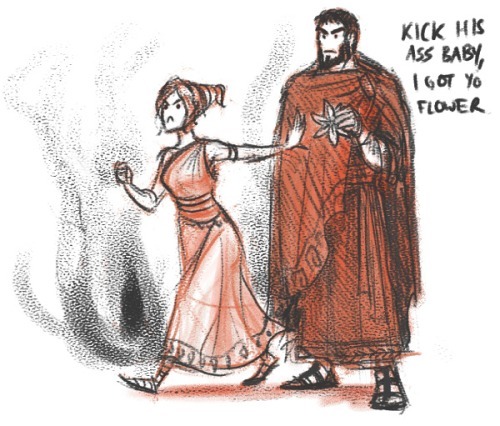
Persephone kisses her husband and grins when people tremble. She is vengeful and wears flowers in her hair and she will make damn sure that the world will never forget her name.
Ares walks through the Middle East, picking his way around the ruins of an elementary school. He stopped understanding war a long time ago. This was not brave, this was not heroic. This was senseless.
Aphrodite narrows her eyes at boys in cars who yell obscene things. She’s long since stopped romanticizing love. She is gaunt and over worked but sometimes she sees a teenage girl handing her baby over to an older couple who had tried for years and she feels young again. Sometimes, she sees Ares from across the room as soldiers embrace their loved ones and they smile at each other.
Hephaestus limps through his shop, his hands are worn down, his back is still twisted but people don’t seem to notice anymore. He makes their furniture, their toys and trinkets and they thank him, they pay him.
Hermes runs through the streets of New York, Tokyo, London. He is young in this time, young and beautiful and slipping between business men, his hands finding their way into their pockets. He never stops laughing.
Dionysus mixes Zeus his drinks. He watches his family grin and cry and get sick in the back room of the bar. He holds back their hair and hands them another drink before they even ask. He’s been here a long time. He’s seen them drunk more often then he’s seen them sober. He is watching them flicker out and fade.
The gods are dying. The gods are dead. The gods are us.
Modern AU of Greek deities??? I’d think Persephone runs a flower shop next to her mother’s all-natural grocery store and gets really distracted when the pawn shop guy comes to visit.
Tumblr likes Persephone. A couple of months ago I had like three different analyses and retellings of the story on my dash circling around for weeks, and I started this post then, but I came back to it today. Because it makes me think sometimes about the stories we tell, and how, and why.




 Kimchi and Justice