In holland when someone doesn’t close the door behind their backs we say ‘Ben je in de kerk geboren?’ which literally translates to ‘Have you been born in church?’
@useless-netherlandsfactsIn the United States we say, “Were you raised in a barn?” It’s supposed to imply that the person was raised without any manners. But as people who frequently use barns have told me, you would never leave the barn door open because then the animals could get out.
In Italy when someone walks in a room and doesn’t close the door we say “abiti al Colosseo?” (and other variants), which translates to “do you live at the Colosseum?” because the Colosseum hasn’t got doors
in Australia we say ‘Were you born in a tent?’ which so far has no official etymology but probably has something to do with swagmen and bush culture…
In German we say: “Hast du keine Türen zu Hause?”, which translates to: “Don’t you have doors at home?”
In Czech we have two versions of this. First, more polite one is “Máte doma otroky?” (Do you have slaves at home?) and then quite rude one, which is “Máš v prdeli oje?” (Do you have poles/drawbars in you ass?)
In Hungary we say “Te barlangban élsz?” Which means “Are you living in a cave?”
In Denmark we say ‘Er du født i et s-tog?’, which means ‘Were you born on a (S-) train’, or ‘Er du født i et telt?’, which means ‘Were you born in a tent?’
In Poland we say “Co ty w tramwaju mieszkasz?” which means “Do you live in a tram?” because doors on trams open on its own obviously
addition to the German thing: We also say “Haste Säcke vor der Tür?” which translates to “do you put bags in front of the door?” as in ‘do you use bags instead of a door?’
In my family we just say “HEY! DON’T LET THE CATS OUT!”
Tag: language is amazing
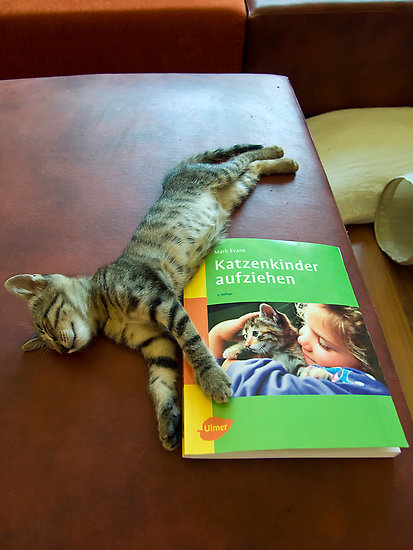
Raising Kittens
(via Valerija S. Vlasov)
dsfklsajflsjfdlk that’s the german word for kittens?
katzenkinder?
literally: “cat children”
aaaaaaaaaaaaaaaaaaaaaaaa ;w;
ISN’T GERMAN A CUTE LANGUAGE
DO YOU KNOW THE GERMAN WORD FOR BAT
IT’S FLEDERMAUS
FLUTTER-MOUSE
HOW IS THAT NOT JUST KAWAII AS HECK
My favorite is their word for bagpipes.
DUDELSACK
doodle sack
seriously
But then their word for skull is Totenkopf, as in Death’s Head.
So German basically has two settings, kawaii and metal, and there is no in between.
I love German.
Reblogging for the German lesson.
Dauphin (dolphin in French) was a sort of pet name that the son of the Count of Vienne, Guigues, was given by his English mother when he was a child. When Guigues inherited the title and lands of the Count of Vienne, he formally called himself “The Dauphin,” and had a dolphin as his motif on his arms. The territory he ruled became known as the “Dauphiné.” When it was later purchased by the King of France, he gave the land, and the title, to his son and heir. Which is why to this day thee heir to the throne in France is called the “dauphin.”
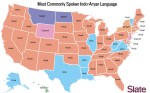
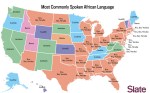
What does ‘dragged’ mean in AAVE
I have a) no idea why you’re asking this question, and b) no idea what the answer is. This is why the only AAVE expression I use is “on point” (and sparingly), because its meaning is easy to grasp. “Fleek”, “dragged”, “throwing shade” (I sort of get that one but like the word facetious can’t really use it in context), and anything to do with tea are just not in my vernacular.
Oh, I guess “cool” counts but that’s been thoroughly assimilated by now.
Of course, I live 3000 miles away from any place AAVE is spoken, so my understanding of it is gleaned through tumblr and imported sitcoms. We don’t have a concept of BBE (Black British English?), but if we did it would probably include the phrase “innit bruv”, unless that’s part of the chav dialect? Fuck, the relatively small island of Britain can’t decide on what to call a bread roll (it’s a bap guys, a barm is a completely made up word that my spell-checker can’t handle). We’re not ready for race-based dialects when we have so many regional ones going on.
This appears to have gotten away from me a little bit, so tl;dr: fuck knows.
We don’t have a direct equivalent – the closest we have is Multicultural London English which is basically a combination of slang from many different backgrounds – AAVE, various Caribbean dialects and cockney in particular.
Interesting thing I’ve noticed about that is that the pace of change of MLE seems really high – I understood a reasonable amount in 2011 or so, then a couple of years later had real difficulty with it. It’s pretty cool 😀
England does have BBE (or BEV (Black English Vernacular), but it is not so prominent as AAVE for a few reasons.
Features of BBE include vocabulary like “bruv”, “innit”, “ma boi”, “man demz” and “safe”. Accent features are things like diphthong flattening, th- fronting and fronting of back vowels.
However, (I believe) the main difference that means that BBE is not really a thing in the same way that AAVE is, is the history of Black people in the UK compared with in the US. BBE comes from people from the Caribbean migrating to the UK in the 1950s and 1960s, and as such has more (historically) in common with Jamaican Creole than AAVE, which developed from the creoles spoken by slaves back in the day. Therefore, BBE is a much younger migrant dialect (which is still totally important as a marker of identity) whereas AAVE is a really massive historical identity marker with shit tonnes of historical significance.
Another thing to note is that London and its surrounding areas, where BBE is predominantly spoken (I don’t think I have ever heard it spoken in the North), is a huge cultural mixing pot, so lots of features of BBE are no longer unique to that variety, and have become common features of MLE, which in turn become common features of Estuary English, which is the fastest spreading dialect in the UK, so basically everyone between 12 and 35 uses features of it without really realising that they are doing so, and that in doing so they are adopting features of MLE and BBE.
Please note that I am not an expert in this area either, so if anyone has any corrections to what I just said, they should share them.
The excellent apunninglinguist laid down much better facts than me!
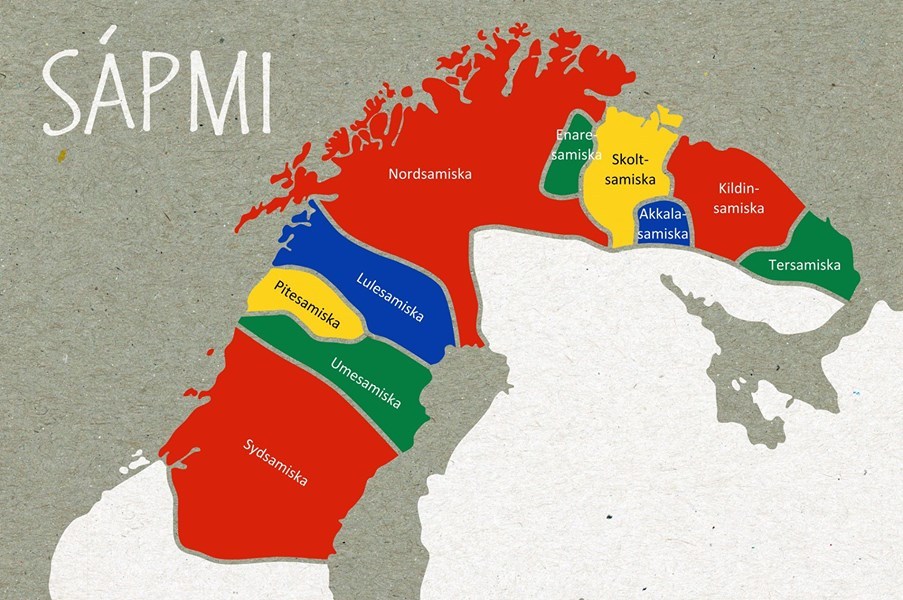
A map of Saepmie, showing our different languages. Maps showing linguistic borders can never be 100 % correct, but this is one of the better maps I’ve seen in a while anyway.
GUYS HEY LISTEN
SO I FEEL LIKE THIS IS IMPORTANT
But I just found an online resource for learning Inuktitut, which includes different dialects in the language! I’m so happy because look at this. It’s beautiful.
So if anyone is interested in learning more about Inuktitut, a wonderful language native to Northern Canada and Alaska, check out TUSAALANGA, because it’s amazing and wonderful and not only provides audio clips of pronunciation but in-depth explanation of sentence structure!
Help support this and the keeping of the Inuit language and culture!
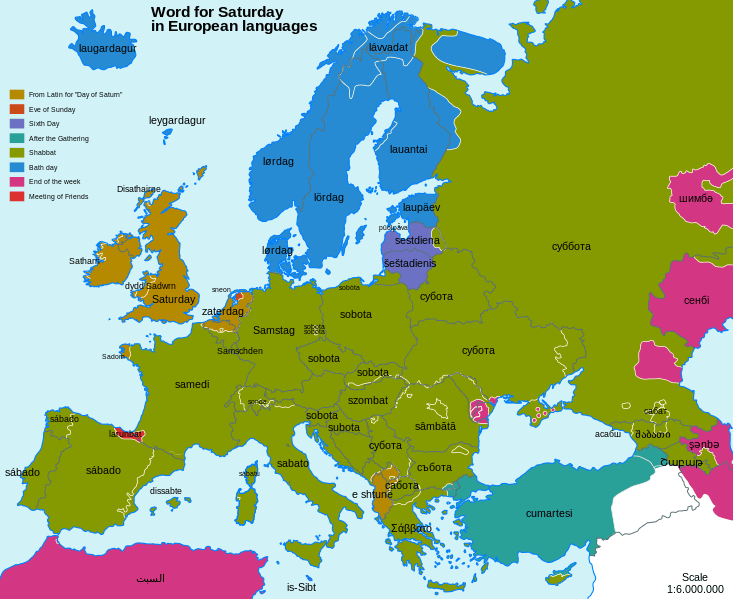
the word for “Saturday” in various European languages [733×599]
CLICK HERE FOR MORE MAPS!
thelandofmaps.tumblr.com
 Kimchi and Justice