Here is a tiger just going about life until this human gives it the fright of its life. Still cute af. Dream job to be honest. 17/10 would be such an honor to pet
no no no no no look at those ears, tiger totally knows he’s there
tiger thinks the bipeds are terrible, terrible tigers and don’t know how to tiger worth a damn so when one actually pays tiger cub ambush game tiger is so happy
look at that happy tiger
look at it
YES YOU TERRIBLE TIGER YOU ARE FINALLY LEARNING HOORAY 😀
as far as I know, there is no large carnivore who would abandon actively eating a killed meal to chase live prey. chasing and hunting live prey is a risk, as a healthy live creature has the capability to injure a carnivore, or tire it out through the chase. If there is, say, a giant pile of dead bodies to eat, which abandoning would allow other carnivores or scavengers to steal and eat instead, it makes no sense at all.
please stop doing that thing
The sole exception I can think of is if the large carnivore thought the live prey was another carnivore or scavenger, and was chasing them as a threat display to ensure they didn’t steal the dead bodies. Even in that case, though, it would only be a short, mock charge followed by returning to the pile if the opponent fled. With possibly whatever the animal’s equivalent of “and stay out” would be.
Another thing: most carnivores don’t like to fight. They have to mug something to death for every single meal, they have to stay in top shape while conserving their energy. Meanwhile, herbivores have plenty of extra energy because they eat stuff that comes out of the ground and doesn’t fight back, and they often live in big social groups, so they’re better at handling stress and more used to having to actually come to blows with other animals to get their way.
So like, a zebra will try kick your ass just to see what’s up. A tiger won’t do shit unless it’s damn sure it can take you. I’d rather come face to face with a cougar than a stag— have you seen videos of what happens to hunters when a stag catches a dude on the ground? the stag tears the dude apart. Not even to eat him. Just because the stag didn’t like what was going on and decided it was time to curb stomp a motherfucker.
So if you’re deciding what kind of Big Scary Animals to have be a threat, like, forget wolves and lions and eagles and velociraptors. Go drop in a moose.
This is why loud noise can scare bears away. It’s a threat display that normally convinces them that the charge isn’t worth the effort.
-Exception:
If a carnivore is Not That Hungry it might drop something dead to chase something that is doing Extreme Prey Behavior– but it’s not going to be serious about it. I’m thinking of things like a domestic cat that chases birds and mice for kicks. Honestly, I think that the t rex in Jurassic Park was a good example of predator behavior– she abandons something difficult (like the kids in the jeep) for the bright shiny thing she has been conditioned to understand means food (tightpants math guy with the flare + gruff dino man with flare). For the rest of the film, she chases things that run, and then quits and chows down once she has something. This has been one of my biggest beefs with the later JP films, especially Jurassic World– rather than the scares coming from being treated and stalked like prey by animals, the scares are based on monsters killing and eating randomly. (And what’s with the treatment of all the herbivores as good and gentle? Herbivores will fuck you up because they got scared or because you pissed them off and those are the two primary emotions of large herbivores– they won’t eat you, but they’ll still trample you).
+Addition:
The predators that aren’t snipers (like cougars or herons) tend to test individuals in a herd– they want to gauge your health and willingness to fuck somebody up before they commit to you as a target. If you stare them down with your cold dead eyes and gear up to wreck their shit they’ll piss off unless they’re completely desperate. (Like I said, the main emotions of prey animals are Time To Fuck Shit Up and Time To Run). So, I’m desperately tired of all these people running and screaming away from wolves and velociraptors and bears oh my.
Consider:
How much scarier fiction could be if predators acted like actual predators that can be intelligent and patient and are pressing around the edges of your party to find weakness and fear.
Ever gone back and read the original Jurassic Park book? Please don’t, fuckin’ awful I couldn’t even finish it for various reason but the predator behavior like this was a BIG problem. I got so angry at it…haha.
In many situations you’d be more likely to get chased and damaged by a herbivore feeling threatened than a predator already feeding (though push your luck there and see what happens…)
My favourite example of the “herbivores are harmless” fallacy is the
Cape Buffalo. If they’re unhappy about the presence of something that upsets them, they’ll make it go away…
…and if the
something-that-upsets-them
can’t run away fast enough (people, for one) then its going-away can be messy and permanent.
Someone (I think it was writer Robert Ruark) once described Cape Buffalo as “looking at you as if you owe them money.”
This lot all know you owe them money…
…but the big guy on the left knows how much, and that your repayment is late.
How can we distinguish what is biologically determined from what people merely try to justify through biological myths? A good rule of thumb is ‘Biology enables, culture forbids.’ Biology is willing to tolerate a very wide spectrum of possibilities. It’s culture that obliges people to realise some possibilities while forbidding others. Biology enables women to have children – some cultures oblige women to realise this possibility. Biology enables men to enjoy sex with one another – some cultures forbid them to realise this possibility.
Culture tends to argue that it forbids only that which is unnatural. But from a biological perspective, nothing is unnatural. Whatever is possible is by definition also natural. A truly unnatural behaviour, one that goes against the laws of nature, simply cannot exist, so it would need no prohibition. No culture has ever bothered to forbid men to photosynthesise, women to run faster than the speed of light, or negatively charged electrons to be attracted to each other.
In truth, our concepts ‘natural’ and unnatural’ are taken not from biology, but from Christian theology. The theological meaning of ‘natural’ is ‘in accordance with the intentions of the God who created nature’. Christian theologians argued that God created the human body, intending each limb and organ to serve a particular purpose. If we use our limbs and organs for the purpose envisioned by God, then it is a natural activity. To use them differently than God intends is unnatural. But evolution has no purpose. Organs have not evolved with a purpose, and the way they are used is in constant flux. There is not a single organ in the human body that only does the job its prototype did when it first appeared hundreds of millions of years ago. Organs evolve to perform a particular function, but once they exist, they can be adapted for other usages as well. Mouths, for example, appeared because the earliest multicellular organisms needed a way to take nutrients into their bodies. We still use our mouths for that purpose, but we also use them to kiss, speak and, if we are Rambo, to pull the pins out of hand grenades. Are any of these uses unnatural simply because our worm-like ancestors 600 million years ago didn’t do those things with their mouths?
Sapiens: A Brief History of Humankind (Harari, Yuval Noah)
Of all a deer’s senses, their eyesight is the worst.
IT DOESN’T HELP THAT THOSE ARE POSSUMS WHO ALSO HAVE TERRIBLE EYESIGHT. XD SO BOTH CREATURES DIDN’T REALIZE WHAT WAS WHAT UNTIL THE LAST MINUTE I’M DYING.
everyone in this forest is so confused and I love them
ok psa NOAA is literally livestreaming deep sea exploration footage from one of their submersibles!!! like right now!!! you can watch them discover parts of the ocean that NOBODY HAS EVER SEEN
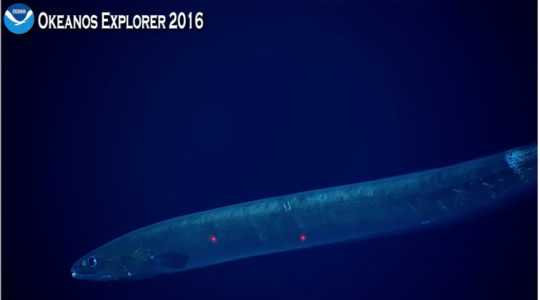
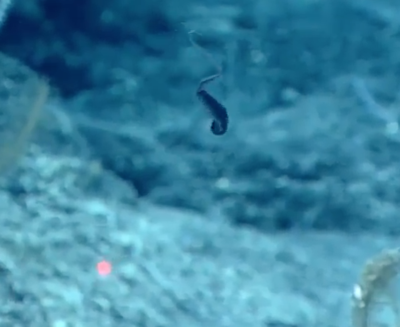
an eel!!!!!!!!!!!
“he has no right swimming that fast in this cold of water. i don’t know what this guy is up to, but it’s rude” – an actual scientist on the NOAA okeanos exploration
ok they’re not streaming rn but they should be later this afternoon!!
they’re in the water again right now/currently descending (as of 3:30 PM CST/4:30 PM EST)
“oh, mm. those are not the right coordinates. i almost sent us into the cliff :)” i love NOAA scientists
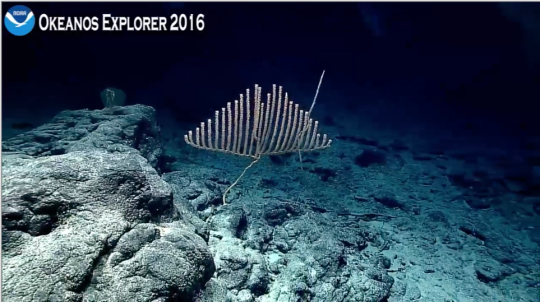
they’re at the bottom!! octocoral
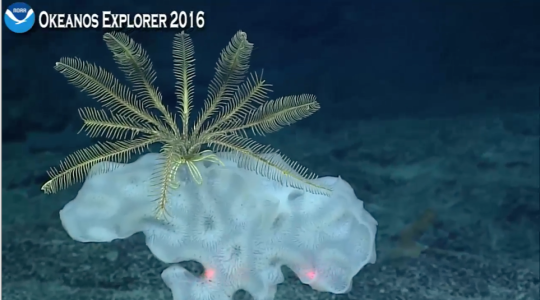
glass sponge with “a crinoid hat, [churlish giggle]” according to the scientists
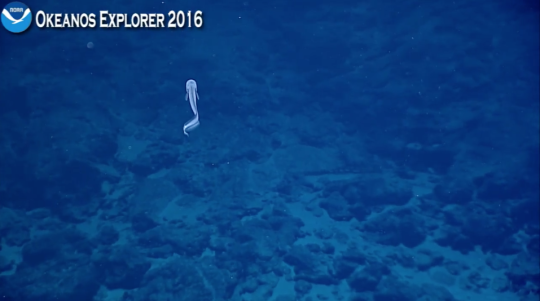
cusk eel!
bonus: “i like corals better, they don’t run away from us”
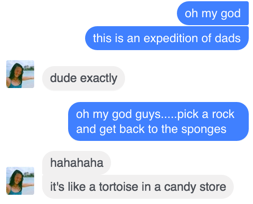
they cannot decide which rock to pick for sampling this is absurd
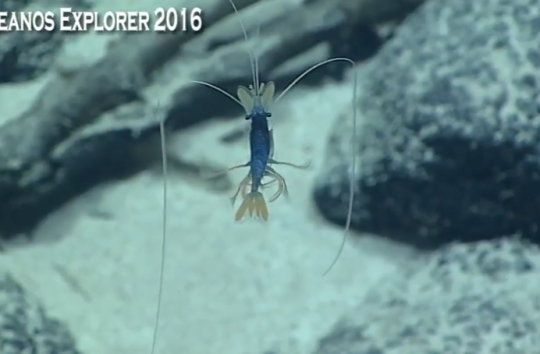
a beautiful blue shrimp!!
“i can’t call it bob, i’ll call it bob and then scott will tell me it’s a female again”
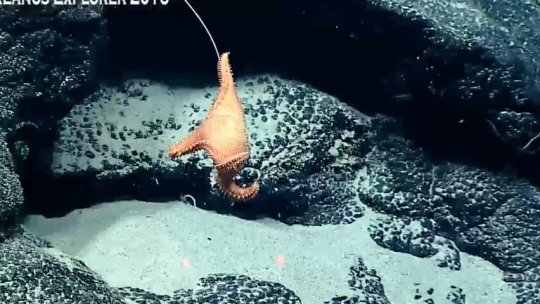
“what is he doing to this poor coral? he’s tipped it over and he’s eating it, the darn guy!!”
I like to ask people why they think it is that chimpanzees–our closest living relatives–can’t speak. Usually people say it’s because they’re not smart enough, but that isn’t quite the case. Many chimps (and other apes!) have been taught to associate words, and pictures with abstract concepts in laboratory settings. Koko the gorilla famously learned ASL! Now they don’t have a great grasp of syntax, so it isn’t an exact 1:1 language ratio, but a chimpanzee can work its way through a (rudimentary) sentence.
So why can’t they speak like us? It’s more of a physical incapability than a mental one. Humans have much more precise muscle control over the larynx, tongue, and all those other lovely mouth and throat organs responsible for producing the many differentiated sounds that make up human speech. It’s theorized that this precise muscle control and resulting ability to make so many differentiated sounds was a vital evolutionary precursor to us developing speech. An example from an old textbook of mine said if a chimpanzee tried to say “peanut butter” it would come out “eeeahhuhhheehhr”, just rough almost vowel noises.
That brings us to birds. Birds don’t have vocal chords or a larynx like us mammals, they have something way better!
Magic!
And also, a syrinx, which is their analogous vocal organ.
Fun Fact: vultures don’t have a syrinx, and the only sound they make is like rasping death.
Syrinxes can do all sorts of cool things. For example, birds can push air through either side of this organ at will, enabling them to make TWO UNRELATED noises at the same time! They can also change the tension in their bronchial membranes, which is the important factor in their ability to mimic human speech.
But you really only have to stick your head outside for a minute to know that birds can and do make a lot of cool noises. Imo, the how of birds mimicking human speech is a lot less interesting than the why.
We know that birds are very auditory(and visual, but that’s not relevant now). Birds are also highly social, and highly intelligent just like our chimp cousins. And since they have the ability to make all these different noises, they do just that to communicate. Birds sing, they make contact calls, they make begging calls, they make alarm calls, they chatter at each other to express mood and condition, etc. Some species of birds have names; both family names parents give to their young so they can recognize each other, and names specific to an individual. Family groups, and overall social structure is very important to birds, so they invest a lot of energy and brain space in maintaining those relationships–just like us.
So why do parrots talk? Well, parrots are among the most social and intelligent of a group of extremely social and intelligent animals. The reigning theory on why parrots so readily mimic human speech is –absent any other recognizable conspecifics–they become so desperate to connect to the other members of their flock, that they start to copy human noises in an attempt to communicate. This has mixed results. People like when their pets ‘talk’, so the bird succeeds in getting attention, affection, and probably a treat. But the question remains, are they getting what they actually want and need? Because at the end of the day, every single pet parrot is a captive bred (or outright stolen) wild animal capable of forming deep social bonds within their chosen family groups that is instead riding a tiny unicycle and singing a pop song because people think it’s ‘cute’ and ‘funny’.
(this last photo is meant to represent humanity’s relationship with the avian world, and my thoughts on parrot ownership)
For more on how bird brains and language acquisition work and how birds are basically superior to us in every way, I recommend “The Genius of Birds” by Jennifer Ackerman! http://www.jenniferackermanauthor.com/genius-ofbirds/







 Kimchi and Justice