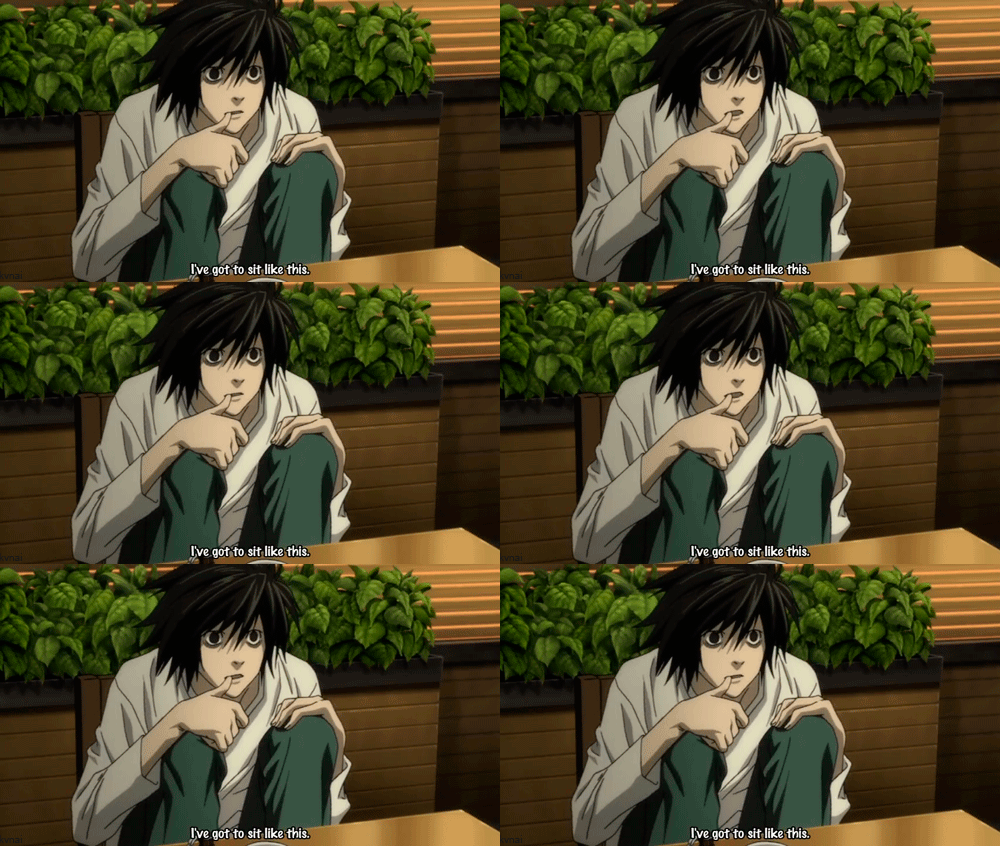
Thatadhdfeel when an adhd reddit thread is how you learn that sitting with your legs up on the chair well into adulthood is an adhd thing.
wait seriously? not sitting in chairs properly is an adhd thing?
(i mean i’d guess it could be a thing for many other reasons but…huh.)
I’ve never seen and can’t find any research on this, but my experience both as ND and in the field is that sensory issues (which come with ADHD, ASD, and SPD) usually lead to unusual sitting and/or standing postures.
Think about it though. Think about a regular standard chair, think what it’s like to sit on it. It’s pretty uncomfortable, right? Wrong! Most people actually have no trouble sitting on regular chairs! that’s why they are designed the way they are! most people can sit on them just fine without squirming or feeling pain or feeling the need to fit their legs onto the seat too!
And if this thought, that chairs aren’t just badly-designed discomfort-items, is as mind-boggling a thought to you as it is to me, you probably aren’t all that neurotypical (I won’t say either way about it being ADHD specific since I don’t have ADHD as far as I know, but I’m not neurotypical).
What the heckie?
I mean, I’m also short, so I just always assumed that was my problem with being comfortable in chairs.
But even in the car, I end up scrunching into the pressure stim of having my legs crossed or under me, so!
yeah this is def an autism/ADHD/etc thing. you see it all the time in coded characters as well
…there’s no WAY neurotypicals can possibly like chairs. Can some people without ADHD or autism chime in?
The invention of comfortable chairs/chaise lounges in the 1700’s caused a moral panic because it was finally comfortable to sit and read. Until the advent of modern office life, most people were not expected to sit in chairs while doing their jobs. Thus the stereotype of a tailor sitting cross legged on his table while he works.
Stools were cheaper and easier to make than chairs, which explains the comfort/stimming angle a little bit more. You can scrunch your feet into the rungs on stools, wrap your legs around the stool legs, and rock more securely than in a table chair. Additionally, it’s relevant that archetypal comfort chair is a rocking chair.
TL;DR: chairs have always sucked, but you’re not imaging your sensory issues.
that autism feel when your bad motor skills show up in weird ways so no one believes you that you have this symptom, like you can do very fine needlework and tiny drawings but you always misjudge how close you are to the corners of tables and chairs so you’re forever hitting your legs on things, and you just can’t seem to judge how far back to tip a can or a bottle sometimes, so you’ll spill soda all down your chin in public and feel completely embarrassed
SO. MANY. INEXPLICABLE. BRUISES. (I tend to phrase it as “sorry my proprioception just fainted.”)
People say that you should really do something out of your comfort zone. Why? I worked very hard to find my comfort zone. It was really rough and I can’t even get there that often. Takes all day and I gotta get off to a good start and do all the right things and avoid the right people and find all the right people and do all of these things to find my comfort zone. And then I’m supposed to do something outside of my – Fuck you! You do something outside your comfort zone. My comfort zone is hard-won….
But then, that’s where popular culture and pop psych comes in and wants – and the shtick I was looking at last night was that like, so, if it’s ‘afraid’, then, ‘You should do the things you’re afraid of’. Why? Why? I have felt quite enough fear. I don’t think I will benefit from more fear. I don’t think it’s the missing element in my life. I don’t think that’s the thing I need to be seeking out. ‘Go to the places that scare you.’ No! I have carved out an awesome space in which I don’t have to visit the places that scare me. I don’t like them there. I’ve been there. I know more about them than you, person telling me to go to the places that scare me.
No! I have carved out an awesome space in which I don’t have to visit the places that scare me. I don’t like them there. I’ve been there. I know more about them than you, person telling me to go to the places that scare me.
After looking at a lot of the criticisms of the proposed DSM5 criteria, I’ve been thinking about what potential criteria would look like if they were written with the perspective of someone autistic in mind–meaning looking at the underlying differences, not behavioural ones. These are what I’ve come up with so far. I would love to be able to refine and validate these/something built off of these some time in the future to replace the crap being put out in DSM5.
A. Differences in perception (at least 3)
Sensory defensiveness (ie, complaints or avoidance of any of the following: loud noises or places, bright lights, textures (food or object/clothing), tastes, smells, touch)
Sensory seeking (ie, stims or stimming behaviour such as rocking, flapping, finger flicking, hair twirling, spinning objects, etc or actively desiring any of the following: deep pressure or touch, vestibular sensation [swings, spinning in any context, etc], specific smells, tastes, or textures)
Auditory processing difficulties
Unusual, awkward, or delayed motor skills, or asymmetry between gross and fine motor skills (ie, clumsy but with strong fine motor skills, good gross motor skills with poor hand-writing or table skills)
A reduced or lack of conscious awareness and/or use of allistic (not autistic) nonverbal behaviour and communication such as facial expression, gesture, and posture.
This criterion should not exclude persons who have learnt to read or otherwise comprehend nonverbal behaviour by rote learning, particularly adults. Intentional learning to overcome an inherent difficulty in comprehension is supportive of this criterion. It should also not exclude persons who have been taught to use nonverbals to be less visibly different. In such cases, internal report of difficulty should take precedence over apparent behaviour.
B. Differences in cognition (at least 3, one of which must be 1 or 2)
Difficulty in beginning or ending (at least 1):
Perseverative thoughts or behaviours
Needing prompts (visual, verbal, hand-over-hand, etc) to begin or finish a task
Difficulties planning complex activities
Catatonia
Difficulty switching between activities
Lack of apparent startle response
Difficulty in using language (at least 1):
Problems with pronoun use that are developmentally inappropriate
A reduced or lack of awareness of tone in self (ie, speaks in a monotone, childish, or otherwise unusual manner) and/or others (ie, does not perceive sarcasm or follow implied prompts, responds to rhetorical statements and questions in earnest)
A reduced or lack of awareness of volume (ie, speaks too loud or too quietly for the situation)
No functional language use
Echolalia
Mutism in some or all situations
At least one special interest in a topic that is unusual for any combination of intensity (ie, does not want to learn/talk about anything else, collects all information about the topic) or subject matter (ie, unusual, obscure, or not considered age appropriate). Topics may be age appropriate and/or common (such as a popular television show or book), but the intensity of interest and/or specific behaviour (such as collecting or organising information as the primary focus) should be taken into account.
Asymmetry of cognitive skills
Talents in pattern recognition, including music, mathematics, specific language structures, puzzles, and art.
A tendency to focus on details instead of the broader picture, across contexts.
C. These differences cause impairment and/or distress in at least one context (ie, school, work, home), which may be variable over time. D. Symptoms should be present in early childhood, but may not be noticable until social demands outpace compensatory skills, at any age
 Kimchi and Justice