How can we distinguish what is biologically determined from what people merely try to justify through biological myths? A good rule of thumb is ‘Biology enables, culture forbids.’ Biology is willing to tolerate a very wide spectrum of possibilities. It’s culture that obliges people to realise some possibilities while forbidding others. Biology enables women to have children – some cultures oblige women to realise this possibility. Biology enables men to enjoy sex with one another – some cultures forbid them to realise this possibility.
Culture tends to argue that it forbids only that which is unnatural. But from a biological perspective, nothing is unnatural. Whatever is possible is by definition also natural. A truly unnatural behaviour, one that goes against the laws of nature, simply cannot exist, so it would need no prohibition. No culture has ever bothered to forbid men to photosynthesise, women to run faster than the speed of light, or negatively charged electrons to be attracted to each other.
In truth, our concepts ‘natural’ and unnatural’ are taken not from biology, but from Christian theology. The theological meaning of ‘natural’ is ‘in accordance with the intentions of the God who created nature’. Christian theologians argued that God created the human body, intending each limb and organ to serve a particular purpose. If we use our limbs and organs for the purpose envisioned by God, then it is a natural activity. To use them differently than God intends is unnatural. But evolution has no purpose. Organs have not evolved with a purpose, and the way they are used is in constant flux. There is not a single organ in the human body that only does the job its prototype did when it first appeared hundreds of millions of years ago. Organs evolve to perform a particular function, but once they exist, they can be adapted for other usages as well. Mouths, for example, appeared because the earliest multicellular organisms needed a way to take nutrients into their bodies. We still use our mouths for that purpose, but we also use them to kiss, speak and, if we are Rambo, to pull the pins out of hand grenades. Are any of these uses unnatural simply because our worm-like ancestors 600 million years ago didn’t do those things with their mouths?
Sapiens: A Brief History of Humankind (Harari, Yuval Noah)
Interviewer: How would you explain DNA to an 8 year old?
Me: I would tell them that DNA is like Legos. Like four different colored legos. Individually, they can’t do much, but when you build them in a certain order, you can make different things, like a house or a tree or little lego people. It’s the same in your body. Four different DNA molecules fit together to create the unique you.
Interviewer: *brief pause* That’s a really good answer.
Me: Thank you. I like Legos and science.
ok psa NOAA is literally livestreaming deep sea exploration footage from one of their submersibles!!! like right now!!! you can watch them discover parts of the ocean that NOBODY HAS EVER SEEN
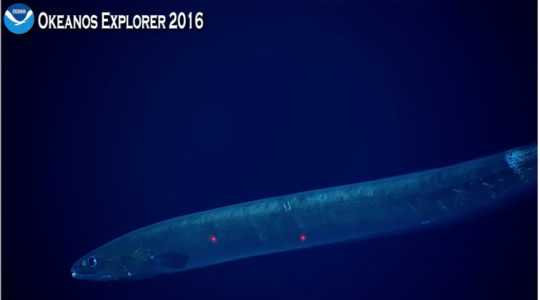
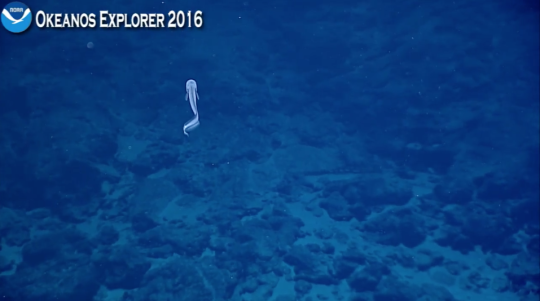
an eel!!!!!!!!!!!
“he has no right swimming that fast in this cold of water. i don’t know what this guy is up to, but it’s rude” – an actual scientist on the NOAA okeanos exploration
ok they’re not streaming rn but they should be later this afternoon!!
they’re in the water again right now/currently descending (as of 3:30 PM CST/4:30 PM EST)
“oh, mm. those are not the right coordinates. i almost sent us into the cliff :)” i love NOAA scientists
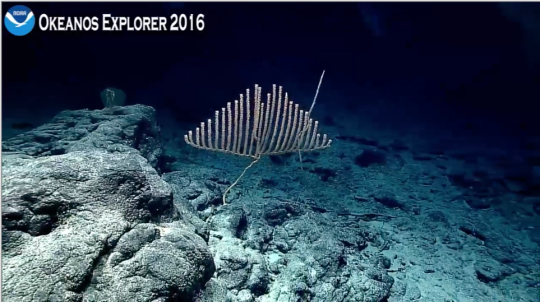
they’re at the bottom!! octocoral
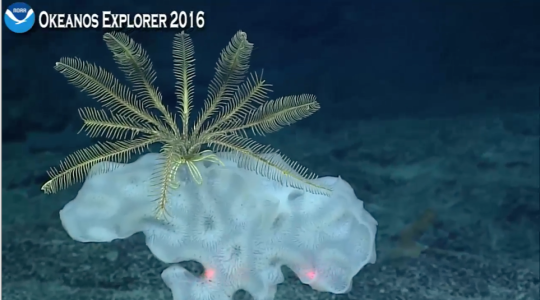
glass sponge with “a crinoid hat, [churlish giggle]” according to the scientists
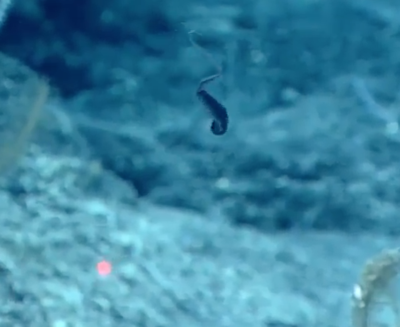
cusk eel!
bonus: “i like corals better, they don’t run away from us”
they cannot decide which rock to pick for sampling this is absurd
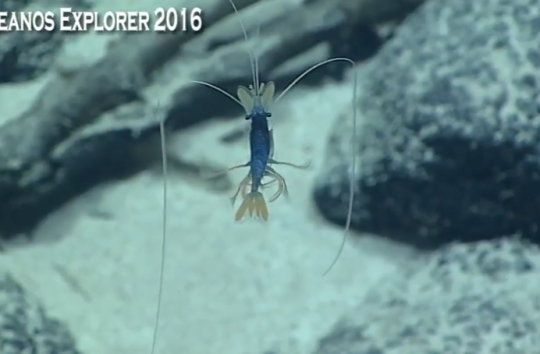
a beautiful blue shrimp!!
“i can’t call it bob, i’ll call it bob and then scott will tell me it’s a female again”
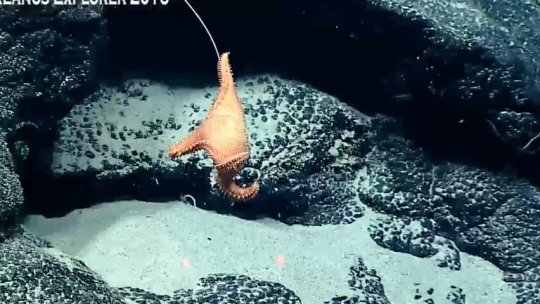
“what is he doing to this poor coral? he’s tipped it over and he’s eating it, the darn guy!!”
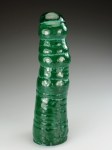
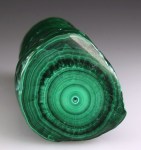
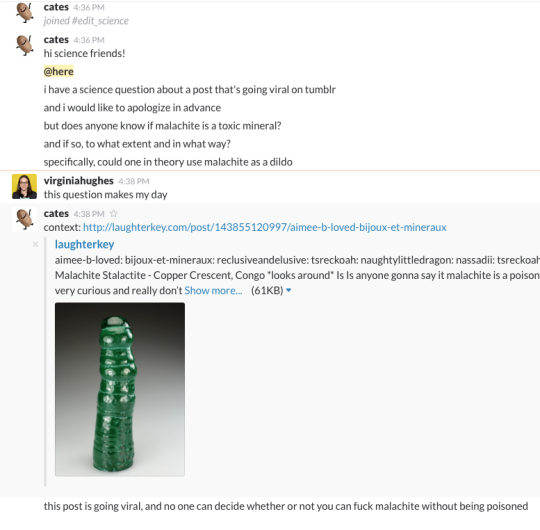
malachite is a poisonous mineral. please do not fuck the malachite stalactite
@lizaleigh do you know any rock people that can confirm/deny because I am very curious and really don’t feel like getting into a conversation with my geophysicist brother that MAY somehow get back to the fact I saw a malachite that looked like a weird dildo.
…sadly, I am not on good enough terms with any of our partner geologists to just attach this to an email with the subject line: “EXPLAIN.”
Although I think @mollisaurus is a mineral person. Thoughts?
oh geeze, i’m kinda rusty on minerals but malachite is just copper carbonate and is really common in both antique and modern jewelry so i think like if you were really gun-ho about it you could go ahead and put it wherever you want?
It’s really only a problem if you’re polishing or cutting it. The particles would be bad to breathe. It’s rather porous too, so I would worry about bacteria growing. Well, being literal anyway… Better to leave the poor thing alone. ._.
I mean it kinda depends on where you stick it because malachite does not like acidic environments very much and the malachite will degrade and also might dye your bits blue-green as the copper dissolves out.
So use a condom when fucking rocks is the takeaway here.
Oh my god guys it’s poisonous
It is super poisonous
There is a reason we do not use it in make up any more
Not even with a condom, do not fuck the rock
Try this one instead.
malachite literally explodes in water does it not?
I… no… I think you’re thinking of pure sodium?
Malachite is however water soluble, which really just means it will poison you quicker
This is both hilarious and cool as fuck because you’re getting all this information on minerals and rocks. You’re also watching people argue over wether or not you can fuck this rock
I go on hiatus for a week and come back to find tumblr molesting my post, but hey, at least we all learned something so yay tumblr, you just keep on being you.
I’m still not sure if I can fuck this rock.
I’m looking into it.
UPDATE:
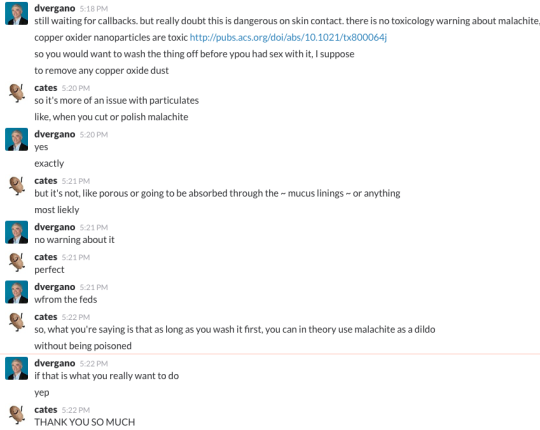
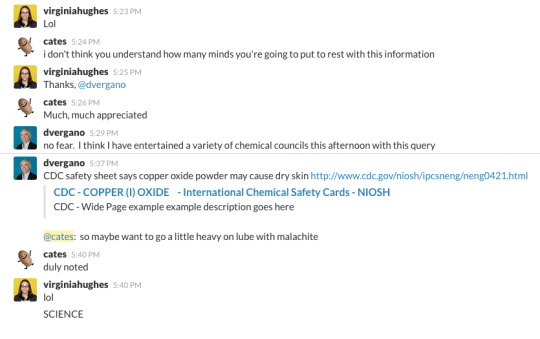
Today in “I’m so sorry, coworkers, it’s for Tumblr,” I brought this post to the attention the science reporters at BuzzFeed. Dan Vergano did a some research and weighed in on the question “Can you use malachite as a dildo or is it toxic?”
The answer is “It’s probably fine, just wash it first and maybe use a bunch of lube.”
Oh man this got so much better than the last time I saw this post
This is my favourite. Science side of tumblr: asking the REAL questions
*biologist crashes through the underbrush*
Ok so here’s the thing though
Malachite is not poisonous to YOU. BUT fucking this stalactite will probably wreck your vaginal flora and leave you with a gruesome infection within a couple days.
Want details? SO GLAD YOU ASKED, ‘CAUSE HERE THEY ARE.
• Malachite is not copper oxide. It’s Cu2CO3(OH)2. Like most carbonates it’s water soluble– that’s how it became a stalactite in the first place! And technically any given chunk of “malachite” isn’t just malachite– it’s a mix of various copper carbonates & oxides. This will become important later.
• When malachite dissolves it makes a bunch of copper (Cu++) ions. Cu++ is GREAT at killing bacteria and fungi– so good at it that sprays with Cu++ get used a lot as a spray in agriculture to stop plant disease. It takes such a large dose to harm larger organisms that copper sprays are used a lot in organic agriculture (like Bordeaux mixture).
So bottom line, yes malachite is technically nontoxic to humans. But it kills bacteria when it dissolves and releases Cu++.
• Malachite dissolves somewhat slowly in water– but vaginal secretions aren’t just any water. A healthy human vagina has a pH of 3.8-4.5 and a salinity of about 0.9%. It’s also warmer than your average underground cave at 37°C (or 98.5°F in American meat units). As luck would have it, acidity, salinity, and warmth all make malachite dissolve faster.
• In other words, the human vagina dissolves malachite.
• I have no deeper explanation for why human females can dissolve rocks with our genitals. It simply is.
• Gonna to take a quick moment to point out that sex toys that dissolve when you use them are maybe not the best investment.
• Anyway the key question now is “how fast does the human vagina dissolve malachite?” Are we talking geological timescale, a Nazis-in-Indiana-Jones situation, or something in between? If the reaction kinetics of dissolution are very slow, then there’s nothing to worry about. An encounter with a stalactite would have to last years for enough Cu++ to leach out to cause problems. If it’s quick then we’re in trouble.
• Unfortunately it looks like nobody really knows. One of the best sources on how malachite dissolves & precipitates in water– an EPA document on how to avoid too much Cu++ in municipal drinking water systems– helpfully says “The kinetic constraints on the formation of these solids in water systems are largely unexplored” (p. 42) because end equilibrium points is all you need to run a city water system safely. In other words, the experiments that would tell us how fast malachite dissolves in various types of water just don’t exist because nobody’s ever needed to know before. So we’d better assume it’s going to happen reasonably quickly, #for safety.
• So in best scientific fashion, we’re just going to bullshit our way ahead using what facts we DO have on hand: endpoint equlibria.
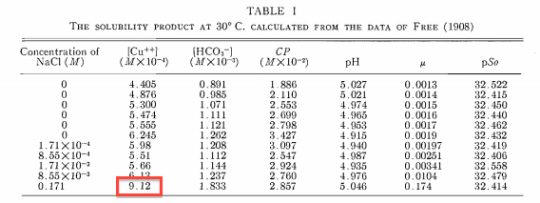
That orange box is how many moles of dissolved Cu++ Scaife got from sticking malachite in some water that had 0.171 moles NaCl/L (body salinity is about 0.154 moles NaCl/L so this is slightly less salty than people) at 30°C. He’s got no acidity in there, and again the salinity and temperature are slightly lower than people. But this is probably the closest we’re going to get to data on how malachite behaves in vaginas anytime soon, folks. From this we can take away that if you leave malachite alone in a vagina you’ll get AT LEAST 9.12 x 10^-4 moles/L, or 5.8 ppm, of Cu++ at equilibrium.
• Recall from above that most “malachite” isn’t actually pure malachite, it’s a mix of various copper carbonates & oxides. The EPA document elaborates: “[T]raditional ‘eyeball’ identification of malachite by its blue-green color is extremely
unreliable, because almost all cupric hydroxysulfates, hydroxycarbonates, hydroxychlorides,
and even fresh cupric hydroxide can be some shade of blue-green. … Thus, the uncertainty in the computed copper
concentration in equilibrium with malachite is at least about a factor of 2 … until further experimental data focusing on this problem is generated.”
In other words, “do your math and then double how much Cu++ you think is going to be in the water, just in case.” So that gives us 11.6ppm Cu++, at equilibrium, with malachite in a (til now!) healthy vagina.
• Next step: do we have any idea what happens to bacteria in acid conditions with copper? OH MY GOD WE TOTALLY DO. Gyawali et al 2011 checked this out in the context of “so what if we rinsed tomatoes with a solution of lactic acid and copper, because that would be a safe & organic way to get rid of E. coli?” So now this post has officially ruined stalactites, vaginas, and tomatoes.
^This would happen. These are the counts of 4 E. coli strains exposed to various levels of lactic acid & Cu++ for 8 hours. This table only shows the end counts but it represents the death of 99.7% of bacteria*.
• Losing 99.7% of your vaginal flora is seriously bad news. You’re looking at really good odds of a yeast infection, bacterial vaginosis, and/or other infection issues. And that’s if you’re lucky enough to not be in the 4% of the population or so that’s sensitive to skin contact with copper.
• The good news? Biochemically speaking, you’re probably ok to put it in your butt. It’s not as acidic or salty in there, plus there’s a huuuuuge stockpile of gut microbes right upstream that can quickly repopulate the colon after spelunking is complete. However this stalactite is not flared at the base so it is the wrong shape for putting in your butt. Do not put this stalactite in your butt.
• This all looks like fun and games, but I think it’s really interesting that the internet’s mistake in concluding that this stalactite is fuckable is very similar to the mistake made by the Flint water management system. Hear me out.
• Central to the Flint lead poisoning crisis is that authorities only looked at & tested Flint’s water in its central treatment plant before it went out through the pipes. Not after it went through the pipes. They did not consider what would happen biochemically as it went through the pipes and metals started dissolving.
• Similarly, in concluding that the stalactite is fuckable, the internet only considered the stalactite itself. Not the biochemical processes that would happen to it as it, welp, went through the pipes.
• Media frequently reports that the Flint River’s water is “corrosive,” leading many to believe the river is full of industrial waste. This ain’t the case. You’d need industry to fill a river with industrial waste, and industry left decades ago. That’s why Flint’s so poor. So what IS in the water? Road salt. Plain old stupid road salt. The old Detroit-based source didn’t have salt because it came from Lake Huron which has a large, mostly rural watershed. Meanwhile the Flint River runs through a lot of towns, making it slightly salty as everything melts down in spring. And as we recall from the stalactite experience, a little salt is all it takes to get metals to dissolve.
• Information on this engineering problem was not coming through clearly from the engineering or chemistry sides. It took a biologist, pediatrician Mona Hanna-Attisha, to document the real-time results and provide the data to kick-start a high-level investigation.
• Morals of the story: when dealing with a biological system pls consider asking a biologist, your vagina and/or city could depend on this
• Pls use a condom when fucking any water-soluble material
• Still don’t put the stalactite in your butt -3/10 do not recommend
Me, at an art store: I need a paint marker with low toxicity and a delicate tip.
Employee: What kind of project are you working on?
Me: It’s for a research project. I just need bright colors.
Employee: What medium are you using? Canvas or paper?
Me: uh….spiders.
Employee: Plastic or felt?
Me: ….live spiders. Like, from the forest.
Employee: ….
Employee: I have to get back to the counter.
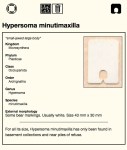
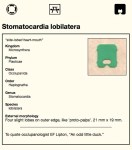
You know those little things that keep bread bags closed? Well, the internet would like to tell you about them. If you’re not doing anything too important right now, I think you should visit HORG (that’s the Holotypic Occlupanid Research Group) and explore a beautiful, obsessive, hilarious taxonomy of occlupanids.













 Kimchi and Justice