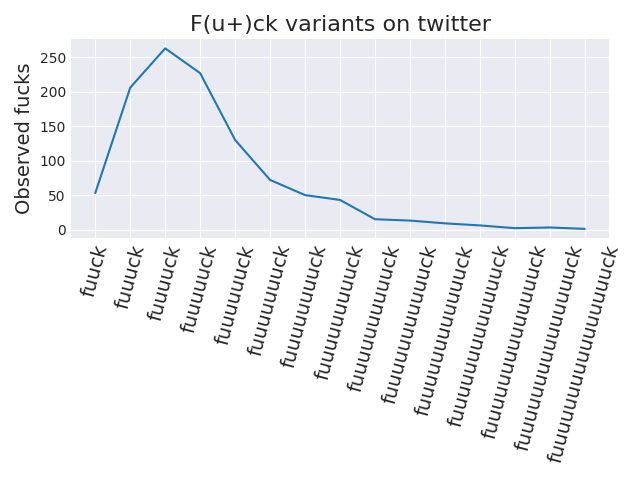
In the case of the f-word, we found that while the average usage was (unsurprisingly) negative, a quarter of the tweets were strongly positive. To illustrate this emotional mélange, we selected nine representative examples at various intervals with inferred sentiment shown in parenthesis. For comparative purposes (and because this is the internet) all of the selected tweets pertain to cats.
– I hate cats.. just evil little fuckers (-0.91) – I just want to go to fucking sleep these stupid ass cats are fighting right outside my window (-0.85) – I just got a cat fucking drunk and he’s abusive (-0.78) – i want a cat now who the fuck am i (-0.49) – Let your cat be a fucking cat. (0.0) – honestly scaring cats is fucking hilarious (0.48) – aye bruh how bout you show yo cats some love too mufucka (0.64) – Cats are just so fucking perfect and I love them and want them all (0.88) – I FUCKING LOVE MY CATS SO MUCH LOOK AT THIS BEAUTIFUL GUY I SWEAR WHAT A SMART LOYAL LOVING ANIMAL GIFTED TO ME (0.96)
The fact that this language is at a point where “I don’t care” and “behold the field in which I grow my fucks” mean exactly the same thing blows my mind sometimes
i really love our generation’s joke trend of like, very calm but incredibly inflated hyperbole. like nobody says “oh she’s pretty” anymore we say “i would willingly let her murder me” and everyone is just like “lol same”
i think “same” is also great and “me,” i love when somebody reblogs a picture of like, a lizard, and just says “me” and we all know exactly what they mean. the current online Humor Discourse is remarkable because we trade exclusively in metaphors and implications and nobody ever, ever says anything outright and yet EVERYBODY understands each other perfectly
This reminds me of the time when I was on vacation with my family and we were hiking, and after using a rest stop, the conversation turned to the grossness of outhouses and port-a-potties, and I said that if I ever got splashback from a port-a-potty, “my soul would depart my body.” My parents found that hilarious, and my dad commented that my generation can be so clever with words bc he would only think to say something like “It would be disgusting” which doesn’t convey the sentiment nearly as well as “my soul would depart my body.”
we, in a manner akin to that of a man who once was, in Rome, an orator of significant skill, who was then for his elegance of speech renowned and now for his elaborate structure of sentences cursed by generations of scholars of Latin, the language which he spoke and we now study, Cicero, write, rather than by any efficiency, functionality, or ease of legibility have our words, our honors, the breaths of our hearts, be besmirched.
A REAL LIST OF ACTUAL NAMES AND THEIR (approximate) PRONUNCIATIONS: Siobhan — “sheh-VAWN” Aoife – “EE-fa” Aislin – “ASH-linn”
Bláithín – “BLAW-heen”
Caoimhe – “KEE-va”
Eoghan – Owen (sometimes with a slight “y” at the beginning)
Gráinne – “GRAW-nya”
Iarfhlaith – “EER-lah” Méabh – “MAYV” Naomh or Niamh – “NEEV” Oisín – OSH-een or USH-een Órfhlaith – OR-la Odhrán – O-rawn Sinéad – shi-NAYD Tadhg – TIEG (like you’re saying “tie” or “Thai” with a G and the end)
I work with an Aoife and I have been pronouncing it SO WRONG
As someone who is trying and failing to learn Gaelic, I feel like is an accurate portrayal of my pain.
This is the Anglicized spelling of a people who really fucking hate the English.
No, no, this is the orthographic equivalent of installing Windows on Mac.
The Latin alphabet was barely adequate for Latin by the time it got to the British Isles, but it’s what people were writing with, so somebody tried to hack it to make it work for Irish. Except, major problem: Irish has two sets of consonants, “broad” and “slender” (labialized and palatalized) and there’s a non-trivial difference between the two of them. But there weren’t enough letters in the Latin alphabet to assign separate characters to the broad and slender version of similar sounds.
Instead, someone though, let’s just use the surrounding vowels to disambiguate–but there weren’t enough vowel characters to indicate all the vowel sounds they needed to write, so that required some doubling up, and then adding in some silent vowels just to serve as markers of broad vs. slender made eveything worse.
They also had to double up some consonants, because, for example, <v> wasn’t actually a letter at the time–just a variation on <u>–so for the /v/ sound they <bh>. AND THEN ALSO Irish has this weird-ass system where the initial consonant sound in a word changes as a grammatical marker, called “mutation,” so they had to account somehow for mutated sounds vs. non-mutated sounds, which sometimes meant leaving a lot of other silent letters in a word to remind you what word you were looking at.
And then a thousand years of sound change rubbed its dirty little hands all over a system that was kind of pasted together in the first place.
My point is, there is a METHOD to the orthography of Irish besides “fuck the English.” The “fuck the English” part is just a delightful side-effect.




 Kimchi and Justice