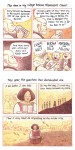
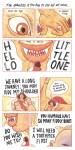
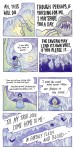
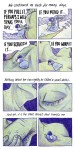
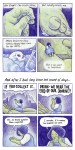
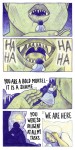
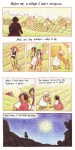
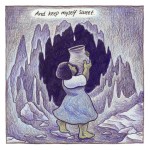
Here’s SWEETROCK, the 24 hour comic I drew this year!
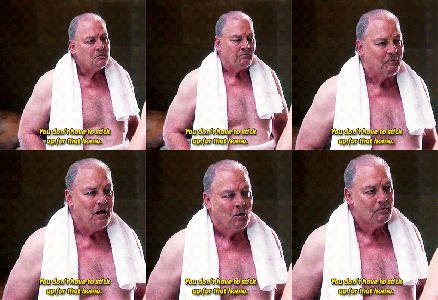
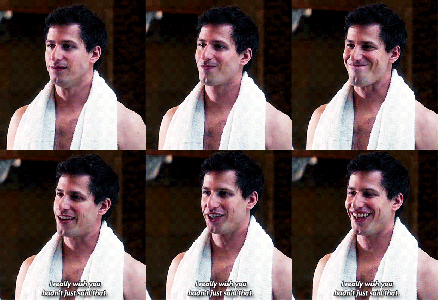
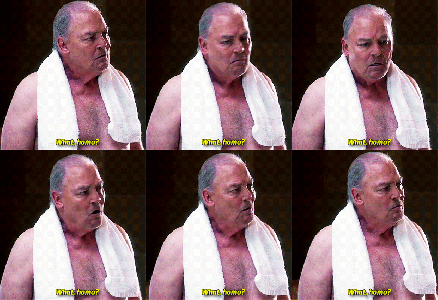
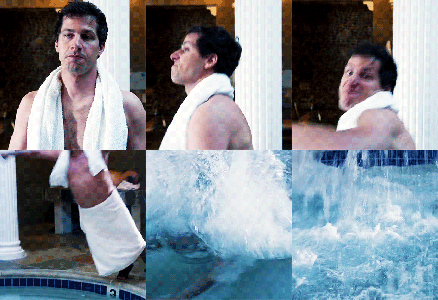
brooklyn nine nine literally hitting homophobia in the face
I can never decide how I feel about this scene. On the one hand, it’s showing homophobia as totally unacceptable, worth punching someone over. That’s good! And it’s the friend of the gay man, so it’s showing that you should stand up for gay people even if you aren’t, which is also good.
But do you think any of the people who wrote or acted this have ever done this in their real lives? Anything even close?
I’m tired of straight people fantasizing aggressively about what they WOULD do and then never doing anything. It’s like that bit from Louis CK about how he sees servicemembers in uniform on planes and fantasizes about giving up his first class seat, and feels good about it without actually giving up his seat for them.
Don’t pretend to be a better ally than you are just because you’ve daydreamed about a power fantasy where you get to punch someone and feel justified.
In real life, I remember one–exactly one–time where a straight friend stood up for me when I was getting bullied by homophobes. She walked me from one class to the next because I’d been chased down those stairs the previous day by older boys shouting at me that I was a lesbian. One friend, one time, out of how many incidents? How many times in the five years between thirteen and eighteen before I got the hell out of that town?
And straight people want to pat themselves on the back? Do something worth self-congratulating, at least.
I liked this scene because it’s the climax of an episode in which Jake (dude doing the hitting) got to meet a guy he’d always admired for his work (dude being punched for being a homophobe) and hang out with him. And like Jake spends the early part of the episode going off about how cool this guy is and how important the work he’s done is and how this guy is the real deal and getting to hang out with this guy is basically a dream come true for Jake.
And then as he’s spending time with him, Jake starts to realize that this guy’s stuck in a way of doing things that’s about 30 years out of date, and that the way people did things 30 years ago is actually, in a lot of ways, really, really shitty. And he has a few ‘yikes’ moments, but basically he just kind of chalks it up to history, because this isn’t how cops and journalists do things now, so it’s not great, but not worth throwing down over. Like, he tries verbally getting the guy to knock it off, but nothing’s taking.
But then this happens, and it’s something that Captain Holt has been very up front about still being a huge issue in the police force, and it’s just the final nooooooooooope moment for Jake.
So the take-away message is less about punching homophobes and more about not turning a blind eye to somebody’s rancid behavior or attitudes or giving them a pass just because you respect their work or used to think they were super-cool or think of them as an authority on something.
Also, maybe the way we get more people doing the right thing in real life is by showing them what it looks like in popular media.
When I was nine, possibly ten, an author came to our school to talk about writing. His name was Hugh Scott, and I doubt he’s known outside of Scotland. And even then I haven’t seen him on many shelves in recent years in Scotland either. But he wrote wonderfully creepy children’s stories, where the supernatural was scary, but it was the mundane that was truly terrifying. At least to little ten year old me. It was Scooby Doo meets Paranormal Activity with a bonny braw Scottish-ness to it that I’d never experienced before.
I remember him as a gangling man with a wiry beard that made him look older than he probably was, and he carried a leather bag filled with paper. He had a pen too that was shaped like a carrot, and he used it to scribble down notes between answering our (frankly disinterested) questions. We had no idea who he was you see, no one had made an effort to introduce us to his books. We were simply told one morning, ‘class 1b, there is an author here to talk to you about writing’, and this you see was our introduction to creative writing. We’d surpassed finger painting and macaroni collages. It was time to attempt Words That Were Untrue.
You could tell from the look on Mrs M’s face she thought it was a waste of time. I remember her sitting off to one side marking papers while this tall man sat down on our ridiculously short chairs, and tried to talk to us about what it meant to tell a story. She wasn’t big on telling stories, Mrs M. She was also one of the teachers who used to take my books away from me because they were “too complicated” for me, despite the fact that I was reading them with both interest and ease. When dad found out he hit the roof. It’s the one and only time he ever showed up to the school when it wasn’t parents night or the school play. After that she just left me alone, but she made it clear to my parents that she resented the fact that a ten year old used words like ‘ubiquitous’ in their essays. Presumably because she had to look it up.
Anyway, Mr Scott, was doing his best to talk to us while Mrs M made scoffing noises from her corner every so often, and you could just tell he was deflating faster than a bouncy castle at a knife sharpening party, so when he asked if any of us had any further questions and no one put their hand up I felt awful. I knew this was not only insulting but also humiliating, even if we were only little children. So I did the only thing I could think of, put my hand up and said “Why do you write?”
I’d always read about characters blinking owlishly, but I’d never actually seen it before. But that’s what he did, peering down at me from behind his wire rim spectacles and dragging tired fingers through his curly beard. I don’t think he expected anyone to ask why he wrote stories. What he wrote about, and where he got his ideas from maybe, and certainly why he wrote about ghosts and other creepy things, but probably not why do you write. And I think he thought perhaps he could have got away with “because it’s fun, and learning is fun, right kids?!”, but part of me will always remember the way the world shifted ever so slightly as it does when something important is about to happen, and this tall streak of a man looked down at me, narrowed his eyes in an assessing manner and said, “Because people told me not to, and words are important.”
I nodded, very seriously in the way children do, and knew this to be a truth. In my limited experience at that point, I knew certain people (with a sidelong glance to Mrs M who was in turn looking at me as though she’d just known it’d be me that type of question) didn’t like fiction. At least certain types of fiction. I knew for instance that Mrs M liked to read Pride and Prejudice on her lunch break but only because it was sensible fiction, about people that could conceivably be real. The idea that one could not relate to a character simply because they had pointy ears or a jet pack had never occurred to me, and the fact that it’s now twenty years later and people are still arguing about the validity of genre fiction is beyond me, but right there in that little moment, I knew something important had just transpired, with my teacher glaring at me, and this man who told stories to live beginning to smile. After that the audience turned into a two person conversation, with gradually more and more of my classmates joining in because suddenly it was fun. Mrs M was pissed and this bedraggled looking man who might have been Santa after some serious dieting, was starting to enjoy himself. As it turned out we had all of his books in our tiny corner library, and in the words of my friend Andrew “hey there’s a giant spider fighting a ghost on this cover! neat!” and the presentation devolved into chaos as we all began reading different books at once and asking questions about each one. “Does she live?”— “What about the talking trees” —“is the ghost evil?” —“can I go to the bathroom, Miss?” —“Wow neat, more spiders!”
After that we were supposed to sit down, quietly (glare glare) and write a short story to show what we had learned from listening to Mr Scott. I wont pretend I wrote anything remotely good, I was ten and all I could come up with was a story about a magic carrot that made you see words in the dark, but Mr Scott seemed to like it. In fact he seemed to like all of them, probably because they were done with such vibrant enthusiasm in defiance of the people who didn’t want us to.
The following year, when I’d moved into Mrs H’s class—the kind of woman that didn’t take away books from children who loved to read and let them write nonsense in the back of their journals provided they got all their work done—a letter arrived to the school, carefully wedged between several copies of a book which was unheard of at the time, by a new author known as J.K. Rowling. Mrs H remarked that it was strange that an author would send copies of books that weren’t even his to a school, but I knew why he’d done it. I knew before Mrs H even read the letter.
Because words are important. Words are magical. They’re powerful. And that power ought to be shared. There’s no petty rivalry between story tellers, although there’s plenty who try to insinuate it. There’s plenty who try to say some words are more valuable than others, that somehow their meaning is more important because of when it was written and by whom. Those are the same people who laud Shakespeare from the heavens but refuse to acknowledge that the quote “Some are born great, some achieve greatness, and some have greatness thrust upon them“ is a dick joke.
And although Mr Scott seems to have faded from public literary consumption, I still think about him. I think about his stories, I think about how he recommended another author and sent copies of her books because he knew our school was a puritan shithole that fought against the Wrong Type of Wordes and would never buy them into the library otherwise. But mostly I think about how he looked at a ten year old like an equal and told her words and important, and people will try to keep you from writing them—so write them anyway.
*sobs for like the umpteenth time this day and reblogs the fuck out of this*
 Kimchi and Justice