Welcome back to FRIDAY FASHION FACT! Today’s topic is one
that seems to be quite the curiosity to many people, or, more
accurately, to many women. That’s right, I’m finally covering maternity
wear in the age of corsets! It’s no wonder why this topic is so
perplexing to so many people- it is a shockingly un-discussed area of
fashion history. We rarely, if ever, see images of pregnant women
throughout history. What we commonly see, though, is women with
teeny-tiny waists that are caged in and perfectly flattened by stays and
corsets. Clearly, those styles didn’t leave much room for a little
alien growing in a woman’s belly. Yet the fact that we all here today is
proof that the vast majority of women throughout history were pregnant
at some point in their lives. This means that some sort of clothing
accommodating a rapidly growing midsection had to exist. So what did it
look like?
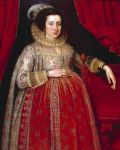
Up until the Renaissance, maternity wear was
barely, if at all, different from regular dress. This is because in these early
days, clothing was not fitted to the body. Fabric was cut in rectangular
pieces that were laced together, making it easy to tighten or loosen a
dress. During pregnancy, women would simply loosen the lacing, allowing
more of her underlayers of clothing to be visible, possibly adding additional layers. Later in a
pregnancy, women simply stayed at home, meaning they could just wear
loose undergarments and open robes. During the late Middle Ages, it was
in fact fashionable for a woman to appear pregnant, whether or not she
actually was. They would wear high waisted gowns with extra fabric
gathered around her belly, thus making specific maternity wear unnecessary.
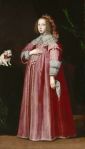
By the Renaissance, though, seams and
structure became integral parts of fashion. Stays came into fashion
(read here) resulting in a restricted bodice. During this era, women
would loosen the bottom of their stays as much as possible during the
early part of their pregnancy, thus causing the bump to appear rather
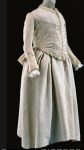
low. Those who could afford new clothing would wear shortened bodices as
their stomachs grew larger. Those who could not had two options. One,
they would wear a man’s waistcoat paired with their loose underlayers
and skirts. This is because during this era men’s waistcoats had vents
in the back, held together by lacing which could be loosened. The other
option was to wear a bodice that laced in the front, leaving the lacing
around the belly open. This would then be covered up with an apron. Using an apron to cover an open bodice that accommodated a full belly remained the go-to style for the pregnant poor for the next couple of
centuries.
The first official pregnancy garment was created
in the 17th century. Known as the Adrienne dress, the style had loose
folds of fabric where normally a fitted waist would be found. The
Adrienne developed throughout the next century, and by the 18th century
it often included a bib that could be folded down for breastfeeding. In the
early 19th century Neoclassical era, fashion was once again in a style
that easily accommodated a pregnant figure. By the 1820s, though,
structured undergarments made their way back into style, soon becoming
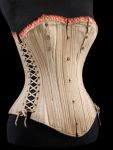
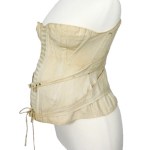
the cinched-waisted corsets we associate with the word today. However, maternity corsets
were also created around this time. These garments were created to
shape, support, and minimize the appearance of a belly. They were
adjustable, and some had flaps for breastfeeding. There were countless
styles created, all boasting some new-found advantage.
Throughout
the 19th and early 20th centuries, maternity wear would either raise or
lower waistlines, depending on which was more fashionable at the time,
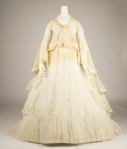
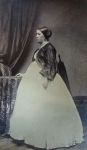
to accommodate the shape. The crinoline era used empire waists, as
well as separate blouses and skirts, often covered by a large jacket to
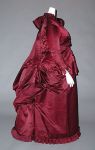
hide the bump. At home, wrappers and robes were extremely common. The bustle era, with its drop waists, attempted to hide
the shape by smoothing it down into folds of fabric by the hips. When
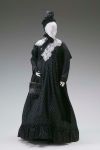
tea gowns- unstructured, flowing dresses- were developed towards the end
of the Victorian era, they became the fashionable choice for women at
home, particularly towards the end of their term. Yet the birth (get it??) of the ready to wear
industry (read here) and the downfall of the corset shortly after caused
maternity wear to shift towards the distinctive garments we often think
of today. That, however, is a topic for another day.
Have a
question about fashion history that you want answered in the next
FRIDAY FASHION FACT? Just click the ASK button at the top of the page!

























 Kimchi and Justice