fun tip for the day, from a former customer service operator: if you call a customer service line that has little “this call may be recorded” disclaimer, and the person who helps you out does a good job, TELL THEM THIS. say, “you have been so helpful, i really appreciate it” or similar, not just because they were nice to you and you want to be nice back but because this counts on their quality assurance scores. at the place i worked doing credit card customer service, our bonuses/raises/continued employment depended heavily on somebody listening to our phone calls and grading them. a clear statement of appreciation (more than just “thank you”) was worth a lot. it takes like 15 extra seconds of your life. i try to do it whenever i can.
p.s. if you’re really feeling wild and/or somebody has rocked your world answering your questions about shipping or giving you a refund or fixing your computer, and you have some extra time, ASK TO TELL THEIR MANAGER HOW GREAT THEY’VE BEEN. trust me.
Tag: useful information
(Leary and Donnellan)
[Marked difficulties in: STARTING, STOPPING, EXECUTING (speed, intensity, rhythm timing, direction, duration), CONTINUING, COMBINING, SWITCHING } { May impede: POSTURES, ACTIONS, SPEECH, THOUGHTS, PERCEPTIONS, EMOTIONS, MEMORIES.]
Fastest way ever to convey the mechanics of autism to someone who is totally new to it and needs something fast and easy.
Slang Resources
Since I had an earlier ask about slang, I thought I’d pull together a few resources:
Historical Dictionary of American Slang – allows you to search by year
Slang Terms for Sex (And Related F*ckery) – Bow chicka wah wah
Medieval Slang Terms and Terminology – PDF File (Use these sparingly)
Shakespearean Slang and Sexual Language
Elizabethan Slang and Terminology
Victorian Slang Terms – Again, use sparingly
sammiwolfe important to our lives lol XD
Oh oh my god now Morse code actually makes SENSE when you lay it out like that
Morse code is pretty sweet.
But PLEASE remember:
… _ _ _ …
(Dit-Dit-Dit-Dah-Dah-Dah-Dit-Dit-Dit)
“S.O.S.”This could save a life.
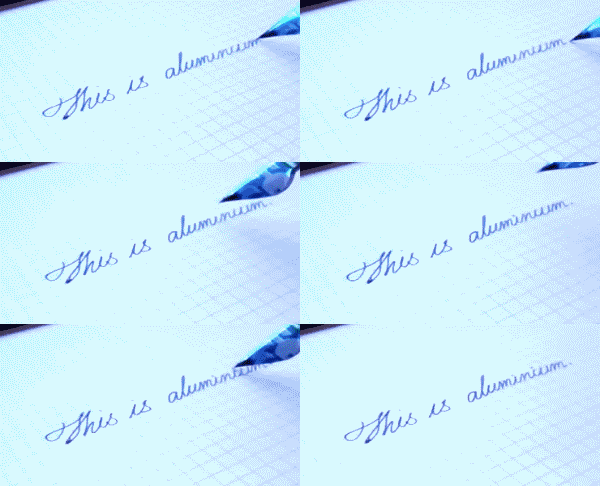
DIY Aluminium Calligraphy Pen
You’ll need tape, scissors, knife, disposable chopsticks, empty aluminium can, stapler and ink.
Calligraphy Pen for Gothic: cut the aluminium into two pieces like above and tape it on chopstick, then Staple the aluminium.
Medium Point Calligraphy Pen: Fold a piece of aluminim, and cut it like picture above. Then tape it on chopstick.
Fine Point Calligraphy Pen: Fold a piece of aluminim, and cut it like picture above. Then tape it on chopstick.
Now enjoy it 🙂
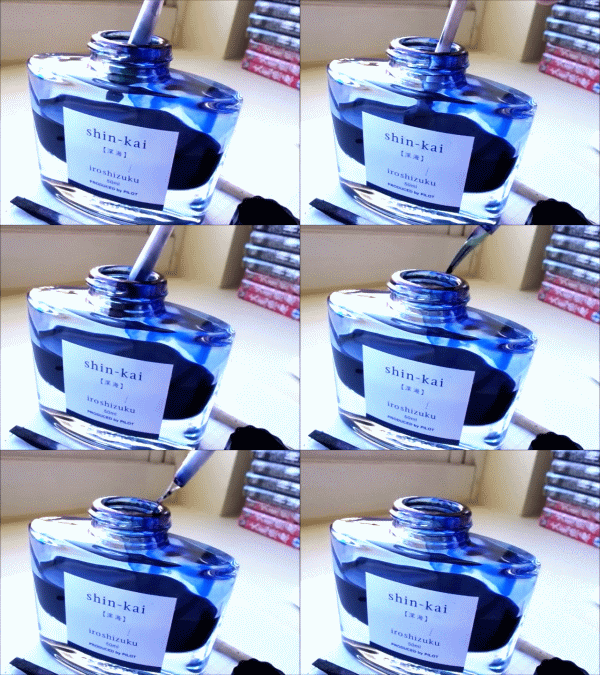

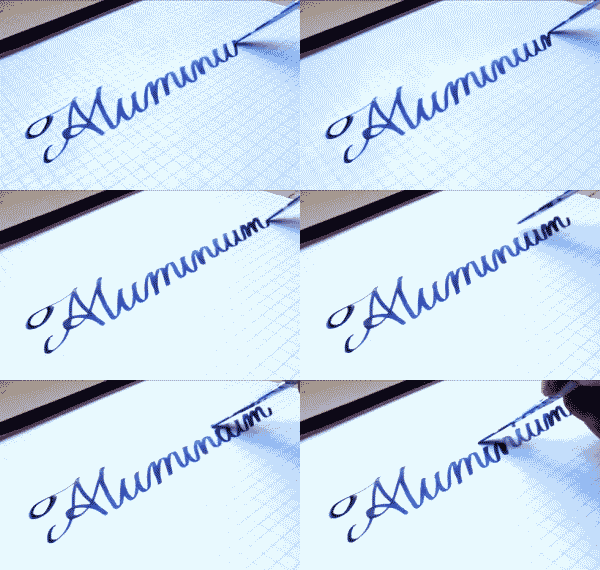
ARE YOU FUCKIN SERIOUS I’VE SPENT SHIT TONS OF MONEY ON CALLIGRAPHY PENS FOR ART AND YOU’RE TELLING ME I CAN MAKE MY OWN FOR LESS THAN 4 FRIGGEN DOLLARS??? THIS IS BULLSHIT MY ENTIRE ART LIFE IS A LIE



Ask Culture and Guess Culture
“One of my wife’s distant friends has attempted to invite herself to stay with us, again,” writes the exasperated owner of a prime 2 bedroom apartment in New York City in this Ask MetaFilter question. “She did this last March, and we used the excuse of me starting a new job and needing to do x, y, and z as well as the “out of town” excuse for any remaining dates. This got us off scot-free, but we both knew the time would come again… and it’s here. We need a final solution.”
He goes on to list two different possibilities he can think of for getting this woman to stop asking for free room and board. The first is a little white lie, something about their keys being hard to duplicate. The other is to be vague, to say something like “Sorry, that isn’t going to work for us” and hope she doesn’t ask why.
The first few answers give this poster very direct advice: Just say no. No need to give an explanation, it’s her who’s being rude by asking. Others give him advice that was probably more like what he was expecting: other ways to be vague like claiming that it’s “One of those random `Life in NYC things.’”
Another thread of discussion popped up around whether or not the woman asking for a place to stay was being rude. Some posters couldn’t understand how simply asking to stay in someone’s apartment was rude, while another went as far to say that putting someone in the position “having to be rude and say no” was rude in and of itself.
It is into this context that user tangerine contributes this answer:
This is a classic case of Ask Culture meets Guess Culture.
In some families, you grow up with the expectation that it’s OK to ask for anything at all, but you gotta realize you might get no for an answer. This is Ask Culture.
In Guess Culture, you avoid putting a request into words unless you’re pretty sure the answer will be yes. Guess Culture depends on a tight net of shared expectations. A key skill is putting out delicate feelers. If you do this with enough subtlety, you won’t even have to make the request directly; you’ll get an offer. Even then, the offer may be genuine or pro forma; it takes yet more skill and delicacy to discern whether you should accept.
All kinds of problems spring up around the edges. If you’re a Guess Culture person — and you obviously are — then unwelcome requests from Ask Culture people seem presumptuous and out of line, and you’re likely to feel angry, uncomfortable, and manipulated.
If you’re an Ask Culture person, Guess Culture behavior can seem incomprehensible, inconsistent, and rife with passive aggression.
Obviously she’s an Ask and you’re a Guess. (I’m a Guess too. Let me tell you, it’s great for, say, reading nuanced and subtle novels; not so great for, say, dating and getting raises.)
Thing is, Guess behaviors only work among a subset of other Guess people — ones who share a fairly specific set of expectations and signalling techniques. The farther you get from your own family and friends and subculture, the more you’ll have to embrace Ask behavior. Otherwise you’ll spend your life in a cloud of mild outrage at (pace Moomin fans) the Cluelessness of Everyone.
As you read through the responses to this question, you can easily see who the Guess and the Ask commenters are. It’s an interesting exercise. (#)
After this comment many users, including the original poster himself, began to use these terms in discussing the issue. And why wouldn’t they? Ask Culture and Guess Culture describe two valid yet opposing ways of interacting with the world with very little value judgment given to them. Framing the argument as such was a stroke of utter genius by tangerine, broadening the perspective of many who participated in the discussion and adding to the general lifebuzz.
Hey Zoe remember this
DMAB trans people resource masterlist
Tucking and making gaffs
- http://sillytranswoman.blogspot.co.uk/2014/07/how-to-tuck-your-penis.html
- https://www.youtube.com/watch?v=pfIyuE34EnY
- http://www.wikihow.com/Tuck-and-Tape
- https://www.youtube.com/watch?v=AtO_OqwgVNk
- https://www.youtube.com/watch?v=Hq3BRAgPQ0Y
- https://www.youtube.com/watch?v=sfwkfkikyJk
Clothes
- http://www.livestrong.com/article/1003415-dress-woman-slim-hips/
- http://www.cosmopolitan.com/style-beauty/fashion/advice/a5742/fashion-q-and-a-ways-to-look-curvy/
- https://www.reddit.com/r/transfashionadvice
- http://feminizationsecrets.com/10-must-have-items-male-to-female-transformation/
- http://www.shopstyle.co.uk/browse?fts=waist+accentuating
- http://www.thechicfashionista.com/rectangle-body-shape.html
Makeup
- http://beautifille.com/makeup-shopping-beginners/
- http://makeup.allwomenstalk.com/makeup-tips-for-beginners
- http://www.wikihow.com/Apply-Makeup-for-Beginners
- http://www.srtrends.com/affordable-makeup-brands-didnt-know/
- https://www.youtube.com/watch?v=rKnwI1hRm0Q
- https://www.youtube.com/watch?v=fhJEhJdAV1w
- https://www.youtube.com/watch?v=Ne_cBk3mBVE
Exercise
- https://www.youtube.com/watch?v=M356v3k3W6s
- http://www.wikihow.com/Make-Your-Hips-Wider
- http://www.wikihow.com/Get-Thicker-Thighs
- http://feminizationsecrets.com/transgender-hourglass-figure/
- http://www.trans-health.com/2003/weight-training-for-mtfs/
- https://www.susans.org/forums/index.php?topic=124337.20
Diet
- http://bembu.com/estrogen-rich-foods
- http://www.wikihow.com/Increase-Estrogen
- http://www.trans-health.com/2001/lose-muscle-gain-fat-dieting-for-mtfs/
- https://www.susans.org/forums/index.php?topic=59440.0
- http://www.livestrong.com/article/21560-foods-high-natural-estrogen/
Behaviour and walking
- https://www.youtube.com/watch?v=DdENAqXRnvg
- https://www.youtube.com/watch?v=lSNh2FyjleQ
- https://www.susans.org/forums/index.php?topic=84474.0
- http://feminizationsecrets.com/transgender-walk-like-woman/
- http://www.tsroadmap.com/physical/feminine-movement.html
- http://sillytranswoman.blogspot.co.uk/2010/09/transition-more-feminine-gait.html
Voice
- https://www.youtube.com/watch?v=a02_j7PGTPI
- http://www.looking-glass.greenend.org.uk/voice.htm
- http://tarasresources.net/voice.htm
- https://www.youtube.com/watch?v=UhQ7LQWD-4s
Hair removal
- http://www.tsroadmap.com/physical/hair/zappriority.html
- http://www.tsroadmap.com/physical/hair/zapidx.html
- https://www.susans.org/forums/index.php?topic=124202.0
- http://www.summerbreezeelectrolysis.com/Transgender-MTF-Facial-Hair-Removal.shtml
- http://feminizationsecrets.com/transgender-hair-removal-mistakes/
Safety
- http://www.supportline.org.uk/problems/gender-identity.php
- http://www.translifeline.org/
- http://www.transgenderzone.com/transpanic.htm
- http://www.transfigurations.co.uk/filestore/trans-friendly-doctors-and-gps.pdf
- http://t-vox.org/index.php?title=Physicians_in_the_United_States
- http://www.transhousingnetwork.com/post/99674057418/transgender-friendly-homeless-shelters
I DON’T CARE WHAT YOU’RE DOING STOP AND READ THIS
Ok Dr. Phil’s wife, Robin, (yes groan, but listen up) has this new app out (iPhone and Android) that’s for people in abusive relationships. It’s called Aspire News and it’s disguised as a regular news app, but when you go to the “Help” section of the app, it leads you to domestic violence resources and also has a “Go Button” that when you press it, if you’re in a compromising situation, alerts local authorities as well as local shelters and starts recording everything that is going on.
Now, if you’re looking up resources on the app and your abuser is near, simply press the X button and it brings you to a random news page. Same goes for the actual foundation site.
ITS COMPLETELY FREE
SiteSPREAD THIS, DONT JUST “LIKE IT”
This
Non-relationship escalator relationship landmarks!
The relationship escalator is seen as “the default set of societal expectations for the proper conduct of intimate relationships. Progressive steps with clearly visible markers and a presumed structural goal of permanently monogamous (sexually and romantically exclusive), cohabitating marriage — legally sanctioned if possible. The social standard by which most people gauge whether a developing intimate relationship is significant, “serious,” good, healthy, committed or worth pursuing or continuing”.(x)
Of course, this style of relationship doesn’t work for everybody, like polyamorous, aromantic, solo, and many others individuals – and that’s okay. Non-escalator relationships can be short term and casual, and they can also be long term, emotionally invested relationships. They are build-your-own-lunch-box relationships, relationshipsa la carte. But, how do people in non escalator relationships measure the investment? How do they read emotional commitment, security, and the ongoing life of the relationship, when they aren’t defaulting to the regular milestones of dating, moving in, getting married, and so forth? (x)
Well!
Things small, things that might seem inconsequential in escalator relationships, can take on greater significance in Non-Escalator relationships. It’s not that these wouldn’t or couldn’t be significant in escalators, it’s just that, in a non escalator relationship, you begin to appreciate them more.
 Kimchi and Justice