a shout out to all the people who started saying “same” as a joke once in awhile but now use it for the most random things like a car honking their horn at another car
good luck to linguistics in the future trying to explain this
@dedalvs explain. You are the future of linguistics! 😀
Future?! I’m the ghost of linguistics past! The future are those here on Tumblr who have yet to take the reins. Seize ye your day like a man taking a picture of a hotel carpet! (Because that’s literally mostly what I do now.)
Every language has a way of expressing this idea (i.e. that we feel the same way as someone else or something suggested by another situation). In English, some that used to be popular are “I feel ya” or “I know the feeling” or “Tell me about it” or “You’re telling me”. Those’ve been used in reference to situations before for humorous effect (I’m kicking my brain trying to remember a specific one on The Simpsons, but it hasn’t come to me yet). “Same” is great because it’s short and expresses the same idea. (I swear, I feel like the younger generation is better at coming up with short stuff like this. My generation is the generation of wordy phrases like “too much information” and “I know you are but what am I”, which sounds positively Shakespearean by today’s standards.)
“Same” has also really interested me because I’ve seen the exact same expression years before it came into vogue in English, but in American Sign Language. ASL has a sign that means “same” and you can use it in the standard way, but you can also use it the Tumblr way. We basically learned it as a way to say “me too”. I doubt the one influenced the other (convergent evolution seems more likely), but it does set Tumblorgs up to know this small facet of ASL grammar rather intuitively. There’s a nice explanation of the sign on this site. Image below from that site:
And actually, just let me copy this paragraph from the explanation on that site, since I think it’s so perfect:
The sign for same is “directional.” By that I mean, the direction in which you do the sign can provide information about the subject and object of the verb. For example, if I slide the “Y” hand back and forth between you and me the sign can mean:“me too” "you and me, both" "I agree with you" “I’m similar to you” You don’t have to add a separate “ME” or a separate “YOU” sign, the meaning is created by the direction of the sign.
So yes, there’s actually more grammar in the ASL sign than in English “same”, but if you see how directionality works with this in ASL, you’ll see how it’s very simple to extrapolate from using it with someone you’re talking to to say “me too”, or using it with someone nearby to say “just like them”, or even using it with a situation to say “I feel just like that hedgehog which can’t even right now”:
Anyway, that’s about the gist of it…? Think I went on a bit of a tangent. Oh well. The point is this: Why isn’t anyone using my word “Tumblorg” for someone who uses Tumblr?! I swear, I will make Tumblorg happen!
True story, a Japanese friend of mine who is very fluent in English mused on her FB:
“Tell me about it” -this phrase is just confusing. It actually means I don’t need to talk about it anymore? Hmm.“
I explained what it meant, she said:
“Thinking
back on Japanese, we also have similar expressions. We say “keep going”
when someone gets annoying and we don’t want to listen anymore.“
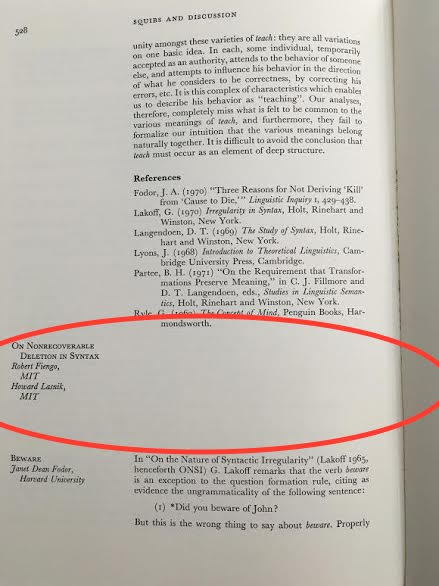
Real Clear Science has pointed out a clever example of the shortest possible academic article. It’s called “On nonrecoverable deletion in syntax,” and was published in 1972 in Linguistic Inquiry. They quote University of Texas associate professor John T. Beavers, who sent in the image above with an explanation:
The 1960s and 1970s saw a growth of work on the syntax of natural languages due to the groundbreaking work of Noam Chomsky, who began a research program known as Generative Grammar that sought to describe and explain the knowledge speakers have of their native languages through explicit formalization and hypothesis testing. One phenomenon that has received attention is ellipsis, i.e. when words are left out of a sentence but the information that is unexpressed is still inferred semantically. An example is “verb phrase ellipsis” where the main verb phrase of a clause is left out, as in the second clause in “John will be here tomorrow but Mary won’t.” In the given context it’s clear that there’s an implicit “be here tomorrow” after “won’t”.
One way of analyzing this is to assume that in some underlying mental representation of the sentence the verb phrase “be here tomorrow” is actually present after “won’t” (accounting for the fact that that’s how we interpret it), but its overt phonetic form is deleted when uttered because the information is recoverable from earlier in the same sentence (the previous mention of the verb phrase “will be here tomorrow”, the antecedent of the ellipsis). It had furthermore been hypothesized that deletion in syntax of this sort could only ever happen if there was an explicit antecedent, a rule of grammar called the Recoverability Condition on Deletion, first proposed by Jerrold J. Katz and Paul M. Postal in 1964 and developed by others later. It had a lot of intuitive appeal — what would it mean to leave out something while giving no clue as to what you left out?
Then, in 1972, Linguistic Inquiry published the Fall issue of its 3rd volume, and on page 528 was a paper called “On nonrecoverable deletion in syntax” by Robert Fiengo and Howard Lasnik on exactly this topic. Indeed, some people who saw the title might have thought, “Ah! Somebody found an instance of nonrecoverable deletion! Unexpressed material without an antecedent! A violation of the Recoverability Condition! I wonder how that works.” In fact, that’s exactly what I thought in 2002 as a grad student when I stumbled across the title. I quickly ran to the library to get the journal out, and I flipped it to page 528 to begin reading.
It was instead a clever joke, and a striking argument in FAVOR of the Recoverability Condition.
The point of the article was to argue for the recoverability condition by violating it in a rather spectacular (and cheeky) way, thus demonstrating the effect.
The amazing set of notes associated with the collaborative songwriting in this post ended up getting forked in several directions, so I’m going to try to merge as many contributions as possible to date, and suggest that future contributors make sure to check the notes before posting 🙂 Making this a new post instead of a reblog so that it shows up in #linguistics.
On the first day of ling-mas, professor gave to me a chart of the IPA! (glottalplosive)
On the second day of ling-mas, professor gave to me binary branching (sointerrobanging) And a chart of the IPA!
On the third day of ling-mas, professor gave to me three loanwords calquing (balalaikaboss) Binary branching And a chart of the IPA!
On the fourth day of ling-mas, professor gave to me four stuffed wugs (maggietenobar) Three loanwords calquing Binary branching And a chart of the IPA!
On the fifth day of ling-mas, professor gave to me FIVE SYNTAX TREES (sailorsoldierlove) Four stuffed wugs Three loanwords calquing Binary branching And a chart of the IPA!
On the sixth day of ling-mas, professor gave to me six heads a-raising
FIVE SYNTAX TREES Four stuffed wugs Three loanwords calquing Binary branching And a chart of the IPA!
On the seventh day of ling-mas, professor gave to me seven stops (or plosives)
Six heads-a-raising FIVE SYNTAX TREES Four stuffed wugs Three loanwords calquing Two binary branches And a chart of the IPA
On the eighth day of ling-mass, professor gave to me eight deleted codas
Seven stops (or plosives) Six heads-a-raising FIVE SYNTAX TREES Four stuffed wugs Three loanwords calquing Two binary branches And a chart of the IPA
On the ninth day of ling-mas, professor gave to me… nine old aphasics,
Eight deleted codas Seven stops (or plosives) Six heads-a-raising FIIIIIIIVE SYNTAX TREEEEEES Four stuffed wugs Three loanwords calquing Two binary branches And a chart of the IPA
Only three more days left to be added! And then we can start talking about making a recording.
On the tenth day of ling-mas,
professor gave to me… ten unbound morphemes,
Nine old aphasiacs Eight deleted codas Seven stops (or plosives) Six heads-a-raising FIIIIIIIVE SYNTAX TREEEEEES Four stuffed wugs Three loanwords calquing Two binary branches And a chart of the IPA
Looks like we have a complete song! High-fives all ‘round!
And in the spirit of collaboration, I’d like to encourage anyone who wants to make this into audio, video, gifs, multilingual, children’s picture book, snow sculptures, or any other version/mashup you can think of. Seriously. Go for it.
On the eleventh day of ling-mas, professor gave to me eleven cleft constructions
Ten unbound morphemes, Nine old aphasiacs Eight deleted codas Seven stops (or plosives) Six heads-a-raising FIIIIIIIVE SYNTAX TREEEEEES Four stuffed wugs Three loanwords calquing Two binary branches And a chart of the IPA
On the twelfth day of ling-mas, professor gave to me twelve phrasal verbs
Eleven cleft constructions Ten unbound morphemes, Nine old aphasiacs Eight deleted codas Seven stops (or plosives) Six heads-a-raising FIIIIIIIVE SYNTAX TREEEEEES Four stuffed wugs Three loanwords calquing Two binary branches And a chart of the IPA
today i learned that the first use of “omg" occurred in 1917 in a letter to winston fucking churchill
in case you think im fucking with you:
I see this “fact” all the time, but folks, this is actually a JOKE THIS GUY IS MAKING. He’s not using an excited acronym, he’s making FUN of the service. In the Order of St. Michael and St. George (honours given to colonial servants), you can be a Companion, a Knight Commander or a Knight Grand Cross, which were abbreviated to CMG, KCMG and KGCMG. The joke is they’re so up themselves that it stands for “Call Me God”, “Kindly Call Me God”, and “God Calls Me God”. “O.M.G./Oh My God” would be another meaningless award for people to be smug about.
tl;dr: O.M.G. in 1919 is a JOKE not an exclamation. Let us all not confuse the timeline of language innovation and make fun of colonial bullshit instead.
when did tumblr collectively decide not to use punctuation like when did this happen why is this a thing
it just looks so smooth I mean look at this sentence flow like a jungle river
ACTUALLY
This is really exciting, linguistically speaking.
Because it’s not true that Tumblr never uses punctuation. But it is true that lack of punctuation has become, itself, a form of punctuation. On Tumblr the lack of punctuation in multisentence-long posts creates the function of rhetorical speech, or speech that is not intended to have an answer, usually in the form of a question. Consider the following two potential posts. Each individual line should be taken as a post:
ugh is there any particular reason people at work have to take these massive handfuls of sauce packets they know they’re not going to use like god put that back we have to pay for that stuff
Ugh. Is there any particular reason people at work have to take these massive handfuls of sauce packets they know they’re not going to use? Like god, put that back. We have to pay for that stuff.
In your head, those two potential posts sound totally different. In the first one I’m ranting about work, and this requires no answer. The second may actually engage you to give an answer about hoarding sauce packets. And if you answer the first post, you will likely do so in the same style.
Here’s what makes this exciting: the English language has no actual punctuation for rhetorical speech–that is, there are no special marks that specifically indicate “this speech is in the abstract, and requires no answer.” Not only that, it never has. The first written record of English (actually proto-English, predating even Old English) dates to the 400s CE, so we’re talking about 1600 years of having absolutely no marker whatsoever for rhetorical speech.
A group of teens and young adults on a blogging website literally reshaped a deficit a millennium and a half old in our language to fit their language needs. More! This group has agreed on a more or less universal standard for these new rules, which fits the definition of “language.” Which is to say Tumblr English is its own actual, real, separate dialect of the English language, and because it is spoken by people worldwide who have introduced concepts from their own languages into it, it may qualify as a written form of pidgin.
Tumblr English should literally be treated as its own language, because it does not follow the rules of any form of formal written English, and yet it does have its own consistent internal rules. If you don’t think that’s cool as fuck then I don’t even know what to tell you.



 Kimchi and Justice