I went home and Googled the statue to see what the internet had to say about this mysterious black man, and I found that the New York City Parks Department website did not mention the presence of a second human being in the monument at all. Instead, it read:
“The work, set in a picturesque pink granite steele designed by architect Henry Bacon, features a heroic-sized Lafayette standing next to his horse.”
Lafayette and his horse. His horse. Nary a mention of the grown man standing there, blanket over his shoulder and a look on his face like he’d rather be someplace else. I was perplexed, and then angry, and then curious. I went to the library.
The statue, by Daniel Chester French, had been commissioned when a Frenchman turned Brooklynite named Henry Harteau died and left the city $35,000 to cast a monument to his celebrated countryman. (Lafayette and Harteau are identified on the statue’s base, and it was dedicated in 1917.) He asked that the statue be based on a painting called Lafayette at Yorktown by Jean-Baptiste Le Paon. The painting was actually of two men named Lafayette; one was the familiar marquis, and the other was named James Armistead Lafayette. The marquis was white and James was black. Still, I wondered: Were they brothers? Why did they share a last name?
It turns out that James Armistead was an enslaved man from Virginia who enlisted to fight against the British and ended up working as a double agent. The information he acquired helped to win the battle of Yorktown; hence, the heroic painting. He served under Lafayette, and the two men became such close friends that the marquis successfully petitioned to have James made a free man, after James’s own request for manumission was denied. (Apparently, they were only freeing “slave-soldiers” who fought in the war; being a “slave-spy” didn’t qualify.) James Armistead then took the name of his friend out of affection and gratitude. He lived a long life and become a farmer and a family man.
(With my deepest apologies to Shakespeare and Dr. Seuss)
Can I kill my Uncle Claude? Yes, I can, I can, by God! I will kill my Uncle Claude!
Should I kill him in the house? Should I kill him while he’s soused? I could kill him here or there I could kill him anywhere Would I, could I, while he prays? Kill him! Kill him! Wherefore stay? I would not, could not, while he prays!
Not in the house, not when he’s soused, Not with his sister, now his spouse! Not while he prays, not while he feasts, O, incestuous, adulterate beast! I do not like my Uncle Claude, I do not like that bloody bawd!
Say! In the dark? Here in the dark! Would I, could I, in the dark?
Should I kill him in his bed? Should I there strike off his head? Kill him with his nightcap on? Kill him when the churchyards yawn? Should I kill him where he lies? I will kill him, by and by! I do not like my Uncle Claude, I’ll kill him, i’ th’ name of God!
The play! The play! The play’s the thing! The thing wherein I’ll catch the king! No more ‘to be or not to be,’ I will kill him, you will see!
Kill him while he wears his crown Kill him while his guard is down
Kill him with some poisoned wine Kill him with this sword of mine
O, is the point envenomed, too? I’m dead–Horatio, adieu! But tell them, tell them, more or less, Who it was that made this mess!
I did not like my Uncle Claude, I killed him in the name of God! Good friend, report my cause aright– And now, goodnight goodnight goodnight!
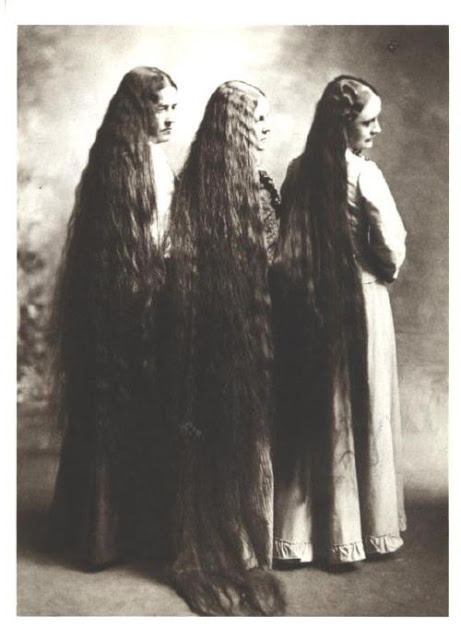
Hair washing and care in the the 19th century
Hair washing is something that almost every historical writer, romance or not, gets wrong. How many times have you read a story in which a heroine sinks gratefully into a sudsy tub of water and scrubs her hair–or, even worse, piles it up on her head to wash it? Or have you watched the BBC’s Manor House and other “historical reenactment” series, in which modern people invariably destroy their hair by washing using historical recipes?
Historical women kept their hair clean, but that doesn’t mean their hair was often directly washed. Those who had incredibly difficult to manage hair might employ a hairdresser to help them wash, cut, and singe (yes, singe!) their hair as often as once a month, but for most women, hair-washing was, at most, a seasonal activity.
“Why?” you might ask. “Wasn’t their hair lank, smelly, and nasty?”
And the writers who embrace ignorance as a badge of honor will say, “Well, that just goes to show that people used to be gross and dirty, and that’s why I never bother with that historical accuracy stuff!”
And then I have to restrain myself from hitting them…
The reason that hair was rarely washed has to do with the nature of soaps versus modern shampoos. Soaps are made from a lye base and are alkaline. Hair and shampoo are acidic. Washing hair in soap makes it very dry, brittle, and tangly. Men’s hair was short enough and cut often enough that using soap didn’t harm it too much and the natural oils from the scalp could re-moisturize it fairly easily after even the harshest treatment, but in an age when the average woman’s hair was down to her waist, soap could literally destroy a woman’s head of hair in fairly short order.
Instead, indirect methods of hair-cleaning were used. Women washed their hair brushes daily, and the proverbial “100 strokes” were used to spread conditioning oils from roots to tips and to remove older or excess oil and dirt. This was more time-consuming than modern washing, and this is one of the reasons that “good hair” was a class marker. The fact that only women of the upper classes could afford all the various rats, rolls, and other fake additions to bulk out their real hair was another. (An average Victorian woman of the upper middle or upper class had more apparent “hair” in her hairstyle than women I know whose unbound hair falls well below their knees.) Women rarely wore their hair lose unless it was in the process of being put up or taken down–or unless they were having a picture specifically taken of it! At night, most women braided their hair for bed. Now that my hair is well below my waist, I understand why!
The first modern shampoo was introduced in the late 1920s. Shampoos clean hair quickly and also remove modern styling products, like hairspray and gel, but the frequent hair-washing that has become common leaves longer hair brittle even with the best modern formulations. (From the 1940s to the 1960s, many if not most middle-class women had their hair washed only once a week, at their hairdresser’s, where it was restyled for the next week. The professional hairdresser stepped into the void that the maid left when domestic service became rare. Washing one’s hair daily or every other day is a very recent development.) That’s where conditioners came into play. Many people have wondered how on earth women could have nice hair by modern standards before conditioners, but conditioners are made necessary by shampoos. Well-maintained hair of the 19th century didn’t need conditioners because the oils weren’t regularly stripped from it.
Additionally, the oils made hair much more manageable than most people’s is today, which made it possible for women to obtain elaborate hairstyles using combs and pins–without modern clips or sprays–to keep their hair in place. This is why hair dressers still like to work with “day-old” hair when making elaborate hairstyles.
There were hair products like oils for women to add shine and powders meant to help brush dirt out of hair, but they weren’t in very wide use at the time. Hair “tonics”–mean to be put on the hair or taken orally to make hair shinier, thicker, or stronger–were ineffective but were readily available and widely marketed.
If you have a heroine go through something particularly nasty–such as a fall into a pond or the like–then she should wash her hair, by all means. This would be done in a tub prepared for the purpose–not in the bath–and would involve dissolving soap shavings into a water and combine them with whatever other products were desired. Then a maid would wash the woman’s hair as she leaned either forward or backward to thoroughly wet and wash her hair. Rinsing would be another stage. The hair would NEVER be piled on the head. If you have greater than waist-length hair and have ever tried to wash it in a modern-sized bathtub, you understand why no one attempted to wash her hair in a hip bath or an old, short claw foot tub! It would be almost impossible.
A quick rundown of other hair facts:
Hydrogen peroxide was used to bleach hair from 1867. Before that, trying to bleach it with soda ash and sunlight was the most a girl could do. Henna was extremely popular from the 1870s through the 1890s, especially for covering gray hair, to such an extent that gray hair became almost unseen in certain circles in England in this time. Red hair was considered ugly up until the 1860s, when the public embracing of the feminine images as presented by the aesthetic movement (Pre-Raphaelite Brotherhood) gained ground, culminating in a positive rage for red hair in the 1870s to 1880s. Some truly scary metallic salt compounds were used to color hair with henna formulations by the late 19th century, often with unfortunate results.
Hair curling was popular in the 19th century and could either by achieved with rag rolls or hot tongs. Loose “sausage” rolls were the result of rag rolling. Hot tongs were used for making the “frizzled” bangs of the 1870s to 1880s–and “frizzled” they certainly were. The damage caused by the poor control of heating a curler over a gas jet or candle flame was substantial, and most women suffered burnt hair at one time or another. For this reason, a number of women chose to eschew the popular style and preserve their hair from such dangers! Permanents were first in use in the 1930s.
(From: http://www.lydiajoyce.com/blog/?p=1022)
Amazing post, thank you!
Super helpful for anyone that writes historical stories featuring women!
For anybody looking for more historical hair stuff, I love Janet Stephens’ videos.
I actually use them to do my own hair as I don’t usually write historical fiction, so it’s really cool for that too.
It was about that time, early in the summer, when magic was best taught
to new witches, when daylight was long and herbs grew with just the
faintest of magic to guide them, and when the mornings were crisp and
full of dewy spiderwebs.
It had been at least a decade since Nonna had seen anyone at her door– she had bribed a few crows to tell her if anyone was on their way, and for the price of a few mirror shards each, they did their job very well.
“A little human,” one crow, Mortimer, said as he landed on Nonna’s porch railing, “is very determined to find you today. She’s been wandering through the trees for an hour, but seems to have found the pathway now. She’s about ten minutes away.”
“Five, from the looks of it.” Chimed in another crow from the cabin’s rooftop.
“Why, thank you. I’ve got a lot of breadcrumbs in a dish, I’ll set it out when the little human is gone.” Said Nonna with a wink, shifting in her seat to watch the silhouette of a child come into focus.
Flushed pink cheeks, mud-covered boots, auburn hair with a few cobwebs dangling around the edges, and oh, magic was eager to bind to her with every step.
As the child approached the front steps, she stopped, looking up at Nonna. “Hi, I’m Rook.” She said, then produced a few sprigs of rosemary, a small river rock, and a piece of paper. “I’m here to Become A Witch. I’ve studied all the books. I’ll do exactly what you say, and I’ll pay attention all the time and I brought a letter from my mom saying it’s O.K. to study with you as long as I’m home by 8:00 on weekdays and 9:30 on weekends.” Rook a breath, but held it, waiting for The Witch to reply.
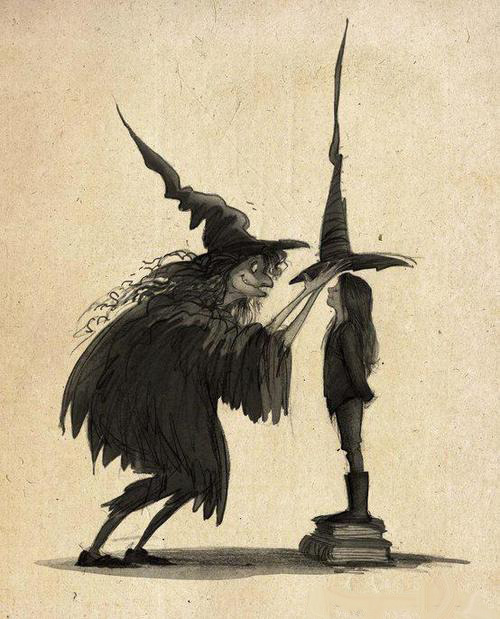
“First of all,” said Nonna, “you’re going to need a proper hat.”
so. they made a new german discowrld essentials edition, with a new covers (which is good because the old ones are real bad)
and they are these manga-like ‘build a picture’ style, which i like
but. oh my god. look at that vimes
this isn’t samuel ‘worked the night-shift for 30 years, runs on coffee and spit, has probably not slept more than 3hours any given day’ vimes
this is the guy who played vimes in murder-mystery play, ‘inspired by real events’. hammy acting, horrible script, ‘Clues’ everywhere, heroic fightscenes, big speaches. Vimes threadened to shut the whole thing down for slander. Sybil probably got an autograph
pro jobseeking tip: never answer these surveys honestly
also a tip: if they have a question like “Everybody steals from work sometimes” answer “disagree.”
I found this out when i was working as a hiring manager and the company i worked for started instituting these tests for managerial hires or promotions. My boss and I were promoting someone and she failed the test because she answered that question as “slightly agree” which in the results tells them that she is someone likely to steal because she believes everyone does it. When we asked her about her answer, it turns out she picked what she did because she’s cynical and does assume that people steal but didnt agree with them doing so. she almost sued the company for not promoting her based on that but chose to leave instead. We lost a good employee because corporate decided these tests were a good way to screen for “good” employees.
tldr these things are poorly designed, ambiguously worded, and structured in ways that are designed to eliminate people because the intention of the questions is never made clear. these tests are evil.
this sounds like an ableist disaster for people who aren’t neurotypical and who struggle with reading signals
When I went to get diagnosed with ADHD, the neuropsychologist couldn’t figure out what was going on, because on paper I’m apparently floridly psychotic. No, the questions are imprecise, and I am hyper-literal and extremely honest.
“Do you often see things that other people do not see?” Yes.
The question I was answering: “Are you especially observant?”
The question the test was actually asking: “Are you having visual hallucinations?”
“Does your environment ever have special messages for you?” Yes.
The question I was answering: “Does the sudden sight of a rainbow during a bout of doubt and self-loathing make you feel as though the world is trying to cheer you up?”
The question the test was actually asking: “Do you believe that your toaster is trying to convince you that the neighbors are spying on you?”
Five years later, I bombed a psych eval for a park ranger job for the same sort of thing. Tread carefully, darlings.
^^^^ that is actually such a huge issue with diagnosis!!!! and I’ve thought I didn’t experience symptoms for ages that I actually clearly had all along because of things being phrased super weirdly and confusingly 😦
And this is why McDonald’s never called me after I applied
Yeah, this is why this kind of thing in job apps needs to be illegal. A lot of discrimination is well hidden.
@tantefledermaus – the EXACT same thing happened to me when I was tested for ADHD. The test asked me if I felt like “other people could hear my thoughts.” I put “yes” thinking “yeah I’m pretty transparent and a terrible liar so I just let whatever I’m feeling show on my face” when they meant “do you feel like other people have telepathic powers?” And there were a handful of others I have forgotten about by now. It was years after my ADHD diagnosis that I really started experiencing psychotic symptoms and then I was like “…this sensation is galaxies away from how I’d lived my life for so long…they can’t be described with the same language.” I hate those vaguely worded questions so much.
On the bright side, the one good thing about having been constantly in mental health care and having to be screened over and over and over again is that I learned how to bullshit my way through these kind of amoral job screenings bc I have learned how to fake normalcy on paper once I identified “what they are looking for.” The fact that the surveys that I have filled out for job applications echo the screenings my old therapist gave me to detect potential personality disorders is extremely disturbing.
The worst part is sometimes they will make people answer those questions for you. I applied for a job that used a hiring company to screen applicants and you had to get FIVE PEOPLE to fill out a job survey for you online, FIVE PEOPLE you had worked with, at least two of which had to be supervisors–this was for a minimum wage entry level job as a SECRETARY. The questions included things about how well you handled stress and stressful situations, how positive your attitude was, how you reacted emotionally to criticism, how well you could suppress negative emotions on the job, stuff like that.
When I saw the questions I broke down and cried and my depression was badly triggered because I felt like a bad employee as someone with depression, anxiety, and borderline personality disorder. I was so frustrated that completing tasks I was hired to do at an above and beyond level was not enough–apparently I had to fit some ridiculous, narrow personality type that someone with emotional disorders is incapable of exhibiting. And I couldn’t even lie and pretend I was those things, because other people I worked with could simply say the truth: I did my job verywell, but I was not the unfailingly positive and emotionally sturdy employee this company wanted me to be.
When I told my mother about these questions, in tears and in a pit of depression, she was shocked and offended at how inappropriate and personal they were for a basic entry level secretary position and advised I not work for a company like that. It’s absolutely bullshit that in a capitalist society it is not enough that you are productive and effective at your job: no matter how underpaid or exploited you are, you must be ever smiling and cheerful about it. Moreover, it is not enough that you work hard, but you must also have a particular personality that mirrors the “virtues” of capitalism.
spoiler: there is no good way to answer these questions on a job survey. for ex.:
also a tip: if they have a question like “Everybody steals from work sometimes” answer “disagree.”
you’d think the obvious interpretation is “no, people do not steal, that is wrong, i am not a thief”, but they can also use this to determine how observant you are: “yes people steal from work, i see that happen all the time, i’m not an oblivious twat”. so, it goes all the way from “are you a thief” to “are you oblivious”, and no matter what you put it’s wrong.
and every question is like that.
which is the problem with questions like this. they have no value, their point is to get rid of people who won’t sit there for hours to fill the things out, and to be an unchallengeable reason to get rid of anyone else they don’t like.
i don’t think they’re allowed to ask the neurological diagnosis type ones on a job app. that’s too close to asking for medical info, and nobody is able to make a medical diagnosis from just that anyway.
I’ve always invalidated shrinks tests because I’d be like “does this mean X? If yes, then Y. If Z is meant, then W. Does this question assume J circumstance/context, or K, or something else entirely?”, either verbally or writing that down near the question.
Apparently that meant I was being “uncooperative” and rebellious on purpose, when actually I thought I was being as accurate as possible because those questions were too arbitrary and ambiguous.
I’m not surprised employers don’t take well to people who don’t just magically know the “right” answer (that seems to me how the entire job system works, you’re magically supposed to know how everything works already and what is expected of you at all times, even if you are seeking an apprenticeship for something you’ve never done to learn how to do it). But shrinks are supposed to care about assessing their patient’s individual needs as best as they can. It’s supposed to be their fucking job. The fuck are we paying them for if not that? Like, at this point I can take an online personality quiz and get the same fucking results.
This is why there’s a huge problem with psychs using the paint-by-numbers technique of diagnosis. Like they go:
“Do you have an illogical belief that doing certain things will prevent negative things from happening?”
and expect a yes or no answer. There are so many problems with that.
1. It doesn’t account for the magnitude of the action . Even the sanest people do strange things, you can’t put people who feel the need to tap the door three times before they open it under the same bracket as people who genuinely believe they’ll choke and die if they eat foods that are a certain colour.
2. It doesn’t account for how often it’s happening. Like I sprinkled salt around my bed the other day because I thought it would protect be from something and I was scarred to step out of the little circle of salt I made for a while. That sounds terrible, but it’s only happened once when I was already having a bad day, and the psych assuming that it happened regularly would seriously skew the diagnosis.
3. It doesn’t account for severity. In this case it doesn’t check to see how strongly the belief is held. Like when I was doing the salt thing, it was more a ‘better do it just in case’ thing than a ‘I one hundred percent without a doubt believe in what I’m doing’ thing. Again assuming one way or the other would seriously skew the diagnosis.
tl;dr For psychs to make an accurate diagnosis they need to have an in depth talk with their patient which covers all bases, not ask questions that assume things that may or may not be true.
4) if you asked me that (”Do you have an illogical belief that doing certain things will prevent negative things from happening?”) I wouldn’t even assume it was about delusions, I’d assume it was about paranoia because that’s what I personally suffer from. I’d likely say yes, which means things like “I have recurring thoughts about just shutting down and closing contact with everyone I know because ‘I’m bad and they’d be better off without me and that’d prevent them from being hurt’ despite normally logically knowing that’d just worry them and/or they’d be hurt by me doing that”, not “I think if I don’t count all the tiles of my floor everyday the roof will crash on me”.
Regarding those job application things… They baffle me too. My inclination is to answer them like the person who missed the promotion did.
Because if a questionnaire asks, like, have you ever told white lies? I would assume the right answer is “very occasionally yes,” not no.
Because anyone who says yes is literally lying to you right now (or possibly has a disability, but mild lying is so common I would think even quite intensely literal minded people, including a sizable number of nonNTs, have done it more than they realize.)
And if I were hiring, I would want the one who talks honestly about being human but is still committed to honesty as a virtue (and so says “rarely but yes”), not the one who claims to be superhuman (“no.”)
Also, you can know that a triggered reaction is irrational and still have it. You can know that a compulsion won’t actually protect you and still have it.
People are complicated.
Some of those tests also have validity scales that are ridiculous.
Like they paraphrase the same question five different ways. If you answer it different every time they assume you’re either lying or not careful enough to fill out the test properly.
I answered them differently because either the differences in wording changed the meaning, or because I wasn’t sure of my answer so I answered multiple ways just in case. This meant they gave me a terrible validity score.
yeah they got upset with me after giving me one of those tests because I answered the questions differently because depending how they worded it the context changed and they SPECIFICALLY TOLD ME WHEN I ASKED I shouldn’t take the test on -just- my psyche symptoms.
They absolutely refuse to acknowledge that for example, feeling hopeless could be from limited access to help for my illnesses instead of depression. That losing interest in things I used to like might be because I was no longer capable of doing them to my unmanaged disability, that being fatigued could be because I have like FIVE DIFFERENT DIAGNOSISES AND FOUR MEDICATIONS that cause fatigue.
No it’s just depression. You need CBT to work on the fact you can’t access proper health care for your physical illnesses clearly, not proper treatment for them, only the depression caused by lack of medical care.
I got nixed from a psych study once for answering “do you ever see things other people don’t?” with “how would I know that?” I wasn’t being pedantic; I literally do not know whether the things I see are the same things other people do. How would anyone know that, really? You have to take people’s word for it.







 Kimchi and Justice