so in my greek class we were talking about oral composition and how something like the iliad must have been composed, and my prof asked us to consider how we would rapidly compose something like poetry on the spot. and i think it was a really important exercise not just for understanding the construction of an oral epic but also for reminding us of how great works can come from supposedly “humble” origins. so if anyone is ever snobby about their homer, just remind them that, as my professor put it, the iliad is basically ancient freestyle rap, and homer is much closer to jay z than to f. scott fitzgerald
basically what i’m saying is please imagine homer asking someone to give him a beat on the lyre and then dropping the sickest fucking meter ever. the ill-iad, by lil homie
the freshest poet this side of the adriatic
drop that meter like odysseus dropped the ball getting home
is “chai” a TYPE of tea??! bc in Hindi/Urdu, the word chai just means tea
its like spicy cinnamon tea instead of bland gross black tea
I think the chai that me and all other Muslims that I know drink is just black tea
i mean i always thought chai was just another word for tea?? in russian chai is tea
why don’t white people just say tea
do they mean it’s that spicy cinnamon tea
why don’t they just call it “spicy cinnamon tea”
the spicy cinnamon one is actually masala chai specifically so like
there’s literally no reason to just say chai or chai
They don’t know better. To them “chai tea” IS that specific kind of like, creamy cinnamony tea. They think “chai” is an adjective describing “tea”.
What English sometimes does when it encounters words in other languages that it already has a word for is to use that word to refer to a specific type of that thing. It’s like distinguishing between what English speakers consider the prototype of the word in English from what we consider non-prototypical.
(Sidenote: prototype theory means that people think of the most prototypical instances of a thing before they think of weirder types. For example: list four kinds of birds to yourself right now. You probably started with local songbirds, which for me is robins, blue birds, cardinals, starlings. If I had you list three more, you might say pigeons or eagles or falcons. It would probably take you a while to get to penguins and emus and ducks, even though those are all birds too. A duck or a penguin, however, is not a prototypical bird.)
“Chai” means tea in Hindi-Urdu, but “chai tea” in English means “tea prepared like masala chai” because it’s useful to have a word to distinguish “the kind of tea we make here” from “the kind of tea they make somewhere else”.
“Naan” may mean bread, but “naan bread” means specifically “bread prepared like this” because it’s useful to have a word to distinguish between “bread made how we make it” and “bread how other people make it”.
We also sometimes say “liege lord” when talking about feudal homage, even though “liege” is just “lord” in French, or “flower blossom” to describe the part of the flower that opens, even though when “flower” was borrowed from French it meant the same thing as blossom.
We also do this with place names: “brea” means tar in Spanish, but when we came across a place where Spanish-speakers were like “there’s tar here”, we took that and said “Okay, here’s the La Brea tar pits”.
Or “Sahara”. Sahara already meant “giant desert,” but we call it the Sahara desert to distinguish it from other giant deserts, like the Gobi desert (Gobi also means desert btw).
Languages tend to use a lot of repetition to make sure that things are clear. English says “John walks”, and the -s on walks means “one person is doing this” even though we know “John” is one person. Spanish puts tense markers on every instance of a verb in a sentence, even when it’s abundantly clear that they all have the same tense (”ayer [yo] caminé por el parque y jugué tenis” even though “ayer” means yesterday and “yo” means I and the -é means “I in the past”). English apparently also likes to use semantic repetition, so that people know that “chai” is a type of tea and “naan” is a type of bread and “Sahara” is a desert. (I could also totally see someone labeling something, for instance, pan dulce sweetbread, even though “pan dulce” means “sweet bread”.)
Also, specifically with the chai/tea thing, many languages either use the Malay root and end up with a word that sounds like “tea” (like té in Spanish), or they use the Mandarin root and end up with a word that sounds like “chai” (like cha in Portuguese).
In relation to the Chai and names for tea, in some areas of London tea is called Char. As far as I’m aware there is some debate over whether this term arose as a bastardisation of the Indian word for tea or is a hold on from the Portuguese word for tea, chá (which to an English ear sounds like char with a hard ch at the front), who were responsible for popularising tea in England in the late 1600s when Catherine of Breganza married Charles II and became Queen of England.
As for prototype and repetition of words to specify certain types of a thing, there are even instances of English doing it to itself. The example of this that comes to mind is the River Avon , Hampshire that runs from Salisbury into the Channel. Avon is a local term for river and so the River Avonin England is the River River.
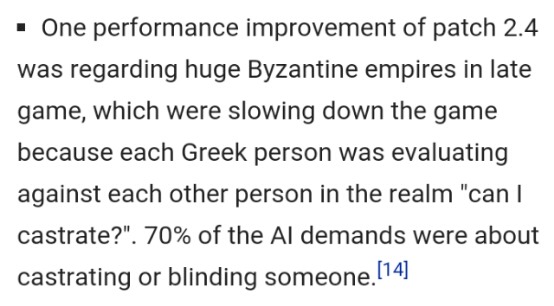
For those that are unawares, these are patch notes to Crusader Kings 2.
These are actual patch notes from a real video game.
Paradox games are wild.
art mirrors life
“…so how did they fix it? does everyone sublimate their castration desires into pressing olives? or did they just optimize the castration process? maybe the Greeks reach industrialization solely for the purpose of castrating more people.”
-the Girl (approximately, she went on about this for about 20 minutes)
It was recently brought to our attention that Saturn had yet to be colonized despite wild antisemitic conspiracy theories to the contrary. So, several of us took a few passenger pods and supplies from the generation ship and here we are. Initial observations:
1. Saturn kind of sucks
2. It’s really cold here
3. Like, REALLY cold
4. We may not have thought this one through all the way
Anyway, we’re here so we’re going to try and make the best of things.
One thing we’re lacking is a flag to raise over our new territory. Has no one gotten around to designing a flag for the Eternal Diaspora yet?? Someone should. It’ll probably end up being us, honestly, because there is. like. Not a whole lot to do here.
You look hungry, why don’t you come over for a nosh?
And put a sweater on, I’m getting cold just from looking at you.
We’ll be right over. SOMEONE thought it would be a good idea to not bring any provisions except doughnuts.
THEY’RE CALLED SUFGANIYOT AND THEY ARE DELICIOUS
I’m reading that numbered list, and … I feel like some of our ancestors have probably had these exact observations, replacing “Saturn” with “Russia”.
Jewish horror story in seven words: “I can see…Russia…from my house…”
That ends poorly no matter the context.
In a choice between Russia and the other side of the asteroid belt, I feel confident that my deceased grandparents would have chosen space travel, on the sound logic that there are no cossacks in space.
And fewer buildings to burn during a pogrom.
What is the Saturnian equivalent of “Margolis”? Whatever it is, it probably would’ve ended up as my maiden name, seeing as when my great-grandfather fled Russia for the US, he Anglicized the name, thus providing future generations with “Pearlman.”
Are we sure there are no cossacks in space? I mean it would suck to get all the way out there and then BOOM, Cossacks from Pluto or something.


 Kimchi and Justice