Leia has, for various reasons, a very dubious outlook on classic Jedi training methods. This is not just because of various circumstances surrounding her son, she’s had this opinion for many years before his birth. But Luke was insistent when Ben proved Force sensitive and there was nothing Leia could say otherwise that had any documentation, any records, any proof.
(she’s concerned that her use of the Force might be considered Other, or Grey, or Dark)
It’s like this: the Jedi are unsubtle.
It’s like this: Moving a blaster’s nose a half centimeter causes the shot to miss by a feet. It’s much easier to make 5 blasters miss than to throw 5 Stormtroopers backwards.
It’s like this: when Leia speaks, she is Forceful. When she speaks to a room, she starts with nudges to make everyone listen, she slides in quiet elation at her words, she ends with encouraging a feeling of being able to do absolutely anything in the Universe.
And she lets her speech carry out the rest of the details, rather than her Force, she lets her people decide how to act, she lets choice finish their decisions and these decisions and choices lasts longer when she leaves the room than if she simply Forced someone to say, “I will do as you command.”
(she takes after her mother, she hears)
Leia wonders if that was how Palpatine caused her father to go Dark, and remains quiet when Luke trains her son.
And when Ben turns, she feels the reverberations, and can’t find it in her to blame Luke for it entirely.
(she wonders if she should have Spoken, or if it would have made things worse)
[[[because lol]]]
The base is collapsing around their ears, their TIE fighters are falling from the sky, and That Girl has come back with That Lightsaber and more training and for the life of him Kylo cannot hold his ground against her so he’s running but those are things he’s not examining too closely. Instead:
“HIGHLY TRAINED FIGHTERS, he says,” Kylo swears under his breath and dodges around more Stormtroopers, hoping they’d stall his pursuit. The Force tells him they don’t do a damn thing. “PICKED from a YOUNG AGE, he says, BETTER than CLONES, he says, THEN WHY CAN’T YOUR STORMTROOPERS HIT THE BROADSIDE OF A DEATHST–”
Hux suddenly skids to a stop. “She’s here.”
“WHO’S HERE?!”
“I don’t know what she has, the scientists can’t figure it out but when she’s around,” Hux staggers, panting, “at this point, no one can aim straight if she’s even on the same planet, let alone the same room and–”
“WHO?!” Kylo reaches out and grabs Hux by the throat, pulling him to his toes. “GIVE ME A NAME.”
A throat clears behind him.
“Ben,” His mother says.
Kylo freezes.
“Put that back where you found it. We need to talk.”
THIS EXPLAINS SO MUCH. How else HOW ELSE I ASK YOU could a whole pack of storm troopers fire down a narrow hallway and hit nobody?
Category: Uncategorized

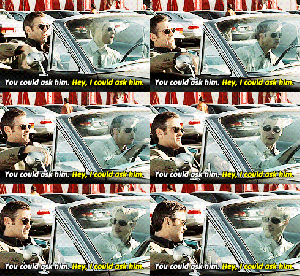
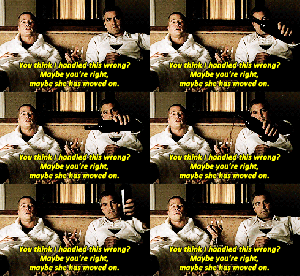
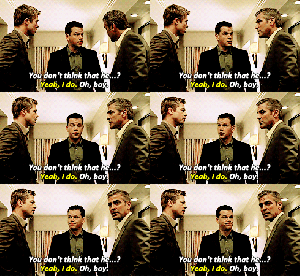
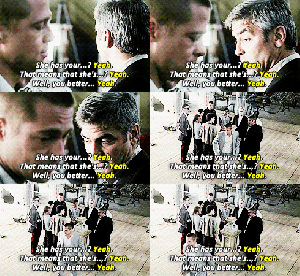
mb: Danny Ocean & Rusty Ryan
#this sort of thing is legitimately better than the standard ‘finishing each other’s sentences’ #or just saying it at the same time #the whole just not speaking words like humans #just sort of random sentence fragments bc the drift compatibility is doing all the heavy lifting #[WORDS WITHOUT CONTEXT] #[OTHER RANDOM WORDS] #[danny and rusty turn and act as one] #everyone else: what just happened. #I live for this sort of dialogue character building malarkey
“when in rome, do as the romans” i say as i paint dicks all over important ancient monuments and the vatican



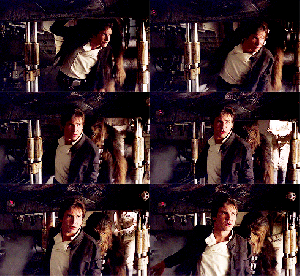




“He’s not a cardboard character to me at all. He’s as real as anything else. I never thought of the character as having only two dimensions until the critics said so. And they’re wrong. The third dimension is me.” – Harrison Ford
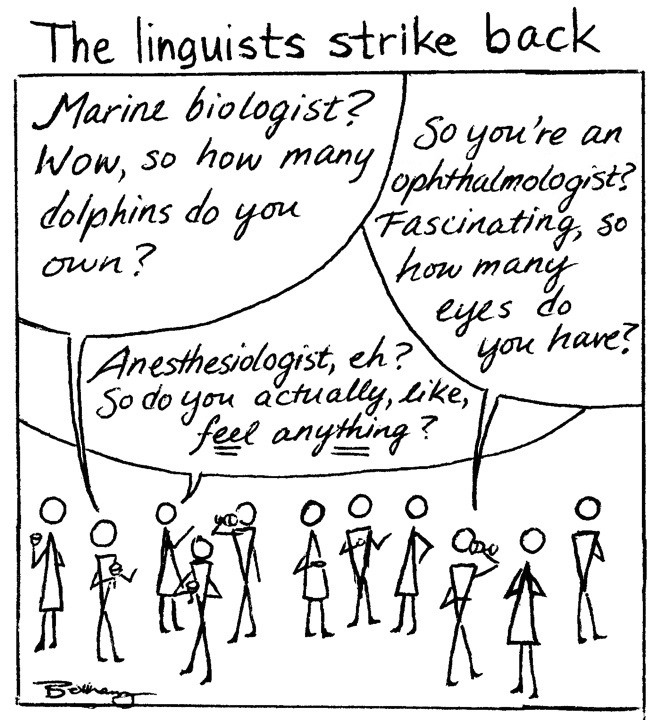
In linguistics, a filler is a sound or word that is spoken in conversation by one participant to signal to others that he/she has paused to think but is not yet finished speaking. These are not to be confused with placeholder names, such as thingamajig, which refer to objects or people whose names are temporarily forgotten, irrelevant, or unknown.
- In Afrikaans, ah, em, and eh are common fillers.
- In Arabic, يعني yaʿni (“I mean”) and وﷲ wallāh(i) (“by God”) are common fillers.[2][3][4]
- In American Sign Language, UM can be signed with open-8 held at chin, palm in, eyebrows down (similar to FAVORITE); or bilateral symmetric bent-V, palm out, repeated axial rotation of wrist (similar to QUOTE).
- In Bengali, mane (“it means”) is a common filler.
- In Catalan, eh /ə/, doncs (“so”), llavors (“therefore”), and o sigui (“it means”) are common fillers.
- In Czech, tak or takže (“so”), prostě (“simply”), jako (“like”) are used as fillers. Čili (“or”) and že (“that”, a conjunction) might also be others. A person who says jako and prostě as fillers might sound a bit simple-minded to others.[5]
- In Danish, øh is one of the most common fillers.
- In Dutch, eh, ehm, and dus are some of the more common fillers.
- In Esperanto, do (“therefore”) is the most common filler.
- In Filipino, ah, eh, ay, and ano are the most common fillers.
- In Finnish, niinku (“like”), tota, and öö are the most common fillers.
- In French, euh /ø/ is most common; other words used as fillers include quoi (“what”), bah, ben (“well”), tu vois (“you see”), and eh bien (roughly “well”, as in “Well, I’m not sure”). Outside of France, other expressions are tu sais (“you know”),
t’sais’veux dire? (“you know what I mean?”), or allez une fois (“go one time”). Additional filler words include genre (“kind”), comme (“like”), and style (“style”; “kind”)- In German, a more extensive series of filler words, called modal particles, exists, which actually do give the sentence some meaning. More traditional filler words are äh /ɛː/, hm, so /zoː/, tja, and eigentlich (“actually”)
- In Hebrew, eh is the most common filler. Em is also quite common.
- In Hindi, matlab (“it means”) and “Mah” are fillers.
- In Hungarian, common filler words include hát (well…) and asszongya (a variant of azt mondja, which means “it says here…”).
- In Icelandic, a common filler is hérna (“here”). Þúst, a contraction of þú veist (“you know”), is popular among younger speakers.
- In Indonesian (Bahasa Indonesia), anu is one of the most common fillers.
- In Italian, common fillers include “tipo” (“like”), “ecco” (“there”) and “cioè” (“actually”)
- In Irish Gaelic, abair /ˈabˠəɾʲ/ (“say”), bhoil /wɛlʲ/ (“well”), and era /ˈɛɾˠə/ are common fillers, along with emm as in Hiberno-English.
- In Japanese, common fillers include eetto, ano, sono, and ee.
- In Kannada,Matte for also,Enappa andre for the matter is are the common fillers.
- In Korean, eung, eo, ge, and eum are commonly used as fillers.
- In Lithuanian, nu, am and žinai (“you know”) are common fillers.
- IN Maltese and Maltese English, mela (“then”), or just la, is a common filler.
- In Mandarin Chinese, speakers often say 这个 zhège/zhèige (“this”) or 那个 nàge/nèige (“that”). Another common filler is 就 jìu (“just/precisely”).
- In Norwegian, common fillers are øh, altså, på en måte (“in a way”), ikke sant (literally “not true?”, “no kidding”, or “exactly”), vel (“well”), and liksom (“like”). In Bergen, sant (“true”) is often used instead of ikke sant. In the Trøndelag region, skjø’ (“see?” or “understand?”) is also a common filler.
- In Persian, bebin (“you see”), چیز “chiz” (“thing”), and مثلا masalan (“for instance”) are commonly-used filler words. As well as in Arabic and Urdu, يعني yaʿni (“I mean”) is also used in Persian. Also, eh is a common filler in Persian.
- In Portuguese, tipo (“like”) is the most common filler.
- In Romanian, deci /detʃʲ/ (“therefore”) is common, especially in school, and ă /ə/ is also very common (can be lengthened according to the pause in speech, rendered in writing as ăăă), whereas păi /pəj/ is widely used by almost anyone.
- In Russian, fillers are called слова-паразиты (“vermin words”); the most common are Э-э (“eh”), это (“this”), того (“that”), ну (“well”), значит (“it means”), так (“so”), как его (“what’s it [called]”), типа (“like”), and как бы (“[just] like”).
- In Serbian, znači (“means”) and ovaj (“this”) are common fillers.
- In Slovak, oné (“that”), tento (“this”), proste (“simply”), or akože are used as fillers. The Hungarian izé (or izí in its Slovak pronunciation) can also be heard, especially in parts of the country with a large Hungarian population. Ta is a filler typical of Eastern Slovak and one of the most parodied features.
- In Slovene, pač (“but”, although it has lost that meaning in colloquial, and it is used as a means of explanation), a ne? (“right?”), and no (“well”) are some of the fillers common in central Slovenia, including Ljubljana.
- In Spanish, fillers are called muletillas. Some of the most common in American Spanish are e /e/, este (“this”), and o sea (roughly means “I mean”).[6], in Spain the previous fillers are also used, but ¿Vale? (“right?”) and ¿no? are very common too.
- In Swedish, fillers are called utfyllningsord; some of the most common are öhm, ja (“yes”), ba (comes from “bara”, which means “just”), asså or alltså (“therefore”, “thus”), va (comes from “vad”, which means “what”), and liksom and typ (both similar to the English “like”).
- In Ukrainian, ой /ɔj/ is a common filler.
- In Urdu, yani (“meaning…”), falan falan (“this and that”; “blah blah”), umm, and aaa are also common fillers.
- In Telugu, ikkada entante (“Whats here is…”) and tarwatha (“then…”) are common and there are numerous like this.
- In Tamil, paatheenga-na (“if you see…”) and apparam (“then…”) are common.
- In Turkish, yani (“meaning…”), şey (“thing”), “işte” (“that is”), and falan (“as such”, “so on”) are common fillers.
- In Welsh, de or ynde is used as a filler (loosely the equivalent of “You know?” or “Isn’t it?”). Ym… and Y… are used similarly to the English “um…”.
Remember that this stuff is really important for fluency of speech. I’ve encountered a bad attitude among language teachers before: “we don’t teach filler words, because that’s not “normative” vocabulary, and it encourages students to sound unsure.” But that’s so, so wrong.
All people use filler words in conversation and even in formal settings. It’s a way to keep the flow of speech when the train of thought pauses; it holds the audience’s attention and actually helps maintain clarity of thought. What’s more, these words are instrumental for language learners, who need to pause more often in their speech than native speakers. Allowing them to pause without breaking into their language (saying a filler word in their language) or completely breaking the flow of their speech allows them to gain fluency faster.
My high school Japanese teacher did it right: “etto” and “anou” were in the second lesson. Teach filler words, people!! And if you’re studying a language and don’t know them, look at this list!! It has a lot!
French Bulldog argues bedtime
I AM TOO FILTHY TO WATCH SOMETHING AS PURE AS THIS
me
now THIS is good content if i’ve ever seen it
Since replies are apparently never coming back, I have a few things I want to say to everyone I follow:
Congrats on that amazing thing that happened! I’m really happy for you.
I’m so sorry to hear about that thing you’re struggling with. I see you, and I’m thinking about you and sending love and good vibes.
I totally agree with what you just said! Solidarity, my friend.
I kind of agree with you but I wonder if you’ve considered this other thing? And did you see what our other friend said? Damn, I wish there was a way for us all to discuss it together.
That story you just told made me laugh out loud, thanks for sharing.
You’re so beautiful! Never stop brightening my dash with your face.
I really, really miss talking to all of you.
Sometimes I wonder if my obsession with elaborately tiled floors is a natural consequence of my upbringing in Freemasonry.
Now I want stories about kitchen witches who have their most work-patterns plotted right out in their kitchen tile.
It’s actually called “Mystic Tile”. The point of the tile in Masonic temples is LITERALLY to show people where to stand and turn at Mystically Important Times. The angles and proportions are Deeply Symbolic and Significant. It’s not even a stretch, just putting actual magic into pretend magic.
Oh yes. I just want it with kitchen-witchery type stuff again, rather than more “high” oriented stuff.
What is this angelfire thing I keep seeing
Back in the mid to late 90’s there was a big fad of letting people build their own basic HTML websites and hosting it on a remote server. Geocities and Homestead were also popular.
Oh ok. So it’s a meme. I thought images were really being directed to some external site for some reason lol.
angelfire is not a meme. it’s where i hosted my linkin park fansite when i was in middle school.
I hope and pray these sites have been erased from existence.
It would spell the end for many people if theirs suddenly resurfaced. Shame compounds with time you know.
i think the internet was less static back then. the things you posted didn’t last for all eternity and usually no one ever saw them.
It was a heady time, filled with fractal .gif backgrounds, dancing babies, evil overlord lists, and fanrings. It was a time when you could post a shitty site composed entirely of tables and have hundreds of people who went to it every single day to read your opinions on wrestling, anime, or star trek. It was a time when porn videos were in quicktime and took ten minutes to load; it was a time when courier new was the default “hacker” font and #000000 backgrounds were considered edgy.
Before myspace, before facebook, before CSS and, in some places, even javascript, it was a place where your grandmother could make a website, so the world could see twenty pages of bad family photos and read terrible poetry about her cats.
 Kimchi and Justice